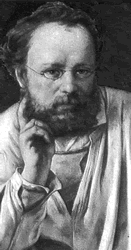
MONSIEUR,— Before resuming my "Inquiries
into Government and Property," it is fitting, for the satisfaction
of some worthy people, and also in the interest of order, that
I should make to you a plain, straightforward explanation. In
a much-governed State, no one would be allowed to attack the
external form of the society, and the groundwork of its institutions,
until he had established his right to do so, — first, by his morality;
second, by his capacity; and, third, by the purity of his intentions.
Any one who, wishing to publish a treatise upon the constitution
of the country, could not satisfy this threefold condition, would
be obliged to procure the endorsement of a responsible patron
possessing the requisite qualifications.
But we Frenchmen
have the liberty of the press. This grand right — the sword
of thought, which elevates the
virtuous citizen to the
rank of legislator, and makes the malicious citizen an agent
of discord — frees us from all preliminary responsibility to the
law; but it does not release us from our internal obligation
to render a public account of our sentiments and thoughts. I
have used, in all its fulness, and concerning an important question,
the right which the charter grants us. I come to-day, sir, to
submit my conscience to your judgment, and my feeble insight
to your discriminating reason. You have criticised in a kindly
spirit — I had almost said with partiality for the writer — a
work which teaches a doctrine that you thought it your duty to
condemn. "The Academy of Moral and Political Sciences," said
you in your report, "can accept the conclusions of the author
only as far as it likes." I venture to hope, sir, that,
after you have read this letter, if your prudence still restrains
you, your fairness will induce you to do me justice.
Men,
equal in the dignity of their persons and equal before the
law, should
be equal in their conditions, — such
is the thesis
which I maintained and developed in a memoir bearing the title, "What
is Property? or, An Inquiry into the Principle of Right and of
Government."
The idea of social equality, even in individual fortunes, has
in all ages besieged, like a vague presentiment, the human imagination.
Poets have sung of it in their hymns; philosophers have dreamed
of it in their Utopias; priests teach it, but only for the spiritual
world. The people, governed by it, never have had faith in it;
and the civil power is never more disturbed than by the fables
of the age of gold and the reign of Astrea. A year ago, however,
this idea received a scientific demonstration, which has not
yet been satisfactorily answered, and, permit me to add, never
will be. This demonstration, owing to its slightly impassioned
style, its method of reasoning, — which was so at variance with
that employed by the generally recognized authorities, — and the
importance and novelty of its conclusions, was of a nature to
cause some alarm; and might have been dangerous, had it not been — as
you, sir, so well said — a sealed letter, so far as the general
public was concerned, addressed only to men of intelligence.
I was glad to see that through its metaphysical dress you recognized
the wise foresight of the author; and I thank you for it. May
God grant that my intentions, which are wholly peaceful, may
never be charged upon me as treasonable!
Like a stone thrown into a mass of serpents, the First Memoir
on Property excited intense animosity, and aroused the passions
of many. But, while some wished the author and his work to be
publicly denounced, others found in them simply the solution
of the fundamental problems of society; a few even basing evil
speculations upon the new light which they had obtained. It was
not to be expected that a system of inductions abstractly gathered
together, and still more abstractly expressed, would be understood
with equal accuracy in its ensemble and in each of its parts.
To find the law of equality, no longer in charity and self-
sacrifice (which are not binding in their nature), but in justice;
to base equality of functions upon equality of persons; to determine
the absolute principle of exchange; to neutralize the inequality
of individual faculties by collective force; to establish an
equation between property and robbery; to change the law of succession
without destroying the principle; to maintain the human personality
in a system of absolute association, and to save liberty from
the chains of communism; to synthetize the monarchical and democratic
forms of government; to reverse the division of powers; to give
the executive power to the nation, and to make legislation a
positive, fixed, and absolute science, — what a series of paradoxes!
what a string of delusions! if I may not say, what a chain of
truths! But it is not my purpose here to pass upon the theory
of the right of possession. I discuss no dogmas. My only object
is to justify my views, and to show that, in writing as I did,
I not only exercised a right, but performed a duty.
Yes, I have
attacked property, and shall attack it again; but, sir, before
demanding that I shall make the amende honorable for having obeyed my conscience and spoken the exact truth, condescend,
I beg of you, to cast a glance at the events which are happening
around us; look at our deputies, our magistrates, our philosophers,
our ministers, our professors, and our publicists; examine their
methods of dealing with the matter of property; count up with
me the restrictions placed upon it every day in the name of the
public welfare; measure the breaches already made; estimate those
which society thinks of making hereafter; add the ideas concerning
property held by all theories in common; interrogate history,
and then tell me what will be left, half a century hence, of
this old right of property; and, thus perceiving that I have
so many accomplices, you will immediately declare me innocent.
What is
the law of expropriation on the ground of public utility, which
everybody favors, and which is even thought too lenient?1 A
flagrant violation of the right of property. Society indemnifies,
it
is said, the dispossessed proprietor;
but does it return to
him the traditional associations, the poetic charm, and the family
pride which accompany property? Naboth, and the miller of Sans-Souci,
would have protested against French law, as they protested against
the caprice of their kings. "It is the field of our fathers," they
would have cried, "and we will not sell it!" Among
the ancients, the refusal of the individual limited the powers
of the State. The Roman law bowed to the will of the citizen,
and an emperor — Commodus, if I remember rightly — abandoned
the project of enlarging the forum out of respect for the rights
of the occupants who refused to abdicate. Property is a real
right, jus in re, — a right inherent in the thing,
and whose principle lies in the external manifestation of man's
will. Man
leaves his imprint, stamps his character, upon the objects of
his handiwork. This plastic force of man, as the modern jurists
say, is the seal which, set upon matter, makes it holy. Whoever
lays hands upon it, against the proprietor's will, does violence
to the latter's personality. And yet, when an administrative
committee saw fit to declare that public utility required it,
property had to give way to the general will. Soon, in the name
of public utility, methods of cultivation and conditions of enjoyment
will be prescribed; inspectors of agriculture and manufactures
will be appointed; property will be taken away from unskilful
hands, and entrusted to laborers who are more deserving of it;
and a general superintendence of production will be established.
It is not two years since I saw a proprietor destroy a forest
more than five hundred acres in extent. If public utility had
interfered, that forest — the only one for miles around — would
still be standing.
But, it is said, expropriation on the ground of public utility
is only an exception which confirms the principle, and bears
testimony in favor of the right. Very well; but from this exception
we will pass to another, from that to a third, and so on from
exceptions to exceptions, until we have reduced the rule to a
pure abstraction.
How many supporters do you think, sir, can be claimed for the
project of the conversion of the public funds? I venture to say
that everybody favors it, except the fund-holders. Now, this
so-called conversion is an extensive expropriation, and in this
case with no indemnity whatever. The public funds are so much
real estate, the income from which the proprietor counts upon
with perfect safety, and which owes its value to the tacit promise
of the government to pay interest upon it at the established
rate, until the fund-holder applies for redemption. For, if the
income is liable to diminution, it is less profitable than house-rent
or farm-rent, whose rates may rise or fall according to the fluctuations
in the market; and in that case, what inducement has the capitalist
to invest his money in the State? When, then, you force the fund-holder
to submit to a diminution of interest, you make him bankrupt
to the extent of the diminution; and since, in consequence of
the conversion, an equally profitable investment becomes impossible,
you depreciate his property.
That such a measure may be justly executed, it must be generalized;
that is, the law which provides for it must decree also that
interest on sums lent on deposit or on mortgage throughout the
realm, as well as house and farm-rents, shall be reduced to three
per cent. This simultaneous reduction of all kinds of income
would be not a whit more difficult to accomplish than the proposed
conversion; and, further, it would offer the advantage of forestalling
at one blow all objections to it, at the same time that it would
insure a just assessment of the land- tax. See! If at the moment
of conversion a piece of real estate yields an income of one
thousand francs, after the new law takes effect it will yield
only six hundred francs. Now, allowing the tax to be an aliquot
part — one-fourth for example — of the income derived from each
piece of property, it is clear on the one hand that the proprietor
would not, in order to lighten his share of the tax, underestimate
the value of his property; since, house and farm-rents being
fixed by the value of the capital, and the latter being measured
by the tax, to depreciate his real estate would be to reduce
his revenue. On the other hand, it is equally evident that the
same proprietors could not overestimate the value of their property,
in order to increase their incomes beyond the limits of the law,
since the tenants and farmers, with their old leases in their
hands, would enter a protest.
Such, sir, must be the result sooner or later of the conversion
which has been so long demanded; otherwise, the financial operation
of which we are speaking would be a crying injustice, unless
intended as a stepping-stone. This last motive seems the most
plausible one; for in spite of the clamors of interested parties,
and the flagrant violation of certain rights, the public conscience
is bound to fulfil its desire, and is no more affected when charged
with attacking property, than when listening to the complaints
of the bondholders. In this case, instinctive justice belies
legal justice.
Who has
not heard of the inextricable confusion into which the Chamber
of Deputies was thrown last year, while discussing the
question of colonial and native sugars? Did they leave these
two industries to themselves? The native manufacturer was ruined
by the colonist. To maintain the beet-root, the cane had to be
taxed. To protect the property of the one, it became necessary
to violate the property of the other. The most remarkable feature
of this business was precisely that to which the least attention
was paid; namely, that, in one way or another, property had to
be violated. Did they impose on each industry a proportional
tax, so as to preserve a balance in the market? They created
a maximum price for each variety of sugar; and, as this maximum
price was not the same, they attacked property in two ways, — on
the one hand, interfering with the liberty of trade; on the other,
disregarding the equality of proprietors. Did they suppress the
beet-root by granting an indemnity to the manufacturer? They
sacrificed the property of the tax-payer. Finally, did they prefer
to cultivate the two varieties of sugar at the nation's expense,
just as different varieties of tobacco are cultivated? They abolished,
so far as the sugar industry was concerned, the right of property.
This last course, being the most social, would have been certainly
the best; but, if property is the necessary basis of civilization,
how is this deep-seated antagonism to be explained?2
Not satisfied
with the power of dispossessing a citizen on the ground of
public utility, they want also to dispossess him on
the ground of private utility. For a long time, a revision of
the law concerning mortgages was clamored for; a process was
demanded, in behalf of all kinds of credit and in the interest
of even the debtors themselves, which would render the expropriation
of real estate as prompt, as easy, and as effective as that which
follows a commercial protest. The Chamber of Deputies, in the
early part of this year, 1841, discussed this project, and the
law was passed almost unanimously. There is nothing more just,
nothing more reasonable, nothing more philosophical apparently,
than the motives which gave rise to this reform.
Formerly,
the small proprietor whose obligation had arrived at maturity,
and who found himself unable to meet it, had to
employ all that he had left, after being released from his debt,
in defraying the legal costs. Henceforth, the promptness of expropriation
will save him from total ruin.
The difficulties
in the way of payment arrested credit, and prevented the employment
of capital
in agricultural enterprises. This cause of distrust no longer
existing, capitalists will find new markets, agriculture will
rapidly develop, and farmers will be the first to enjoy the
benefit of the new law.
Finally,
it was iniquitous and absurd, that,
on account of a protested note, a poor manufacturer should
see in twenty-four hours his business arrested, his labor
suspended, his merchandise seized, his machinery sold at auction,
and
finally
himself led off to prison, while two years were sometimes
necessary to expropriate the most miserable piece of real estate.
These arguments, and others besides, you clearly stated, sir,
in your first lectures of this academic year.
But, when stating these excellent arguments, did you ask yourself,
sir, whither would tend such a transformation of our system of
mortgages? . . . To monetize, if I may say so, landed property;
to accumulate it within portfolios; to separate the laborer from
the soil, man from Nature; to make him a wanderer over the face
of the earth; to eradicate from his heart every trace of family
feeling, national pride, and love of country; to isolate him
more and more; to render him indifferent to all around him; to
concentrate his love upon one object, — money; and, finally, by
the dishonest practices of usury, to monopolize the land to the
profit of a financial aristocracy, — a worthy auxiliary
of that industrial feudality whose pernicious influence we begin
to feel
so bitterly. Thus, little by little, the subordination of the
laborer to the idler, the restoration of abolished castes, and
the distinction between patrician and plebeian, would be effected;
thus, thanks to the new privileges granted to the property of
the capitalists, that of the small and intermediate proprietors
would gradually disappear, and with it the whole class of free
and honest laborers. This certainly is not my plan for the abolition
of property. Far from mobilizing the soil, I would, if possible,
immobilize even the functions of pure intelligence, so that society
might be the fulfilment of the intentions of Nature, who gave
us our first possession, the land. For, if the instrument or
capital of production is the mark of the laborer, it is also
his pedestal, his support, his country, and, as the Psalmist
says, the place of his activity and his rest.3
Let us examine more closely still the inevitable and approaching
result of the last law concerning judicial sales and mortgages.
Under the system of competition which is killing us, and whose
necessary expression is a plundering and tyrannical government,
the farmer will need always capital in order to repair his losses,
and will be forced to contract loans. Always depending upon the
future for the payment of his debts, he will be deceived in his
hope, and surprised by maturity. For what is there more prompt,
more unexpected, more abbreviatory of space and time, than the
maturity of an obligation? I address this question to all whom
this pitiless Nemesis pursues, and even troubles in their dreams.
Now, under the new law, the expropriation of a debtor will be
effected a hundred times more rapidly; then, also, spoliation
will be a hundred times surer, and the free laborer will pass
a hundred times sooner from his present condition to that of
a serf attached to the soil. Formerly, the length of time required
to effect the seizure curbed the usurer's avidity, gave the borrower
an opportunity to recover himself, and gave rise to a transaction
between him and his creditor which might result finally in a
complete release. Now, the debtor's sentence is irrevocable:
he has but a few days of grace.
And what advantages are promised by this law as an offset to
this sword of Damocles, suspended by a single hair over the head
of the unfortunate husbandman? The expenses of seizure will be
much less, it is said; but will the interest on the borrowed
capital be less exorbitant? For, after all, it is interest which
impoverishes the peasant and leads to his expropriation. That
the law may be in harmony with its principle, that it may be
truly inspired by that spirit of justice for which it is commended,
it must — while facilitating expropriation — lower the legal price
of money. Otherwise, the reform concerning mortgages is but a
trap set for small proprietors, — a legislative trick.
Lower interest on money! But, as we have just seen, that is
to limit property. Here, sir, you shall make your own defence.
More than once, in your learned lectures, I have heard you deplore
the precipitancy of the Chambers, who, without previous study
and without profound knowledge of the subject, voted almost unanimously
to maintain the statutes and privileges of the Bank. Now these
privileges, these statutes, this vote of the Chambers, mean simply
this, — that the market price of specie, at five or six per cent.,
is not too high, and that the conditions of exchange, discount,
and circulation, which generally double this interest, are none
too severe. So the government thinks. M. Blanqui — a professor
of political economy, paid by the State — maintains the contrary,
and pretends to demonstrate, by decisive arguments, the necessity
of a reform. Who, then, best understands the interests of property, — the
State, or M. Blanqui?
If specie could be borrowed at half the present rate, the revenues
from all sorts of property would soon be reduced one- half also.
For example: when it costs less to build a house than to hire
one, when it is cheaper to clear a field than to procure one
already cleared, competition inevitably leads to a reduction
of house and farm-rents, since the surest way to depreciate active
capital is to increase its amount. But it is a law of political
economy that an increase of production augments the mass of available
capital, consequently tends to raise wages, and finally to annihilate
interest. Then, proprietors are interested in maintaining the
statutes and privileges of the Bank; then, a reform in this matter
would compromise the right of increase; then, the peers and deputies
are better informed than Professor Blanqui.
But these
same deputies, — so jealous of their privileges whenever
the equalizing effects of a reform are within their intellectual
horizon, — what did they do a few days before they passed
the law concerning judicial sales? They formed a conspiracy against
property! Their law to regulate the labor of children in factories
will, without doubt, prevent the manufacturer from compelling
a child to labor more than so many hours a day; but it will not
force him to increase the pay of the child, nor that of its father.
To-day, in the interest of health, we diminish the subsistence
of the poor; to-morrow it will be necessary to protect them by
fixing their minimum wages. But to fix their minimum wages is
to compel the proprietor, is to force the master to accept his
workman as an associate, which interferes with freedom and makes
mutual insurance obligatory. Once entered upon this path, we
never shall stop. Little by little the government will become
manufacturer, commission-merchant, and retail dealer.
It will be the sole proprietor. Why, at all epochs, have the
ministers of State been so reluctant to meddle with the question
of wages? Why have they always refused to interfere between the
master and the workman? Because they knew the touchy and jealous
nature of property, and, regarding it as the principle of all
civilization, felt that to meddle with it would be to unsettle
the very foundations of society. Sad condition of the proprietary
régime, — one of inability to exercise charity without violating
justice!4
And, sir,
this fatal consequence which necessity forces upon the State
is no mere imagination. Even now the legislative power
is asked, no longer simply to regulate the government of factories,
but to create factories itself. Listen to the millions of voices
shouting on all hands for the organisation of labor, the creation
of national workshops! The whole laboring class is agitated:
it has its journals, organs, and representatives. To guarantee
labor to the workingman, to balance production with sale, to
harmonize industrial proprietors, it advocates to-day — as a
sovereign remedy — one sole head, one national wardenship, one
huge manufacturing company. For, sir, all this is included in
the idea of national workshops. On this subject I wish to quote,
as proof, the views of an illustrious economist, a brilliant
mind, a progressive intellect, an enthusiastic soul, a true patriot,
and yet an official defender of the right of property.5
The honorable
professor of the Conservatory proposes then, —
To check
the continual emigration of laborers from the country into
the cities.
But, to keep the peasant in his village, his residence there
must be made endurable: to be just to all, the proletaire of
the country must be treated as well as the proletaire of the
city. Reform is needed, then, on farms as well as in factories;
and, when the government enters the workshop, the government
must seize the plough! What becomes, during this progressive
invasion, of independent cultivation, exclusive domain, property?
To
fix for each profession a moderate salary, varying with time
and place and based upon certain data.
The
object of this measure would be to secure to laborers their subsistence,
and to proprietors their profits, while obliging
the latter to sacrifice from motives of prudence, if for no other
reason, a portion of their income. Now, I say, that this portion,
in the long run, would swell until at last there would be an
equality of enjoyment between the proletaire and the proprietor.
For, as we have had occasion to remark several times already,
the interest of the capitalist — in other words the increase of
the idler — tends, on account of the power of labor, the multiplication
of products and exchanges, to continually diminish, and, by constant
reduction, to disappear. So that, in the society proposed by
M. Blanqui, equality would not be realized at first, but would
exist potentially; since property, though outwardly seeming to
be industrial feudality, being no longer a principle of exclusion
and encroachment, but only a privilege of division, would not
be slow, thanks to the intellectual and political emancipation
of the proletariat, in passing into absolute equality, — as
absolute at least as any thing can be on this earth.
I omit, for the sake of brevity, the numerous considerations
which the professor adduces in support of what he calls, too
modestly in my opinion, his Utopia. They would serve only to
prove beyond all question that, of all the charlatans of radicalism
who fatigue the public ear, no one approaches, for depth and
clearness of thought, the audacious M. Blanqui.
National workshops should be in operation only during periods
of stagnation in ordinary industries; at such times they should
be opened as vast outlets to the flood of the laboring population.
But,
sir, the stoppage of private industry is the result of over-
production, and insufficient markets. If, then, production
continues in the national workshops, how will the crisis be terminated?
Undoubtedly, by the general depreciation of merchandise, and,
in the last analysis, by the conversion of private workshops
into national workshops. On the other hand, the government will
need capital with which to pay its workmen; now, how will this
capital be obtained? By taxation. And upon what will the tax
be levied? Upon property. Then you will have proprietary industry
sustaining against itself, and at its own expense, another industry
with which it cannot compete. What, think you, will become, in
this fatal circle, of the possibility of profit, — in a
word, of property?
Thank Heaven! equality of conditions is taught in the public
schools; let us fear revolutions no longer. The most implacable
enemy of property could not, if he wished to destroy it, go to
work in a wiser and more effective way. Courage, then, ministers,
deputies, economists! make haste to seize this glorious initiative;
let the watchwords of equality, uttered from the heights of science
and power, be repeated in the midst of the people; let them thrill
the breasts of the proletaires, and carry dismay into the ranks
of the last representatives of privilege!
The tendency
of society in favor of compelling proprietors to support national
workshops and public manufactories
is so strong
that for several years, under the name of electoral reform, it
has been exclusively the question of the day. What is, after
all, this electoral reform which the people grasp at, as if it
were a bait, and which so many ambitious persons either call
for or denounce? It is the acknowledgment of the right of the
masses to a voice in the assessment of taxes, and the making
of the laws; which laws, aiming always at the protection of material
interests, affect, in a greater or less degree, all questions
of taxation or wages. Now the people, instructed long since by
their journals, their dramas,6 and their songs,7 know
to-day that taxation, to be equitably divided, must be graduated,
and
must be borne mainly by the rich, — that it must be levied upon
luxuries, &c. And be sure that the people, once in the majority
in the Chamber, will not fail to apply these lessons. Already
we have a minister of public works. National workshops will follow;
and soon, as a consequence, the excess of the proprietor's revenue
over the workingman's wages will be swallowed up in the coffers
of the laborers of the State. Do you not see that in this way
property is gradually reduced, as nobility was formerly, to a
nominal title, to a distinction purely honorary in its nature?
Either the electoral reform will fail to accomplish that which
is hoped from it, and will disappoint its innumerable partisans,
or else it will inevitably result in a transformation of the
absolute right under which we live into a right of possession;
that is, that while, at present, property makes the elector,
after this reform is accomplished, the citizen, the producer
will be the possessor.8 Consequently, the radicals are right
in saying that the electoral reform is in their eyes only a means;
but, when they are silent as to the end, they show either profound
ignorance, or useless dissimulation. There should be no secrets
or reservations from peoples and powers. He disgraces himself
and fails in respect for his fellows, who, in publishing his
opinions, employs evasion and cunning. Before the people act,
they need to know the whole truth. Unhappy he who shall dare
to trifle with them! For the people are credulous, but they are
strong. Let us tell them, then, that this reform which is proposed
is only a means, — a means often tried, and hitherto without effect, — but
that the logical object of the electoral reform is equality of
fortunes; and that this equality itself is only a new means having
in view the superior and definitive object of the salvation of
society, the restoration of morals and religion, and the revival
of poetry and art.
It would be an abuse of the reader's patience to insist further
upon the tendency of our time towards equality. There are, moreover,
so many people who denounce the present age, that nothing is
gained by exposing to their view the popular, scientific, and
representative tendencies of the nation.
Prompt to
recognize the accuracy of the inferences drawn from observation,
they confine themselves to a general
censure of
the facts, and an absolute denial of their legitimacy. "What
wonder," they say, "that this atmosphere of equality
intoxicates us, considering all that has been said and done during
the past ten years! . . . Do you not see that society is dissolving,
that a spirit of infatuation is carrying us away? All these hopes
of regeneration are but forebodings of death; your songs of triumph
are like the prayers of the departing, your trumpet peals announce
the baptism of a dying man. Civilization is falling in ruin:
Imus, imus, praecipites!"
Such people
deny God. I might content myself with the reply that the spirit
of 1830 was the result of the
maintenance of
the violated charter; that this charter arose from the Revolution
of '89; that '89 implies the States-General's right of remonstrance,
and the enfranchisement of the communes; that the communes suppose
feudalism, which in its turn supposes invasion, Roman law, Christianity, &c.
But it is necessary to look further. We must penetrate to the
very heart of ancient institutions, plunge into the social depths,
and uncover this indestructible leaven of equality which the
God of justice breathed into our souls, and which manifests itself
in all our works.
Labor is
man's contemporary; it is a duty, since it is a condition of
existence: "In the sweat of thy face shalt thou eat bread." It
is more than a duty, it is a mission: "God put the man into
the garden to dress it." I add that labor is the cause and
means of equality.
Cast away
upon a desert island two men: one large, strong, and active;
the other weak, timid, and domestic. The latter will
die of hunger; while the other, a skilful hunter, an expert fisherman,
and an indefatigable husbandman, will overstock himself with
provisions. What greater inequality, in this state of Nature
so dear to the heart of Jean Jacques, could be imagined! But
let these two men meet and associate themselves: the second immediately
attends to the cooking, takes charge of the household affairs,
and sees to the provisions, beds, and clothes; provided the stronger
does not abuse his superiority by enslaving and ill-treating
his companion, their social condition will be perfectly equal.
Thus, through exchange of services, the inequalities of Nature
neutralize each other, talents associate, and forces balance.
Violence and inertia are found only among the poor and the aristocratic.
And in that lies the philosophy of political economy, the mystery
of human brotherhood. Hic est sapientia. Let us pass from the
hypothetical state of pure Nature into civilization.
The proprietor
of the soil, who produces, I will suppose with the economists,
by lending his instrument, receives
at the foundation
of a society so many bushels of grain for each acre of arable
land. As long as labor is weak, and the variety of its products
small, the proprietor is powerful in comparison with the laborers;
he has ten times, one hundred times, the portion of an honest
man. But let labor, by multiplying its inventions, multiply its
enjoyments and wants, and the proprietor, if he wishes to enjoy
the new products, will be obliged to reduce his income every
day; and since the first products tend rather to depreciate than
to rise in value, — in consequence of the continual addition of
the new ones, which may be regarded as supplements of the first
ones, — it follows that the idle proprietor grows poor as fast
as public prosperity increases. "Incomes" (I like to
quote you, sir, because it is impossible to give too good an
authority for these elementary principles of economy, and because
I cannot express them better myself), "incomes," you
have said, "tend to disappear as capital increases. He who
possesses to-day an income of twenty thousand pounds is not nearly
as rich as he who possessed the same amount fifty years ago.
The time is coming when all property will be a burden to the
idle, and will necessarily pass into the hands of the able and
industrious.9 . . ."
In order to live as a proprietor, or to consume without producing,
it is necessary, then, to live upon the labor of another; in
other words, it is necessary to kill the laborer. It is upon
this principle that proprietors of those varieties of capital
which are of primary necessity increase their farm-rents as fast
as industry develops, much more careful of their privileges in
that respect, than those economists who, in order to strengthen
property, advocate a reduction of interest. But the crime is
unavailing: labor and production increase; soon the proprietor
will be forced to labor, and then property is lost.
The proprietor is a man who, having absolute control of an instrument
of production, claims the right to enjoy the product of the instrument
without using it himself. To this end he lends it; and we have
just seen that from this loan the laborer derives a power of
exchange, which sooner or later will destroy the right of increase.
In the first place, the proprietor is obliged to allow the laborer
a portion of the product, for without it the laborer could not
live. Soon the latter, through the development of his industry,
finds a means of regaining the greater portion of that which
he gives to the proprietor; so that at last, the objects of enjoyment
increasing continually, while the income of the idler remains
the same, the proprietor, having exhausted his resources, begins
to think of going to work himself. Then the victory of the producer
is certain. Labor commences to tip the balance towards its own
side, and commerce leads to equilibrium.
Man's instinct
cannot err; as, in liberty, exchange of functions leads inevitably
to equality among men, so commerce — or exchange
of products, which is identical with exchange of functions — is
a new cause of equality. As long as the proprietor does not labor,
however small his income, he enjoys a privilege; the laborer's
welfare may be equal to his, but equality of conditions does
not exist. But as soon as the proprietor becomes a producer, — since
he can exchange his special product only with his tenant or his
commandité, — sooner or later this tenant,
this exploited man, if violence is not
done him, will make a profit out of the proprietor, and will
oblige him to restore — in the exchange of
their respective products — the interest on his capital.
So that, balancing one injustice by another, the contracting
parties will
be equal. Labor and exchange, when liberty prevails, lead, then,
to equality of fortunes; mutuality of services neutralizes privilege.
That is why despots in all ages and countries have assumed control
of commerce; they wished to prevent the labor of their subjects
from becoming an obstacle to the rapacity of tyrants.
Up to this point, all takes place in the natural order; there
is no premeditation, no artifice. The whole proceeding is governed
by the laws of necessity alone. Proprietors and laborers act
only in obedience to their wants. Thus, the exercise of the right
of increase, the art of robbing the producer, depends — during
this first period of civilization — upon physical violence, murder,
and war.
But at this
point a gigantic and complicated conspiracy is hatched against
the capitalists. The weapon of the exploiters is met
by the exploited with the instrument of commerce, — a marvellous
invention, denounced at its origin by the moralists who favored
property, but inspired without doubt by the genius of labor,
by the Minerva of the proletaires.
The principal
cause of the evil lay in the accumulation and immobility of
capital of all sorts, — an immobility which
prevented
labor, enslaved and subalternized by haughty idleness, from ever
acquiring it. The necessity was felt of dividing and mobilizing
wealth, of rendering it portable, of making it pass from the
hands of the possessor into those of the worker. Labor invented
money. Afterwards, this invention was revived and developed by
the bill of exchange and the Bank. For all these things
are substantially the same, and proceed from the same mind. The
first
man who conceived
the idea of representing a value by a shell, a precious stone,
or a certain weight of metal, was the real inventor of the Bank.
What is a piece of money, in fact? It is a bill of exchange written
upon solid and durable material, and carrying with it its own
redemption. By this means, oppressed equality was enabled to
laugh at the efforts of the proprietors, and the balance of justice
was adjusted for the first time in the tradesman's shop. The
trap was cunningly set, and accomplished its purpose so thoroughly
that in idle hands money became only dissolving wealth, a false
symbol, a shadow of riches. An excellent economist and profound
philosopher was that miser who took as his motto, "When
a guinea is exchanged, it evaporates." So it may be said, "When
real estate is converted into money, it is lost." This explains
the constant fact of history, that the nobles — the unproductive
proprietors of the soil — have every where been dispossessed
by industrial and commercial plebeians. Such was especially the
case in the formation of the Italian republics, born, during
the middle ages, of the impoverishment of the seigniors. I will
not pursue the interesting considerations which this matter suggests;
I could only repeat the testimony of historians, and present
economical demonstrations in an altered form.
The greatest
enemy of the landed and industrial aristocracy to- day, the
incessant promoter of equality of fortunes, is the
banker. Through him immense plains are divided, mountains change
their positions, forests are grown upon the public squares, one
hemisphere produces for another, and every corner of the globe
has its usufructuaries. By means of the Bank new wealth is continually
created, the use of which (soon becoming indispensable to selfishness)
wrests the dormant capital from the hands of the jealous proprietor.
The banker is at once the most potent creator of wealth, and
the main distributor of the products of art and Nature. And yet,
by the strangest antinomy, this same banker is the most relentless
collector of profits, increase, and usury ever inspired by the
demon of property. The importance of the services which he renders
leads us to endure, though not without complaint, the taxes which
he imposes. Nevertheless, since nothing can avoid its providential
mission, since nothing which exists can escape the end for which
it exists the banker (the modern Croesus) must some day become
the restorer of equality. And following in your footsteps, sir,
I have already given the reason; namely, that profit decreases
as capital multiplies, since an increase of capital — calling
for more laborers, without whom it remains unproductive — always
causes an increase of wages. Whence it follows that the Bank,
to-day the suction-pump of wealth, is destined to become the
steward of the human race.
The phrase
equality of fortunes chafes people, as if it referred to a
condition of the other world, unknown here below. There
are some persons, radicals as well as moderates, whom the very
mention of this idea fills with indignation. Let, then, these
silly aristocrats abolish mercantile societies and insurance
companies, which are founded by prudence for mutual assistance.
For all these social facts, so spontaneous and free from all
levelling intentions, are the legitimate fruits of the instinct
of equality.
When the
legislator makes a law, properly speaking he does not make it, — he
does not create it: he describes it. In legislating
upon the moral, civil, and political relations of citizens,
he
does not express an arbitrary notion: he states the general idea, — the
higher principle which governs the matter which he is considering;
in a word, he is the proclaimer, not the inventor, of the law.
So, when two or more men form among themselves, by synallagmatic
contract, an industrial or an insurance association, they recognize
that their interests, formerly isolated by a false spirit of
selfishness and independence, are firmly connected by their inner
natures, and by the mutuality of their relations. They do not
really bind themselves by an act of their private will: they
swear to conform henceforth to a previously existing social law
hitherto disregarded by them. And this is proved by the fact
that these same men, could they avoid association, would not
associate. Before they can be induced to unite their interests,
they must acquire full knowledge of the dangers of competition
and isolation; hence the experience of evil is the only thing
which leads them into society.
Now I say
that, to establish equality among men, it is only necessary
to generalize the principle upon which insurance, agricultural,
and commercial associations are based. I say that competition,
isolation of interests, monopoly, privilege, accumulation of
capital, exclusive enjoyment, subordination of functions, individual
production, the right of profit or increase, the exploitation
of man by man, and, to sum up all these species under one head,
that property is the principal cause of misery and crime. And,
for having arrived at this offensive and anti-proprietary conclusion,
I am an abhorred monster; radicals and conservatives alike point
me out as a fit subject for prosecution; the academies shower
their censures upon me; the most worthy people regard me as mad;
and those are excessively tolerant who content themselves with
the assertion that I am a fool. Oh, unhappy the writer who publishes
the truth otherwise than as a performance of a duty! If he has
counted upon the applause of the crowd; if he has supposed that
avarice and self-interest would forget themselves in admiration
of him; if he has neglected to encase himself within three thicknesses
of brass, — he will fail, as he ought, in his selfish undertaking.
The unjust criticisms, the sad disappointments, the despair of
his mistaken ambition, will kill him.
But, if I am no longer permitted to express my own personal
opinion concerning this interesting question of social equilibrium,
let me, at least, make known the thought of my masters, and develop
the doctrines advocated in the name of the government.
It never
has been my intention, sir, in spite of the vigorous censure
which you, in behalf of your academy,
have pronounced
upon the doctrine of equality of fortunes, to contradict and
cope with you. In listening to you, I have felt my inferiority
too keenly to permit me to enter upon such a discussion. And
then, — if it must be said, — however different
your language is from mine, we believe in the same principles;
you share all
my opinions. I do not mean to insinuate thereby, sir, that you
have (to use the phraseology of the schools) an esoteric and
an exoteric doctrine, — that, secretly believing in equality,
you defend property only from motives of prudence and by command.
I am not rash enough to regard you as my colleague in my revolutionary
projects; and I esteem you too highly, moreover, to suspect you
of dissimulation. I only mean that the truths which methodical
investigation and laborious metaphysical speculation have painfully
demonstrated to me, a profound acquaintance with political economy
and a long experience reveal to you. While I have reached my
belief in equality by long reflection, and almost in spite of
my desires, you hold yours, sir, with all the zeal of faith, — with
all the spontaneity of genius. That is why your course of lectures
at the Conservatory is a perpetual war upon property and inequality
of fortunes; that is why your most learned investigations, your
most ingenious analyses, and your innumerable observations always
conclude in a formula of progress and equality; that is why,
finally, you are never more admired and applauded than at those
moments of inspiration when, borne upon the wings of science,
you ascend to those lofty truths which cause plebeian hearts
to beat with enthusiasm, and which chill with horror men whose
intentions are evil. How many times, from the place where I eagerly
drank in your eloquent words, have I inwardly thanked Heaven
for exempting you from the judgment passed by St. Paul upon the
philosophers of his time, — "They have known the truth,
and have not made it known"! How many times have I rejoiced
at finding my own justification in each of your discourses! No,
no; I neither wish nor ask for any thing which you do not teach
yourself. I appeal to your numerous audience; let it belie me
if, in commenting upon you, I pervert your meaning.
A disciple
of Say, what in your eyes is more anti-social than the custom-houses;
or, as you correctly call
them, the barriers
erected by monopoly between nations? What is more annoying, more
unjust, or more absurd, than this prohibitory system which compels
us to pay forty sous in France for that which in England or Belgium
would bring us but fifteen? It is the custom-house, you once
said,10 which
arrests the development of civilization by preventing the specialization
of industries; it is the custom- house which
enriches a hundred monopolists by impoverishing millions of citizens;
it is the custom-house which produces famine in the midst of
abundance, which makes labor sterile by prohibiting exchange,
and which stifles production in a mortal embrace. It is the custom-house
which renders nations jealous of, and hostile to, each other;
four-fifths of the wars of all ages were caused originally by
the custom-house. And then, at the highest pitch of your enthusiasm,
you shouted: "Yes, if to put an end to this hateful system,
it should become necessary for me to shed the last drop of my
blood, I would joyfully spring into the gap, asking only time
enough to give thanks to God for having judged me worthy of martyrdom!"
And, at
that solemn moment, I said to myself: "Place
in every department of France such a professor as that, and
the
revolution is avoided."
But, sir, by this magnificent theory of liberty of commerce
you render military glory impossible, — you leave nothing for
diplomacy to do; you even take away the desire for conquest,
while abolishing profit altogether. What matters it, indeed,
who restores Constantinople, Alexandria, and Saint Jean d'Acre,
if the Syrians, Egyptians, and Turks are free to choose their
masters; free to exchange their products with whom they please?
Why should Europe get into such a turmoil over this petty Sultan
and his old Pasha, if it is only a question whether we or the
English shall civilize the Orient, — shall instruct Egypt and
Syria in the European arts, and shall teach them to construct
machines, dig canals, and build railroads? For, if to national
independence free trade is added, the foreign influence of these
two countries is thereafter exerted only through a voluntary
relationship of producer to producer, or apprentice to journeyman.
Alone among
European powers, France cheerfully accepted the task of civilizing
the Orient, and began an invasion
which was
quite apostolic in its character, — so joyful and high-minded
do noble thoughts render our nation! But diplomatic rivalry,
national selfishness, English avarice, and Russian ambition stood
in her way. To consummate a long-meditated usurpation, it was
necessary to crush a too generous ally: the robbers of the Holy
Alliance formed a league against dauntless and blameless France.
Consequently, at the news of this famous treaty, there arose
among us a chorus of curses upon the principle of property, which
at that time was acting under the hypocritical formulas of the
old political system. The last hour of property seemed to have
struck by the side of Syria; from the Alps to the ocean, from
the Rhine to the Pyrenees, the popular conscience was aroused.
All France sang songs of war, and the coalition turned pale at
the sound of these shuddering cries: "War upon the autocrat,
who wishes to be proprietor of the old world! War upon the English
perjurer, the devourer of India, the poisoner of China, the tyrant
of Ireland, and the eternal enemy of France! War upon the allies
who have conspired against liberty and equality! War! war! war
upon property!"
By the counsel of Providence the emancipation of the nations
is postponed. France is to conquer, not by arms, but by example.
Universal reason does not yet understand this grand equation,
which, commencing with the abolition of slavery, and advancing
over the ruins of aristocracies and thrones, must end in equality
of rights and fortunes; but the day is not far off when the knowledge
of this truth will be as common as that of equality of origin.
Already it seems to be understood that the Oriental question
is only a question of custom-houses. Is it, then, so difficult
for public opinion to generalize this idea, and to comprehend,
finally, that if the suppression of custom-houses involves the
abolition of national property, it involves also, as a consequence,
the abolition of individual property?
In fact, if we suppress the custom-houses, the alliance of the
nations is declared by that very act; their solidarity is recognized,
and their equality proclaimed. If we suppress the custom-houses,
the principle of association will not be slow in reaching from
the State to the province, from the province to the city, and
from the city to the workshop. But, then, what becomes of the
privileges of authors and artists? Of what use are the patents
for invention, imagination, amelioration, and improvement? When
our deputies write a law of literary property by the side of
a law which opens a large breach in the custom- house they contradict
themselves, indeed, and pull down with one hand what they build
up with the other. Without the custom- house. literary property
does not exist, and the hopes of our starving authors are frustrated.
For, certainly you do not expect, with the good man Fourier,
that literary property will exercise itself in China to the profit
of a French writer; and that an ode of Lamartine, sold by privilege
all over the world, will bring in millions to its author! The
poet's work is peculiar to the climate in which he lives; every
where else the reproduction of his works, having no market value,
should be frank and free. But what! will it be necessary for
nations to put themselves under mutual surveillance for the sake
of verses, statues, and elixirs? We shall always have, then,
an excise, a city-toll, rights of entrance and transit, custom-houses
finally; and then, as a reaction against privilege, smuggling.
Smuggling!
That word reminds me of one of the most horrible forms of property. "Smuggling," you
have said, sir,11 "is
an offence of political creation; it is the exercise of natural
liberty, defined as a crime in certain cases by the will of the
sovereign. The smuggler is a gallant man, — a man of spirit,
who gaily busies himself in procuring for his neighbor, at a
very
low price, a jewel, a shawl, or any other object of necessity
or luxury, which domestic monopoly renders excessively dear." Then,
to a very poetical monograph of the smuggler, you add this dismal
conclusion, — that the smuggler belongs to the family of
Mandrin, and that the galleys should be his home!
But, sir, you have not called attention to the horrible exploitation
which is carried on in this way in the name of property.
It is said, — and I give this report only as an hypothesis and
an illustration, for I do not believe it, — it is said that the
present minister of finances owes his fortune to smuggling. M.
Humann, of Strasbourg, sent out of France, it is said, enormous
quantities of sugar, for which he received the bounty on exportation
promised by the State; then, smuggling this sugar back again,
he exported it anew, receiving the bounty on exportation a second
time, and so on. Notice, sir, that I do not state this as a fact;
I give it only as it is told, not endorsing or even believing
it. My sole design is to fix the idea in the mind by an example.
If I believed that a minister had committed such a crime, that
is, if I had personal and authentic knowledge that he had, I
would denounce M. Humann, the minister of finances, to the Chamber
of Deputies, and would loudly demand his expulsion from the ministry.
But that which is undoubtedly false of M. Humann is true of
many others, as rich and no less honorable than he. Smuggling,
organized on a large scale by the eaters of human flesh, is carried
on to the profit of a few pashas at the risk and peril of their
imprudent victims. The inactive proprietor offers his merchandise
for sale; the actual smuggler risks his liberty, his honor, and
his life. If success crowns the enterprise, the courageous servant
gets paid for his journey; the profit goes to the coward. If
fortune or treachery delivers the instrument of this execrable
traffic into the hands of the custom-house officer, the master-smuggler
suffers a loss which a more fortunate voyage will soon repair.
The agent, pronounced a scoundrel, is thrown into prison in company
with robbers; while his glorious patron, a juror, elector, deputy,
or minister, makes laws concerning expropriation, monopoly, and
custom-houses!
I promised, at the beginning of this letter, that no attack
on property should escape my pen, my only object being to justify
myself before the public by a general recrimination. But I could
not refrain from branding so odious a mode of exploitation, and
I trust that this short digression will be pardoned. Property
does not avenge, I hope, the injuries which smuggling suffers.
The conspiracy
against property is general; it is flagrant; it takes possession
of all minds, and inspires all our laws;
it lies at the bottom of all theories. Here the proletaire pursues
property in the street, there the legislator lays an interdict
upon it; now, a professor of political economy or of industrial
legislation,12 paid
to defend it, undermines it with redoubled blows; at another — time,
an academy calls it in question,13 or inquires as to the progress of its demolition.14 To-day there is not an idea, not an opinion, not a sect, which
does not dream
of muzzling property. None confess it, because none are yet conscious
of it; there are too few minds capable of grasping spontaneously
this ensemble of causes and effects, of principles and consequences,
by which I try to demonstrate the approaching disappearance of
property; on the other hand, the ideas that are generally formed
of this right are too divergent and too loosely determined to
allow an admission, so soon, of the contrary theory. Thus, in
the middle and lower ranks of literature and philosophy, no less
than among the common people, it is thought that, when property
is abolished, no one will be able to enjoy the fruit of his labor;
that no one will have any thing peculiar to himself, and that
tyrannical communism will be established on the ruins of family
and liberty! — chimeras, which are to support for a little
while longer the cause of privilege.
But, before
determining precisely the idea of property, before seeking
amid the contradictions of systems for the common element
which must form the basis of the new right, let us cast a rapid
glance at the changes which, at the various periods of history,
property has undergone. The political forms of nations are the
expression of their beliefs. The mobility of these forms, their
modification and their destruction, are solemn experiences which
show us the value of ideas, and gradually eliminate from the
infinite variety of customs the absolute, eternal, and immutable
truth. Now, we shall see that every political institution tends,
necessarily, and on pain of death, to equalize conditions; that
every where and always equality of fortunes (like equality of
rights) has been the social aim, whether the plebeian classes
have endeavored to rise to political power by means of property,
or whether — rulers already — they have used political
power to overthrow property. We shall see, in short, by the progress
of
society, that the consummation of justice lies in the extinction
of individual domain.
For the
sake of brevity, I will disregard the testimony of ecclesiastical
history and Christian theology: this subject deserves a separate
treatise, and I propose hereafter to return to it. Moses and
Jesus Christ proscribed, under the names of usury and inequality,15
all sorts of profit and increase. The church itself, in its purest
teachings, has always condemned property; and when I attacked,
not only the authority of the church, but also its infidelity
to justice, I did it to the glory of religion. I wanted to provoke
a peremptory reply, and to pave the way for Christianity's triumph,
in spite of the innumerable attacks of which it is at present
the object. I hoped that an apologist would arise forthwith,
and, taking his stand upon the Scriptures, the Fathers, the canons,
and the councils and constitutions of the Popes, would demonstrate
that the church always has maintained the doctrine of equality,
and would attribute to temporary necessity the contradictions
of its discipline. Such a labor would serve the cause of religion
as well as that of equality. We must know, sooner or later, whether
Christianity is to be regenerated in the church or out of it,
and whether this church accepts the reproaches cast upon it of
hatred to liberty and antipathy to progress. Until then we will
suspend judgment, and content ourselves with placing before the
clergy the teachings of history.
When Lycurgus
undertook to make laws for Sparta, in what condition did he
find this republic? On this point all historians agree.
The people and the nobles were at war. The city was in a confused
state, and divided by two parties, — the party of the poor,
and the party of the rich. Hardly escaped from the barbarism
of the
heroic ages, society was rapidly declining. The proletariat made
war upon property, which, in its turn, oppressed the proletariat.
What did Lycurgus do? His first measure was one of general security,
at the very idea of which our legislators would tremble. He abolished
all debts; then, employing by turns persuasion and force, he
induced the nobles to renounce their privileges, and re-established
equality.
Lycurgus, in a word, hunted property out of Lacedaemon, seeing
no other way to harmonize liberty, equality, and law. I certainly
should not wish France to follow the example of Sparta; but it
is remarkable that the most ancient of Greek legislators, thoroughly
acquainted with the nature and needs of the people, more capable
than any one else of appreciating the legitimacy of the obligations
which he, in the exercise of his absolute authority, cancelled;
who had compared the legislative systems of his time, and whose
wisdom an oracle had proclaimed, — it is remarkable, I
say, that Lycurgus should have judged the right of property incompatible
with free institutions, and should have thought it his duty to
preface his legislation by a coup d'état which destroyed
all distinctions of fortune.
Lycurgus understood perfectly that the luxury, the love of enjoyments,
and the inequality of fortunes, which property engenders, are
the bane of society; unfortunately the means which he employed
to preserve his republic were suggested to him by false notions
of political economy, and by a superficial knowledge of the human
heart. Accordingly, property, which this legislator wrongly confounded
with wealth, reentered the city together with the swarm of evils
which he was endeavoring to banish; and this time Sparta was
hopelessly corrupted.
"The introduction of wealth," says M. Pastoret, "was
one of the principal causes of the misfortunes which they
experienced. Against these, however, the laws had taken
extraordinary precautions,
the best among which was the inculcation of morals which
tended to suppress desire."
The best of all precautions would have been the anticipation
of desire by satisfaction. Possession is the sovereign remedy
for cupidity, a remedy which would have been the less perilous
to Sparta because fortunes there were almost equal, and conditions
were nearly alike. As a general thing, fasting and abstinence
are bad teachers of moderation.
"There was a law," says M. Pastoret again, "to
prohibit the rich from wearing better clothing than the poor,
from eating more delicate food, and from owning elegant furniture,
vases, carpets, fine houses," &c. Lycurgus hoped, then,
to maintain equality by rendering wealth useless. How much wiser
he would have been if, in accordance with his military discipline,
he had organized industry and taught the people to procure by
their own labor the things which he tried in vain to deprive
them of. In that case, enjoying happy thoughts and pleasant feelings,
the citizen would have known no other desire than that with which
the legislator endeavored to inspire him, — love of
honor and glory, the triumphs of talent and virtue."
Gold and all kinds of ornaments were forbidden the women."
Absurd.
After the death of Lycurgus, his institutions became corrupted;
and four centuries before the Christian era not a vestige remained
of the former simplicity. Luxury and the thirst for gold were
early developed among the Spartans in a degree as intense as
might have been expected from their enforced poverty and their
inexperience in the arts. Historians have accused Pausanias,
Lysander, Agesilaus, and others of having corrupted the morals
of their country by the introduction of wealth obtained in
war. It is a slander. The morals of the Spartans necessarily
grew
corrupt as soon as the Lacedaemonian poverty came in contact
with Persian luxury and Athenian elegance. Lycurgus, then,
made a fatal mistake in attempting to inspire generosity
and modesty
by enforcing vain and proud simplicity.
"Lycurgus was not frightened at idleness! A Lacedemonian,
happening to be in Athens (where idleness was forbidden) during
the punishment of a citizen who had been found guilty, asked
to see the Athenian thus condemned for having exercised the rights
of a free man. . . . It was one of the principles of Lycurguss,
acted upon for several centuries, that free men should not follow
lucrative professions. . . . The women disdained domestic labor;
they did not spin their wool themselves, as did the other Greeks
[they did not, then, read Homer!]; they left their slaves to
make their clothing for them." — Pastoret: History of Legislation.
Could any thing be more contradictory? Lycurgus proscribed property
among the citizens, and founded the means of subsistence on the
worst form of property, — on property obtained by force. What
wonder, after that, that a lazy city, where no industry was carried
on, became a den of avarice? The Spartans succumbed the more
easily to the allurements of luxury and Asiatic voluptuousness,
being placed entirely at their mercy by their own coarseness.
The same thing happened to the Romans, when military success
took them out of Italy, — a thing which the author of the prosopopoeia
of Fabricius could not explain. It is not the cultivation of
the arts which corrupts morals, but their degradation, induced
by inactive and luxurious opulence. The instinct of property
is to make the industry of Daedalus, as well as the talent of
Phidias, subservient to its own fantastic whims and disgraceful
pleasures. Property, not wealth, ruined the Spartans.
When Solon
appeared, the anarchy caused by property was at its height
in the Athenian republic.
"The inhabitants of Attica
were divided among themselves as to the form of government. Those
who lived on the mountains (the poor) preferred the popular form;
those of the plain (the middle class), the oligarchs; those by
the sea coast, a mixture of oligarchy and democracy. Other dissensions
were arising from the inequality of fortunes. The mutual antagonism
of the rich and poor had become so violent, that the one-man
power seemed the only safe-guard against the revolution with
which the republic was threatened." (Pastoret:
History of Legislation.)
Quarrels between the rich and the poor, which seldom occur in
monarchies, because a well established power suppresses dissensions,
seem to be the life of popular governments. Aristotle had noticed
this. The oppression of wealth submitted to agrarian laws, or
to excessive taxation; the hatred of the lower classes for the
upper class, which is exposed always to libellous charges made
in hopes of confiscation, — these were the features of the Athenian
government which were especially revolting to Aristotle, and
which caused him to favor a limited monarchy. Aristotle, if he
had lived in our day, would have supported the constitutional
government. But, with all deference to the Stagirite, a government
which sacrifices the life of the proletaire to that of the proprietor
is quite as irrational as one which supports the former by robbing
the latter; neither of them deserve the support of a free man,
much less of a philosopher.
Solon followed
the example of Lycurgus. He celebrated his legislative inauguration
by the abolition of debts, — that is, by bankruptcy.
In other words, Solon wound up the governmental machine for a
longer or shorter time depending upon the rate of interest. Consequently,
when the spring relaxed and the chain became unwound, the republic
had either to perish, or to recover itself by a second bankruptcy.
This singular policy was pursued by all the ancients. After the
captivity of Babylon, Nehemiah, the chief of the Jewish nation,
abolished debts; Lycurgus abolished debts; Solon abolished debts;
the Roman people, after the expulsion of the kings until the
accession of the Caesars, struggled with the Senate for the abolition
of debts. Afterwards, towards the end of the republic, and long
after the establishment of the empire, agriculture being abandoned,
and the provinces becoming depopulated in consequence of the
excessive rates of interest, the emperors freely granted the
lands to whoever would cultivate them, — that is, they
abolished debts. No one, except Lycurgus, who went to the other
extreme,
ever perceived that the great point was, not to release debtors
by a coup d'état, but to prevent the contraction of debts
in future. On
the contrary, the most democratic governments were always exclusively
based upon individual property; so that the social
element of all these republics was war between the citizens.
Solon decreed that a census should be taken of all fortunes,
regulated political rights by the result, granted to the larger
proprietors more influence, established the balance of powers, —
in a word, inserted in the constitution the most active leaven
of discord; as if, instead of a legislator chosen by the people,
he had been their greatest enemy. Is it not, indeed, the height
of imprudence to grant equality of political rights to men of
unequal conditions? If a manufacturer, uniting all his workmen
in a joint-stock company, should give to each of them a consultative
and deliberative voice, — that is, should make all of them masters, — would
this equality of mastership secure continued inequality of wages?
That is the whole political system of Solon, reduced to its simplest
expression.
"In
giving property a just preponderance," says
M. Pastoret, "Solon repaired, as far
as he was able, his first official act, — the abolition
of debts. . .He thought he owed it to public peace to make
this great sacrifice of
acquired rights
and natural equity. But the violation of individual property
and written contracts is a bad preface to a public code."
In fact, such violations are always cruelly punished. In '89
and '93, the possessions of the nobility and the clergy were
confiscated, the clever proletaires were enriched; and to-day
the latter, having become aristocrats, are making us pay dearly
for our fathers' robbery. What, therefore, is to be done now?
It is not for us to violate right, but to restore it. Now, it
would be a violation of justice to dispossess some and endow
others, and then stop there. We must gradually lower the rate
of interest, organize industry, associate laborers and their
functions, and take a census of the large fortunes, not for the
purpose of granting privileges, but that we may effect their
redemption by settling a life-annuity upon their proprietors.
We must apply on a large scale the principle of collective production,
give the State eminent domain over all capital! make each producer
responsible, abolish the custom-house, and transform every profession
and trade into a public function. Thereby large fortunes will
vanish without confiscation or violence; individual possession
will establish itself, without communism, under the inspection
of the republic; and equality of conditions will no longer depend
simply on the will of citizens.
Of the authors who have written upon the Romans, Bossuet and
Montesquieu occupy prominent positions in the first rank; the
first being generally regarded as the father of the philosophy
of history, and the second as the most profound writer upon law
and politics. Nevertheless, it could be shown that these two
great writers, each of them imbued with the prejudices of their
century and their cloth, have left the question of the causes
of the rise and fall of the Romans precisely where they found
it.
Bossuet
is admirable as long as he confines himself to description:
witness, among other passages, the picture
which he has given
us of Greece before the Persian War, and which seems to have
inspired "Telemachus;" the parallel between Athens
and Sparta, drawn twenty times since Bossuet; the description
of the character and morals of the ancient Romans; and, finally,
the sublime peroration which ends the "Discourse on Universal
History." But when the famous historian deals with causes,
his philosophy is at fault.
"The
tribunes always favored the division of captured lands, or
the proceeds of their sale, among the
citizens. The Senate
steadfastly opposed those laws which were damaging to the State,
and wanted the price of lands to be awarded to the public treasury."
Thus,
according to Bossuet, the first and greatest wrong of civil
wars was inflicted upon the people, who, dying of hunger,
demanded that the lands, which they had shed their blood to conquer,
should be given to them for cultivation. The patricians, who
bought them to deliver to their slaves, had more regard for justice
and the public interests. How little affects the opinions of
men! If the rôles of Cicero and the Gracchi had been inverted,
Bossuet, whose sympathies were aroused by the eloquence of the
great orator more than by the clamors of the tribunes, would
have viewed the agrarian laws in quite a different light. He
then would have understood that the interest of the treasury
was only a pretext; that, when the captured lands were put up
at auction, the patricians hastened to buy them, in order to
profit by the revenues from them, — certain, moreover, that the
price paid would come back to them sooner or later, in exchange
either for supplies furnished by them to the republic, or for
the subsistence of the multitude, who could buy only of them,
and whose services at one time, and poverty at another, were
rewarded by the State. For a State does not hoard; on the contrary,
the public funds always return to the people. If, then, a certain
number of men are the sole dealers in articles of primary necessity,
it follows that the public treasury, in passing and repassing
through their hands, deposits and accumulates real property there.
When Menenius related to the people his fable of the limbs and
the stomach, if any one had remarked to this story-teller that
the stomach freely gives to the limbs the nourishment which it
freely receives, but that the patricians gave to the plebeians
only for cash, and lent to them only at usury, he undoubtedly
would have silenced the wily senator, and saved the people from
a great imposition. The Conscript Fathers were fathers only of
their own line. As for the common people, they were regarded
as an impure race, exploitable, taxable, and workable at the
discretion and mercy of their masters.
As a general
thing, Bossuet shows little regard for the people. His monarchical
and theological instincts know nothing but authority,
obedience, and alms-giving, under the name of charity. This unfortunate
disposition constantly leads him to mistake symptoms for causes;
and his depth, which is so much admired,
is borrowed from his authors, and amounts to very little, after
all. When
he says, for instance, that "the dissensions in the
republic, and finally its fall, were caused by the jealousies
of its citizens, and their love of liberty carried to an extreme
and intolerable extent," are we not tempted to ask him what
caused those jealousies? — what inspired the people
with that love of liberty, extreme and intolerable? It
would be useless
to reply, The corruption of morals; the disregard for the ancient
poverty; the debaucheries, luxury, and class jealousies; the
seditious character of the Gracchi, &c. Why did the morals
become corrupt, and whence arose those eternal dissensions between
the patricians and the plebeians?
In Rome, as in all other places, the dissension between the
rich and the poor was not caused directly by the desire for wealth
(people, as a general thing, do not covet that which they deem
it illegitimate to acquire), but by a natural instinct of the
plebeians, which led them to seek the cause of their adversity
in the constitution of the republic. So we are doing to-day;
instead of altering our public economy, we demand an electoral
reform. The Roman people wished to return to the social compact;
they asked for reforms, and demanded a revision of the laws,
and a creation of new magistracies. The patricians, who had nothing
to complain of, opposed every innovation. Wealth always has been
conservative. Nevertheless, the people overcame the resistance
of the Senate; the electoral right was greatly extended; the
privileges of the plebeians were increased, — they had their representatives,
their tribunes, and their consuls; but, notwithstanding these
reforms, the republic could not be saved. When all political
expedients had been exhausted, when civil war had depleted the
population, when the Caesars had thrown their bloody mantle over
the cancer which was consuming the empire, — inasmuch as accumulated
property always was respected, and since the fire never stopped,
the nation had to perish in the flames. The imperial power was
a compromise which protected the property of the rich, and nourished
the proletaires with wheat from Africa and Sicily: a double error,
which destroyed the aristocrats by plethora and the commoners
by famine. At last there was but one real proprietor left, — the
emperor, — whose dependent, flatterer, parasite, or slave, each
citizen became; and when this proprietor was ruined, those who
gathered the crumbs from under his table, and laughed when he
cracked his jokes, perished also.
Montesquieu
succeeded no better than Bossuet in fathoming the causes of
the Roman decline; indeed, it may
be said that the
president has only developed the ideas of the bishop. If the
Romans had been more moderate in their conquests, more just to
their allies, more humane to the vanquished; if the nobles had
been less covetous, the emperors less lawless, the people less
violent, and all classes less corrupt; if . . . &c., — perhaps
the dignity of the empire might have been preserved, and Rome
might have retained the sceptre of the world! That is all that
can be gathered from the teachings of Montesquieu. But the truth
of history does not lie there; the destinies of the world are
not dependent upon such trivial causes. The passions of men,
like the contingencies of time and the varieties of climate,
serve to maintain the forces which move humanity and produce
all historical changes; but they do not explain them. The grain
of sand of which Pascal speaks would have caused the death of
one man only, had not prior action ordered the events of which
this death was the precursor.
Montesquieu has read extensively; he knows Roman history thoroughly,
is perfectly well acquainted with the people of whom he speaks,
and sees very clearly why they were able to conquer their rivals
and govern the world. While reading him we admire the Romans,
but we do not like them; we witness their triumphs without pleasure,
and we watch their fall without sorrow. Montesquieu's work, like
the works of all French writers, is skilfully composed, — spirited,
witty, and filled with wise observations. He pleases, interests,
instructs, but leads to little reflection; he does not conquer
by depth of thought; he does not exalt the mind by elevated reason
or earnest feeling. In vain should we search his writings for
knowledge of antiquity, the character of primitive society, or
a description of the heroic ages, whose morals and prejudices
lived until the last days of the republic. Vico, painting the
Romans with their horrible traits, represents them as excusable,
because he shows that all their conduct was governed by preexisting
ideas and customs, and that they were informed, so to speak,
by a superior genius of which they were unconscious; in Montesquieu,
the Roman atrocity revolts, but is not explained. Therefore,
as a writer, Montesquieu brings greater credit upon French literature;
as a philosopher, Vico bears away the palm.
Originally,
property in Rome was national, not private. Numa was the first
to establish individual property by distributing
the lands captured by Romulus. What was the dividend of this
distribution effected by Numa? What conditions were imposed upon
individuals, what powers reserved to the State? None whatever.
Inequality of fortunes, absolute abdication by the republic of
its right of eminent domain over the property of citizens, — such
were the first results of the division of Numa, who justly may
be regarded as the originator of Roman revolutions. He it was
who instituted the worship of the god Terminus, — the guardian
of private possession, and one of the most ancient gods of Italy.
It was Numa who placed property under the protection of Jupiter;
who, in imitation of the Etrurians, wished to make priests of
the land-surveyors; who invented a liturgy for cadastral operations,
and ceremonies of consecration for the marking of boundaries, —
who, in short, made a religion of property.16 All
these fancies would have been more beneficial than dangerous,
if the holy king
had not forgotten one essential thing; namely, to fix the amount
that each citizen could possess, and on what conditions he could
possess it. For, since it is the essence of property to continually
increase by accession and profit, and since the lender will take
advantage of every opportunity to apply this principle inherent
in property, it follows that properties tend, by means of their
natural energy and the religious respect which protects them,
to absorb each other, and fortunes to increase or diminish to
an indefinite extent, — a process which necessarily results
in the ruin of the people, and the fall of the republic. Roman
history
is but the development of this law.
Scarcely
had the Tarquins been banished from Rome and the monarchy abolished,
when quarrels commenced between
the orders. In the
year 494 B.C., the secession of the commonalty to the Mons Sacer
led to the establishment of the tribunate. Of what did the plebeians
complain? That they were poor, exhausted by the interest which
they paid to the proprietors, — foeneratoribus; that the
republic, administered for the benefit of the nobles, did nothing
for the
people; that, delivered over to the mercy of their creditors,
who could sell them and their children, and having neither hearth
nor home, they were refused the means of subsistence, while the
rate of interest was kept at its highest point, &c. For five
centuries, the sole policy of the Senate was to evade these just
complaints; and, notwithstanding the energy of the tribunes,
notwithstanding the eloquence of the Gracchi, the violence of
Marius, and the triumph of Caesar, this execrable policy succeeded
only too well. The Senate always temporized; the measures proposed
by the tribunes might be good, but they were inopportune. It
admitted that something should be done; but first it was necessary
that the people should resume the performance of their duties,
because the Senate could not yield to violence, and force must
be employed only by the law. If the people — out of respect
for legality — took this beautiful advice, the Senate conjured
up a difficulty; the reform was postponed, and that was the end
of it. On the contrary, if the demands of the proletaires became
too pressing, it declared a foreign war, and neighboring nations
were deprived of their liberty, to maintain the Roman aristocracy.
But the toils of war were only a halt for the plebeians in their
onward march towards pauperism. The lands confiscated from the
conquered nations were immediately added to the domain of the
State, to the ager publicus; and, as such, cultivated for the
benefit of the treasury; or, as was more often the case, they
were sold at auction. None of them were granted to the proletaires,
who, unlike the patricians and knights, were not supplied by
the victory with the means of buying them. War never enriched
the soldier; the extensive plundering has been done always by
the generals. The vans of Augereau, and of twenty others, are
famous in our armies; but no one ever heard of a private getting
rich. Nothing was more common in Rome than charges of peculation,
extortion, embezzlement, and brigandage, carried on in the provinces
at the head of armies, and in other public capacities. All these
charges were quieted by intrigue, bribery of the judges, or desistance
of the accuser. The culprit was allowed always in the end to
enjoy his spoils in peace; his son was only the more respected
on account of his father's crimes. And, in fact, it could not
be otherwise. What would become of us, if every deputy, peer,
or public functionary should be called upon to show his title
to his fortune!
"The patricians arrogated the exclusive enjoyment of the
ager publicus; and, like the feudal seigniors, granted some portions
of their lands to their dependants, — a wholly precarious concession,
revocable at the will of the grantor. The plebeians, on the contrary,
were entitled to the enjoyment of only a little pasture-land
left to them in common: an utterly unjust state of things, since,
in consequence of it, taxation — census — weighed
more heavily upon the poor than upon the rich. The patrician,
in fact, always
exempted himself from the tithe which he owed as the price
and as the acknowledgment of the concession of domain; and,
on the
other hand, paid no taxes on his possessions, if, as there
is good reason to believe, only citizens' property was taxed." — Laboulaye:
History of Property.
In
order thoroughly to understand the preceding quotation, we
must know that the estates of citizens — that
is, estates independent of the public domain, whether they
were obtained
in the division
of Numa, or had since been sold by the questors — were
alone regarded as property; upon these a tax, or cense,
was imposed.
On the contrary, the estates obtained by concessions of the public
domain, of the ager publicus (for which a light rent was paid),
were called possessions. Thus, among the Romans, there
was a right of property and a right of possession regulating
the administration
of all estates. Now, what did the proletaires wish? That the
jus possessionis — the simple right of possession — should
be extended to them at the expense, as is evident, not of private
property,
but of the public domain, — agri publici. The proletaires,
in short, demanded that they should be tenants of the land which
they had conquered. This demand, the patricians in their avarice
never would accede to. Buying as much of this land as they could,
they afterwards found means of obtaining the rest as possessions.
Upon this land they employed their slaves. The people, who could
not buy, on account of the competition of the rich, nor hire,
because — cultivating with their own hands — they
could not promise a rent equal to the revenue which the land
would yield when cultivated
by slaves, were always deprived of possession and property.
Civil wars
relieved, to some extent, the sufferings of the multitude.
"The
people enrolled themselves under the banners of the ambitious,
in order to obtain by force that which the law refused them, — property.
A colony was the reward of a victorious legion. But it was no
longer the ager publicus only; it was all Italy that lay at the
mercy of the legions. The ager publicus disappeared almost entirely,
. . . but the cause of the evil — accumulated property — became
more potent than ever." (Laboulaye: History of
Property.)
The author
whom I quote does not tell us why this division of territory
which followed civil wars did not
arrest the encroachments
of accumulated property; the omission is easily supplied. Land
is not the only requisite for cultivation; a working-stock is
also necessary, — animals, tools, harnesses, a house, an
advance, &c.
Where did the colonists, discharged by the dictator who rewarded
them, obtain these things? From the purse of the usurers; that
is, of the patricians, to whom all these lands finally returned,
in consequence of the rapid increase of usury, and the seizure
of estates. Sallust, in his account of the conspiracy of Catiline,
tells us of this fact. The conspirators were old soldiers of
Sylla, who, as a reward for their services, had received from
him lands in Cisalpine Gaul, Tuscany, and other parts of the
peninsula Less than twenty years had elapsed since these colonists,
free of debt, had left the service and commenced farming; and
already they were crippled by usury, and almost ruined. The poverty
caused by the exactions of creditors was the life of this conspiracy
which well-nigh inflamed all Italy, and which, with a worthier
chief and fairer means, possibly would have succeeded. In Rome,
the mass of the people were favorable to the conspirators — cuncta
plebes Catilinae incepta probabat; the allies were weary
of the patricians' robberies; deputies from the Allobroges (the
Savoyards) had come to Rome to appeal to the Senate in behalf
of their fellow-citizens involved in debt; in short, the complaint
against the large proprietors was universal. "We call men
and gods to witness," said the soldiers of Catiline, who
were Roman citizens with not a slave among them, "that we
have taken arms neither against the country, nor to attack any
one, but in defence of our lives and liberties. Wretched, poor,
most of us deprived of country, all of us of fame and fortune,
by the violence and cruelty of usurers, we have no rights, no
property, no liberty."17
The bad reputation of Catiline, and his atrocious designs, the
imprudence of his accomplices, the treason of several, the strategy
of Cicero, the angry outbursts of Cato, and the terror of the
Senate, baffled this enterprise, which, in furnishing a precedent
for expeditions against the rich, would perhaps have saved the
republic, and given peace to the world. But Rome could not evade
her destiny; the end of her expiations had not come. A nation
never was known to anticipate its punishment by a sudden and
unexpected conversion. Now, the long-continued crimes of the
Eternal City could not be atoned for by the massacre of a few
hundred patricians. Catiline came to stay divine vengeance; therefore
his conspiracy failed.
The encroachment
of large proprietors upon small proprietors, by the aid of
usury, farm-rent, and profits of all sorts, was
common throughout the empire. The most honest citizens invested
their money at high rates of interest.18 Cato,
Cicero, Brutus, all the stoics so noted for their frugality,
viri frugi, —
Seneca, the teacher of virtue, — levied enormous taxes
in the provinces, under the name of usury; and it is something
remarkable,
that the last defenders of the republic, the proud Pompeys, were
all usurious aristocrats, and oppressors of the poor. But the
battle of Pharsalus, having killed men only, without touching
institutions, the encroachments of the large domains became every
day more active. Ever since the birth of Christianity, the Fathers
have opposed this invasion with all their might. Their writings
are filled with burning curses upon this crime of usury, of which
Christians are not always innocent.19
St. Cyprian
complains of certain bishops of his time, who, absorbed in
disgraceful stock-jobbing operations, abandoned their churches,
and went about the provinces appropriating lands by artifice
and fraud, while lending money and piling up interests upon interests.20
Why, in the midst of this passion for accumulation, did not the
possession of the public land, like private property, become
concentrated in a few hands?
By
law, the domain of the State was inalienable, and consequently
possession was always revocable; but the edict of the praetor
continued it indefinitely, so that finally the possessions
of the patricians were transformed into absolute property,
though the name, possessions, was still applied to them. This
conversion, instigated by senatorial avarice; owed its accomplishment
to the most deplorable and indiscreet policy. If, in the time
of Tiberius Gracchus, who wished to limit each citizen's possession
of the ager publicus to five hundred acres, the amount
of this possession had been fixed at as much as one family
could cultivate, and granted on the express condition that
the possessor should cultivate it himself, and should lease
it to no one, the empire never would have been desolated by
large estates; and possession, instead of increasing property,
would have absorbed it. On what, then, depended the establishment
and maintenance of equality in conditions and fortunes? On
a more equitable division of the ager publicus, a wiser
distribution of the right of possession.
I insist upon this point, which is of the utmost importance,
because it gives us an opportunity to examine the history of
this individual possession, of which I said so much in my first
memoir, and which so few of my readers seem to have understood.
The Roman republic — having, as it did, the power to dispose absolutely
of its territory, and to impose conditions upon possessors — was
nearer to liberty and equality than any nation has been since.
If the Senate had been intelligent and just, — if, at the time
of the retreat to the Mons Sacer, instead of the ridiculous farce
enacted by Menenius Agrippa, a solemn renunciation of the right
to acquire had been made by each citizen on attaining his share
of possessions, — the republic, based upon equality of possessions
and the duty of labor, would not, in attaining its wealth, have
degenerated in morals; Fabricius would have enjoyed the arts
without controlling artists; and the conquests of the ancient
Romans would have been the means of spreading civilization, instead
of the series of murders and robberies that they were.
But property, having unlimited power to amass and to lease,
was daily increased by the addition of new possessions. From
the time of Nero, six individuals were the sole proprietors of
one- half of Roman Africa. In the fifth century, the wealthy
families had incomes of no less than two millions: some possessed
as many as twenty thousand slaves. All the authors who have written
upon the causes of the fall of the Roman republic concur.
M. Giraud
of Aix21 quotes
the testimony of Cicero, Seneca, Plutarch, Olympiodorus, and
Photius. Under Vespasian
and Titus,
Pliny, the naturalist, exclaimed: "Large estates have ruined
Italy, and are ruining the provinces."
But it never
has been understood that the extension of property was effected
then, as it is to-day, under the aegis
of the law,
and by virtue of the constitution. When the Senate sold captured
lands at auction, it was in the interest of the treasury and
of public welfare. When the patricians bought up possessions
and property, they realized the purpose of the Senate's decrees;
when they lent at high rates of interest, they took advantage
of a legal privilege. "Property," said the lender, "is
the right to enjoy even to the extent of abuse, jus utendi
et abutendi; that is, the right to lend at interest, — to
lease, to acquire, and then to lease and lend again." But
property is also the right to exchange, to transfer, and to sell.
If,
then, the social condition is such that the proprietor, ruined
by usury, may be compelled to sell his possession, the means
of his subsistence, he will sell it; and, thanks to the law,
accumulated property — devouring and anthropophagous property — will
be established.22
The immediate
and secondary cause of the decline of the Romans was, then,
the internal dissensions between the two orders of
the republic, — the patricians and the plebeians, — dissensions
which gave rise to civil wars, proscriptions, and loss of liberty,
and finally led to the empire; but the primary and mediate cause
of their decline was the establishment by Numa of the institution
of property.
I end with an extract from a work which I have quoted several
times already, and which has recently received a prize from the
Academy of Moral and Political Sciences: —
"The
concentration of property," says
M. Laboulaye, "while
causing extreme poverty, forced the emperors to feed and
amuse the people, that they might forget their misery.
Panem et circenses:
that was the Roman law in regard to the poor; a dire and
perhaps a necessary evil wherever a landed aristocracy
exists.
"To
feed these hungry mouths, grain was brought from Africa
and the provinces, and distributed gratuitously
among the needy.
In the time of Caesar, three hundred and twenty thousand
people were thus fed. Augustus saw that such a measure led
directly
to the destruction of husbandry; but to abolish these distributions
was to put a weapon within the reach of the first aspirant
for power. The
emperor shrank at the thought.
"While
grain was gratuitous, agriculture was impossible. Tillage
gave way to pasturage, another cause
of depopulation,
even among slaves.
"Finally,
luxury, carried further and further every day, covered
the soil of Italy with elegant villas, which
occupied
whole cantons. Gardens and groves replaced the fields, and
the free population fled to the towns. Husbandry disappeared
almost
entirely, and with husbandry the husbandman. Africa furnished
the wheat, and Greece the wine. Tiberius complained bitterly
of this evil, which placed the lives of the Roman people
at the mercy of the winds and waves: that was his anxiety.
One day later,
and three hundred thousand starving men walked the streets
of Rome: that was a revolution.
"This
decline of Italy and the provinces did not stop. After
the reign of Nero, depopulation commenced
in towns as noted
as Antium and Tarentum. Under the reign of Pertinax, there
was so much desert land that the emperor abandoned it, even
that
which belonged to the treasury, to whoever would cultivate
it, besides exempting the farmers from taxation for a period
of ten
years. Senators were compelled to invest one-third of their
fortunes in real estate in Italy; but this measure served
only to increase
the evil which they wished to cure. To force the rich to
possess in Italy was to increase the large estates which
had ruined the
country. And must I say, finally, that Aurelian wished to
send the captives into the desert lands of Etruria, and that
Valentinian
was forced to settle the Alamanni on the fertile banks of
the Po?"
If the reader, in running through this book, should complain
of meeting with nothing but quotations from other works, extracts
from journals and public lectures, comments upon laws, and interpretations
of them, I would remind him that the very object of this memoir
is to establish the conformity of my opinion concerning property
with that universally held; that, far from aiming at a paradox,
it has been my main study to follow the advice of the world;
and, finally, that my sole pretension is to clearly formulate
the general belief. I cannot repeat it too often, — and I confess
it with pride, — I teach absolutely nothing that is new; and I
should regard the doctrine which I advocate as radically erroneous,
if a single witness should testify against it.
Let us now trace the revolutions in property among the Barbarians.
As long
as the German tribes dwelt in their forests, it did not occur
to them to divide and appropriate the soil.
The land
was held in common: each individual could plow, sow, and reap.
But, when the empire was once invaded, they bethought themselves
of sharing the land, just as they shared spoils after a victory.
"Hence," says
M. Laboulaye, "the expressions sortes Burgundiorum Gothorum and klhroi
Ouandigwn; hence the German words allod, allodium,
and loos, lot, which are used in all
modern languages to designate
the gifts of chance."
Allodial
property, at least with the mass of coparceners, was originally
held, then, in equal shares; for
all of the prizes
were equal, or, at least, equivalent. This property, like that
of the Romans, was wholly individual, independent, exclusive,
transferable, and consequently susceptible of accumulation and
invasion. But, instead of its being, as was the case among the
Romans, the large estate which, through increase and usury, subordinated
and absorbed the small one, among the Barbarians — fonder of
war than of wealth, more eager to dispose of persons than to
appropriate things — it was the warrior who, through superiority
of arms, enslaved his adversary. The Roman wanted matter; the
Barbarian wanted man. Consequently, in the feudal ages, rents
were almost nothing, — simply a hare, a partridge, a pie, a few
pints of wine brought by a little girl, or a Maypole set up within
the suzerain's reach. In return, the vassal or incumbent had
to follow the seignior to battle (a thing which happened almost
every day), and equip and feed himself at his own expense.
"This
spirit of the German tribes — this spirit of companionship and
association — governed the territory as it governed individuals.
The lands, like the men, were secured to a chief or seignior
by a bond of mutual protection and fidelity. This subjection
was the labor of the German epoch which gave birth to feudalism.
By fair means or foul, every proprietor who could not be a chief
was forced to be a vassal." (Laboulaye: History
of Property.)
By fair means or foul, every mechanic who cannot be a master
has to be a journeyman; every proprietor who is not an invader
will be invaded; every producer who cannot, by the exploitation
of other men, furnish products at less than their proper value,
will lose his labor. Corporations and masterships, which are
hated so bitterly, but which will reappear if we are not careful,
are the necessary results of the principle of competition which
is inherent in property; their organization was patterned formerly
after that of the feudal hierarchy, which was the result of the
subordination of men and possessions.
The times
which paved the way for the advent of feudalism and the reappearance
of large proprietors were times of carnage and
the most frightful anarchy. Never before had murder and violence
made such havoc with the human race. The tenth century, among
others, if my memory serves me rightly, was called the century
of iron. His property, his life, and the honor of his wife
and children always in danger the small proprietor made haste
to
do homage to his seignior, and to bestow something on the church
of his freehold, that he might receive protection and security.
"Both facts and laws bear witness that from the sixth to
the tenth century the proprietors of small freeholds were gradually
plundered, or reduced by the encroachments of large proprietors
and counts to the condition of either vassals or tributaries.
The Capitularies are full of repressive provisions; but the incessant
reiteration of these threats only shows the perseverance of the
evil and the impotency of the government. Oppression, moreover,
varies but little in its methods. The complaints of the free
proprietors, and the groans of the plebeians at the time of the
Gracchi, were one and the same. It is said that, whenever a poor
man refused to give his estate to the bishop, the curate, the
count, the judge, or the centurion, these immediately sought
an opportunity to ruin him. They made him serve in the army until,
completely ruined, he was induced, by fair means or foul, to
give up his freehold." — Laboulaye: History
of Property.
How many small proprietors and manufacturers have not been ruined
by large ones through chicanery, law-suits, and competition?
Strategy, violence, and usury, — such are the proprietor's methods
of plundering the laborer.
Thus we see property, at all ages and in all its forms, oscillating
by virtue of its principle between two opposite terms, — extreme
division and extreme accumulation.
Property, at its first term, is almost null. Reduced to personal
exploitation, it is property only potentially. At its second
term, it exists in its perfection; then it is truly property.
When property is widely distributed, society thrives, progresses,
grows, and rises quickly to the zenith of its power. Thus, the
Jews, after leaving Babylon with Esdras and Nehemiah, soon became
richer and more powerful than they had been under their kings.
Sparta was in a strong and prosperous condition during the two
or three centuries which followed the death of Lycurgus. The
best days of Athens were those of the Persian war; Rome, whose
inhabitants were divided from the beginning into two classes, —
the exploiters and the exploited, — knew no such thing as peace.
When property is concentrated, society, abusing itself, polluted,
so to speak, grows corrupt, wears itself out — how shall I express
this horrible idea? — plunges into long-continued and fatal luxury.
When feudalism was established, society had to die of the same
disease which killed it under the Caesars, — I mean accumulated
property. But humanity, created for an immortal destiny, is deathless;
the revolutions which disturb it are purifying crises, invariably
followed by more vigorous health. In the fifth century, the invasion
of the Barbarians partially restored the world to a state of
natural equality. In the twelfth century, a new spirit pervading
all society gave the slave his rights, and through justice breathed
new life into the heart of nations. It has been said, and often
repeated, that Christianity regenerated the world. That is true;
but it seems to me that there is a mistake in the date. Christianity
had no influence upon Roman society; when the Barbarians came,
that society had disappeared. For such is God's curse upon property;
every political organization based upon the exploitation of man
. shall perish: slave-labor is death to the race of tyrants.
The patrician families became extinct, as the feudal families
did, and as all aristocracies must.
It was in
the middle ages, when a reactionary movement was beginning
to secretly undermine accumulated property, that the influence
of Christianity was first exercised to its full extent. The destruction
of feudalism, the conversion of the serf into the commoner, the
emancipation of the communes, and the admission
of the Third Estate to political power, were deeds accomplished
by Christianity exclusively. I say Christianity, not ecclesiasticism;
for the priests and bishops were themselves large proprietors,
and as such often persecuted the villeins. Without the Christianity
of the middle ages, the existence of modern society could not
be explained, and would not be possible. The
truth of this assertion is shown by the very facts which M. Laboulaye
quotes, although this author inclines to the opposite
opinion.23
1. Slavery
among the Romans. —
"The Roman
slave was, in the eyes of the law, only a thing, — no
more than an ox or a horse.
He had neither property, family, nor personality; he was defenceless
against his master's cruelty, folly, or cupidity. `Sell your
oxen that are past use,' said Cato, `sell your calves, your lambs,
your wool, your hides, your old ploughs, your old iron, your
old slave, and your sick slave, and all that is of no use to
you.' When no market could be found for the slaves that were
worn out by sickness or old age, they were abandoned to starvation.
Claudius was the first defender of this shameful practice."
"Discharge your old workman," says
the economist of the proprietary school; "turn off that sick domestic, that
toothless and worn-out servant. Put away the unserviceable beauty;
to the hospital with the useless mouths!"
"The
condition of these wretched beings improved but little under
the emperors; and the best that can
be said of the goodness
of Antoninus is that he prohibited intolerable cruelty, as an
abuse of property. Expedit enim reipublicæ ne quis re re
sua male utatur, says Gaius.
"As
soon as the Church met in council, it launched an anathema
against the masters who had exercised
over their slaves this
terrible right of life and death. Were not the slaves, thanks
to the right of sanctuary and to their poverty, the dearest protégés of religion? Constantine, who embodied in the laws the grand
ideas of Christianity, valued the life of a slave as highly as
that of a freeman, and declared the master, who had intentionally
brought death upon his slave, guilty of murder. Between this
law and that of Antoninus there is a complete revolution in moral
ideas: the slave was a thing; religion has made him a man."
Note the
last words: "Between the law of the Gospel and
that of Antoninus there is a complete revolution in moral ideas:
the slave was a thing; religion has made him a man." The
moral revolution which transformed the slave into a citizen was
effected, then, by Christianity before the Barbarians set foot
upon the soil of the empire. We have only to trace the progress
of this moral revolution in the personnel of
society. "But," M.
Laboulaye rightly says, "it did not change the condition
of men in a moment, any more than that of things; between slavery
and liberty there was an abyss which could not be filled in a
day; the transitional step was servitude."
Now, what was servitude? In what did it differ from Roman slavery,
and whence came this difference? Let the same author answer.
2. Of
servitude. —
"I
see, in the lord's manor, slaves charged with domestic duties.
Some are employed
in the personal service
of the master; others are charged with household cares. The
women spin the wool; the men grind the grain, make the bread,
or practise,
in the interest of the seignior, what little they know of the
industrial arts. The master punishes them when he chooses,
kills them with impunity, and sells them and theirs like so
many cattle.
The slave has no personality, and consequently no wehrgeld24 peculiar
to himself: he is a thing. The wehrgeld belongs to the master
as a compensation for the loss of his property. Whether
the slave is killed or stolen, the indemnity does not change,
for the injury is the same; but the indemnity increases or
diminishes according to the value of the serf. In all these
particulars
Germanic slavery and Roman servitude are alike."
This
similarity is worthy of notice. Slavery is always the same,
whether in a Roman villa or on a Barbarian farm. The man, like
the ox and the ass, is a part of the live-stock; a price is set
upon his head; he is a tool without a conscience, a chattel without
personality, an impeccable, irresponsible being, who has neither
rights nor duties.
Why did his condition improve?
"In good season . . ." [when ?] "the
serf began to be regarded as a man; and, as such, the law
of the Visigoths,
under the influence of Christian ideas, punished with fine
or banishment any one who maimed or killed him."
Always Christianity, always religion, though we should like
to speak of the laws only. Did the philanthropy of the Visigoths
make its first appearance before or after the preaching of the
Gospel? This point must be cleared up.
"After
the conquest, the serfs were scattered over the large estates
of the Barbarians, each having his house,
his lot,
and his peculium, in return for which he paid rent and performed
service. They were rarely separated from their homes when their
land was sold; they and all that they had became the property
of the purchaser. The law favored this realization of the serf,
in not allowing him to be sold out of the country."
What inspired this law, destructive not only of slavery, but
of property itself? For, if the master cannot drive from his
domain the slave whom he has once established there, it follows
that the slave is proprietor, as well as the master.
"The Barbarians," again
says M. Laboulaye, "were
the first to recognize the slave's rights of family and property, — two
rights which are incompatible with slavery."
But was this recognition the necessary result of the mode of
servitude in vogue among the Germanic nations previous to their
conversion to Christianity, or was it the immediate effect of
that spirit of justice infused with religion, by which the seignior
was forced to respect in the serf a soul equal to his own, a
brother in Jesus Christ, purified by the same baptism, and redeemed
by the same sacrifice of the Son of God in the form of man? For
we must not close our eyes to the fact that, though the Barbarian
morals and the ignorance and carelessness of the seigniors, who
busied themselves mainly with wars and battles, paying little
or no attention to agriculture, may have been great aids in the
emancipation of the serfs, still the vital principle of this
emancipation was essentially Christian. Suppose that the Barbarians
had remained Pagans in the midst of a Pagan world. As they did
not change the Gospel, so they would not have changed the polytheistic
customs; slavery would have remained what it was; they would
have continued to kill the slaves who were desirous of liberty,
family, and property; whole nations would have been reduced to
the condition of Helots; nothing would have changed upon the
terrestrial stage, except the actors. The Barbarians were less
selfish, less imperious, less dissolute, and less cruel than
the Romans. Such was the nature upon which, after the fall of
the empire and the renovation of society, Christianity was to
act. But this nature, grounded as in former times upon slavery
and war, would, by its own energy, have produced nothing but
war and slavery.
"Gradually
the serfs obtained the privilege of being judged by the
same standard as their masters. . .
."
When, how, and by what title did they obtain this privilege?
"Gradually their duties were regulated."
Whence came the regulations? Who had the authority to introduce
them?
"The
master took a part of the labor of the serf, — three days, for
instance, — and left the rest to
him. As for Sunday,
that belonged to God."
And what established Sunday, if not religion? Whence I infer,
that the same power which took it upon itself to suspend hostilities
and to lighten the duties of the serf was also that which regulated
the judiciary and created a sort of law for the slave.
But this law itself, on what did it bear? — what was its principle? — what
was the philosophy of the councils and popes with reference to
this matter? The reply to all these questions, coming from me
alone, would be distrusted. The authority of M. Laboulaye shall
give credence to my words. This holy philosophy, to which the
slaves were indebted for every thing, this invocation of the
Gospel, was an anathema against property.
The proprietors
of small freeholds, that is, the freemen of the middle class,
had fallen, in consequence
of the tyranny of
the nobles, into a worse condition than that of the tenants and
serfs.
"The expenses of war weighed less heavily upon the
serf than upon the freeman; and, as for legal protection, the
seigniorial court, where the serf was judged by his peers, was
far preferable to the cantonal assembly. It was better to have
a noble for a seignior than for a judge."
So it is better to-day to have a man of large capital for an
associate than for a rival. The honest tenant — the laborer who
earns weekly a moderate but constant salary — is more to be envied
than the independent but small farmer, or the poor licensed mechanic.
At that
time, all were either seigniors or serfs, oppressors or oppressed.
"Then,
under the protection of convents, or of the seigniorial turret,
new societies were
formed, which silently
spread over the soil made fertile by their hands, and which derived
their power from the annihilation of the free classes whom they
enlisted in their behalf. As tenants, these men acquired, from
generation to generation, sacred rights over the soil which they
cultivated in the interest of lazy and pillaging masters. As
fast as the social tempest abated, it became necessary to respect
the union and heritage of these villeins, who by their labor
had truly prescribed the soil for their own profit."
I ask how prescription could take effect where a contrary title
and possession already existed? M. Laboulaye is a lawyer. Where,
then, did he ever see the labor of the slave and the cultivation
by the tenant prescribe the soil for their own profit, to the
detriment of a recognized master daily acting as a proprietor?
Let us not disguise matters. As fast as the tenants and the serfs
grew rich, they wished to be independent and free; they commenced
to associate, unfurl their municipal banners, raise belfries,
fortify their towns, and refuse to pay their seigniorial dues.
In doing these things they were perfectly right; for, in fact,
their condition was intolerable. But in law — I mean in Roman
and Napoleonic law — their refusal to obey and pay tribute to
their masters was illegitimate.
Now, this imperceptible usurpation of property by the commonalty
was inspired by religion.
The seignior had attached the serf to the soil; religion granted
the serf rights over the soil. The seignior imposed duties upon
the serf; religion fixed their limits. The seignior could kill
the serf with impunity, could deprive him of his wife, violate
his daughter, pillage his house, and rob him of his savings;
religion checked his invasions: it excommunicated the seignior.
Religion was the real cause of the ruin of feudal property. Why
should it not be bold enough to-day to resolutely condemn capitalistic
property? Since the middle ages, there has been no change in
social economy except in its forms; its relations remain unaltered.
The only
result of the emancipation of the serfs was that property changed
hands; or, rather, that new proprietors
were created.
Sooner or later the extension of privilege, far from curing the
evil, was to operate to the disadvantage of the plebeians. Nevertheless,
the new social organization did not meet with the same end in
all places. In Lombardy, for example, where the people rapidly
growing rich through commerce and industry soon conquered the
authorities, even to the exclusion of the nobles, — first,
the nobility became poor and degraded, and were forced, in order
to live and maintain their credit, to gain admission to the guilds;
then, the ordinary subalternization of property leading to inequality
of fortunes, to wealth and poverty, to jealousies and hatreds,
the cities passed rapidly from the rankest democracy under the
yoke of a few ambitious leaders. Such was the fate of most of
the Lombardic cities, — Genoa, Florence, Bologna, Milan,
Pisa, &c,. — which
afterwards changed rulers frequently, but which have never since
risen in favor of liberty. The people can easily escape from
the tyranny of despots, but they do not know how to throw off
the effects of their own despotism; just as we avoid the assassin's
steel, while we succumb to a constitutional malady. As soon as
a nation becomes proprietor, either it must perish, or a foreign
invasion must force it again to begin its evolutionary round.25
In France,
the Revolution was much more gradual. The communes, in taking
refuge under the protection of the kings, had found
them masters rather than protectors. Their liberty had long since
been lost, or, rather, their emancipation had been suspended,
when feudalism received its death-blow at the hand of Richelieu.
Then liberty halted; the prince of the feudatories held sole
and undivided sway. The nobles, the clergy, the commoners, the
parliaments, every thing in short except a few seeming privileges,
were controlled by the king; who, like his early predecessors,
consumed regularly, and nearly always in advance, the revenues
of his domain, — and that domain was France.
Finally, '89 arrived; liberty resumed its march; a century and
a half had been required to wear out the last form of feudal
property, — monarchy.
The French
Revolution may be defined as the substitution of real right
for personal right; that is to say, in the days of
feudalism, the value of property depended upon the standing of
the proprietor, while, after the Revolution, the regard for the
man was proportional to his property. Now, we have seen from
what has been said in the preceding pages, that this recognition
of the right of laborers had been the constant aim of the serfs
and communes, the secret motive of their efforts. The movement
of '89 was only the last stage of that long insurrection. But
it seems to me that we have not paid sufficient attention to
the fact that the Revolution of 1789, instigated by the same
causes, animated by the same spirit, triumphing by the same struggles,
was consummated in Italy four centuries ago. Italy was the first
to sound the signal of war against feudalism; France has followed;
Spain and England are beginning to move; the rest still sleep.
If a grand example should be given to the world, the day of trial
would be much abridged.
Note the following summary of the revolutions of property, from
the days of the Roman Empire down to the present time: —
Fifth
century. — Barbarian invasions; division of the lands
of the empire into independent portions or freeholds.
From
the fifth to the eighth century. — Gradual concentration of
freeholds, or transformation of the small
freeholds into fiefs,
feuds, tenures, &c. Large properties, small possessions.
Charlemagne (771-814) decrees that all freeholds are dependent
upon the king of France.
From
the eighth to the tenth century. — The relation between
the crown and the superior dependents is broken; the latter becoming
freeholders, while the smaller dependents cease to recognize
the king, and adhere to the nearest suzerain. Feudal system.
Twelfth
century. — Movement of the serfs towards liberty;
emancipation of the communes.
Thirteenth
century. — Abolition of personal right, and of
the feudal system in Italy. Italian Republics.
Seventeenth
century. — Abolition of feudalism in France during
Richelieu's ministry. Despotism.
1789. — Abolition of all privileges
of birth, caste, provinces, and corporations; equality of persons
and of rights. French democracy.
1830. — The
principle of concentration inherent in individual property
is remarked. Development of the idea of association.
The more we reflect upon this series of transformations and
changes, the more clearly we see that they were necessary in
their principle, in their manifestations, and in their result.
It was necessary that inexperienced conquerors, eager for liberty,
should divide the Roman Empire into a multitude of estates, as
free and independent as themselves.
It was necessary that these men, who liked war even better than
liberty, should submit to their leaders; and, as the freehold
represented the man, that property should violate property.
It was necessary that, under the rule of a nobility always idle
when not fighting, there should grow up a body of laborers, who,
by the power of production, and by the division and circulation
of wealth, would gradually gain control over commerce, industry,
and a portion of the land, and who, having become rich, would
aspire to power and authority also.
It was necessary, finally, that liberty and equality of rights
having been achieved, and individual property still existing,
attended by robbery, poverty, social inequality, and oppression,
there should be an inquiry into the cause of this evil, and an
idea of universal association formed, whereby, on condition of
labor, all interests should be protected and consolidated.
"Evil,
when carried too far," says a learned jurist, "cures
itself; and the political innovation which aims to increase the
power of the State, finally succumbs to the effects of its own
work. The Germans, to secure their independence, chose chiefs;
and soon they were oppressed by their kings and noblemen. The
monarchs surrounded themselves with volunteers, in order to control
the freemen; and they found themselves dependent upon their proud
vassals. The missi dominici were sent into the provinces
to maintain the power of the emperors, and to protect the people
from the oppressions of the noblemen; and not only did they usurp
the imperial power to a great extent, but they dealt more severely
with the inhabitants. The freemen became vassals, in order to
get rid of military service and court duty; and they were immediately
involved in all the personal quarrels of their seigniors, and
compelled to do jury duty in their courts. . . . The kings protected
the cities and the communes, in the hope of freeing them from
the yoke of the grand vassals, and of rendering their own power
more absolute; and those same communes have, in several European
countries, procured the establishment of a constitutional power,
are now holding royalty in check, and are giving rise to a universal
desire for political reform." — Meyer: Judicial Institutions
of Europe.
In recapitulation.
What was
feudalism? A confederation of the grand seigniors against
the villeins, and against the king.26 What
is constitutional government? A confederation of the bourgeoisie against
the laborers, and against the king.27
How did feudalism end? In the union of the communes and the
royal authority. How will the bourgeoisie aristocracy end? In
the union of the proletariat and the sovereign power.
What was the immediate result of the struggle of the communes
and the king against the seigniors? The monarchical unity of
Louis XIV. What will be the result of the struggle of the proletariat
and the sovereign power combined against the bourgeoisie? The
absolute unity of the nation and the government.
It remains
to be seen whether the nation, one and supreme, will be represented
in its executive and central power by one, by five, by one
hundred, or one thousand; that is, it remains to
be seen, whether the royalty of the barricades intends to maintain
itself by the people, or without the people, and whether Louis
Philippe wishes his reign to be the most famous in all history.
I have made this statement as brief, but at the same time as
accurate as I could, neglecting facts and details, that I might
give the more attention to the economical relations of society.
For the study of history is like the study of the human organism;
just as the latter has its system, its organs, and its functions,
which can be treated separately, so the former has its ensemble,
its instruments, and its causes. Of course I do not pretend that
the principle of property is a complete résumé of
all the social forces; but, as in that wonderful machine which
we call our body,
the harmony of the whole allows us to draw a general conclusion
from the consideration of a single function or organ, so, in
discussing historical causes, I have been able to reason with
absolute accuracy from a single order of facts, certain as I
was of the perfect correlation which exists between this special
order and universal history. As is the property of a nation,
so is its family, its marriage, its religion, its civil and military
organization, and its legislative and judicial institutions.
History, viewed from this standpoint, is a grand and sublime
psychological study.
Well, sir,
in writing against property, have I done more than quote the
language of history? I have said to modern society, —
the daughter and heiress of all preceding societies, — Age
guod agis: complete the task which for six thousand years you
have
been executing under the inspiration and by the command of God;
hasten to finish your journey; turn neither to the right nor
the left, but follow the road which lies before you. You seek
reason, law, unity, and discipline; but hereafter you can find
them only by stripping off the veils of your infancy, and ceasing
to follow instinct as a guide. Awaken your sleeping conscience;
open your eyes to the pure light of reflection and science; behold
the phantom which troubled your dreams, and so long kept you
in a state of unutterable anguish. Know thyself, O long-deluded
society know
thy enemy! . . . And I have denounced property.
We often hear the defenders of the right of domain quote in
defence of their views the testimony of nations and ages. We
can judge, from what has just been said, how far this historical
argument conforms to the real facts and the conclusions of science.
To complete this apology, I must examine the various theories.
Neither politics, nor legislation, nor history, can be explained
and understood, without a positive theory which defines their
elements, and discovers their laws; in short, without a philosophy.
Now, the two principal schools, which to this day divide the
attention of the world, do not satisfy this condition.
The first,
essentially practical in its character, confined to a statement
of facts, and buried in learning, cares very little
by what laws humanity develops itself. To it these laws are the
secret of the Almighty, which no one can fathom without a commission
from on high. In applying the facts of history to government,
this school does not reason; it does not anticipate; it makes
no comparison of the past with the present, in order to predict
the future. In its opinion, the lessons of experience teach us
only to repeat old errors, and its whole philosophy consists
in perpetually retracing the tracks of antiquity, instead of
going straight ahead forever in the direction in which they point.
The second
school may be called either fatalistic or pantheistic. To it
the movements of empires and the revolutions of humanity
are the manifestations, the incarnations, of the Almighty. The
human race, identified with the divine essence, wheels in a circle
of appearances, informations, and destructions, which necessarily
excludes the idea of absolute truth, and destroys providence
and liberty.
Corresponding to these two schools of history, there are two
schools of jurisprudence, similarly opposed, and possessed of
the same peculiarities.
The practical
and conventional school, to which the law is always a creation
of the legislator, an expression of his will,
a privilege which he condescends to grant, — in short, a gratuitous
affirmation to be regarded as judicious and legitimate, no matter
what it declares.
The fatalistic
and pantheistic school, sometimes called the historical school,
which opposes the despotism of the first,
and maintains that law, like literature and religion, is always
the expression of society, — its manifestation, its form, the
external realization of its mobile spirit and its ever-changing
inspirations.
Each of these schools, denying the absolute, rejects thereby
all positive and à priori philosophy.
Now, it
is evident that the theories of these two schools, whatever
view we take of them, are utterly unsatisfactory: for, opposed,
they form no dilemma, — that is, if one is false, it does
not follow that the other is true; and, united, they do not constitute
the truth, since they disregard the absolute, without which there
is no truth. They are respectively a thesis and an antithesis.
There remains to be found, then, a synthesis, which, predicating
the absolute, justifies the will of the legislator, explains
the variations of the law, annihilates the theory of the circular
movement of humanity, and demonstrates its progress.
The legists, by the very nature of their studies and in spite
of their obstinate prejudices, have been led irresistibly to
suspect that the absolute in the science of law is not as chimerical
as is commonly supposed; and this suspicion arose from their
comparison of the various relations which legislators have been
called upon to regulate.
M. Laboulaye,
the laureate of the Institute, begins his "History
of Property" with these words: —
"While
the law of contract, which regulates only the mutual interests
of men, has not varied for centuries
(except in certain
forms which relate more to the proof than to the character of
the obligation), the civil law of property, which regulates the
mutual relations of citizens, has undergone several radical changes,
and has kept pace in its variations with all the vicissitudes
of society. The law of contract, which holds essentially to those
principles of eternal justice which are engraven upon the depths
of the human heart, is the immutable element of jurisprudence,
and, in a certain sense, its philosophy. Property, on the contrary,
is the variable element of jurisprudence, its history, its policy."
Marvellous! There is in law, and consequently in politics, something
variable and something invariable. The invariable element is
obligation, the bond of justice, duty; the variable element is
property, — that is, the external form of law, the subject-matter
of the contract. Whence it follows that the law can modify, change,
reform, and judge property. Reconcile that, if you can, with
the idea of an eternal, absolute, permanent, and indefectible
right.
However,
M. Laboulaye is in perfect accord with himself when he adds, "Possession
of the soil rests solely upon force until society takes it
in hand, and espouses the cause of the
possessor;"28 and,
a little farther, "The right of
property is not natural, but social. The laws not only protect
property: they give it birth," &c. Now, that which the
law has made the law can unmake; especially since, according
to M. Laboulaye, — an avowed partisan of the historical
or pantheistic school, — the law is not absolute, is not
an idea, but a form.
But why
is it that property is variable, and, unlike obligation, incapable
of definition and settlement? Before affirming, somewhat
boldly without doubt, that in right there are no absolute principles
(the most dangerous, most immoral, most tyrannical — in a word,
most anti-social — assertion imaginable), it was proper that the
right of property should be subjected to a thorough examination,
in order to put in evidence its variable, arbitrary, and contingent
elements, and those which are eternal, legitimate, and absolute;
then, this operation performed, it became easy to account for
the laws, and to correct all the codes. Now, this examination
of property I claim to have made, and in the fullest detail;
but, either from the public's lack of interest in an unrecommended
and unattractive pamphlet, or — which is more probable — from the
weakness of exposition and want of genius which characterize
the work, the First Memoir on Property passed unnoticed; scarcely
would a few communists, having turned its leaves, deign to brand
it with their disapprobation. You alone, sir, in spite of the
disfavor which I showed for your economical predecessors in too
severe a criticism of them, — you alone have judged me
justly; and although I cannot accept, at least literally, your
first
judgment, yet it is to you alone that I appeal from a decision
too equivocal to be regarded as final.
It not being my intention to enter at present into a discussion
of principles, I shall content myself with estimating, from the
point of view of this simple and intelligible absolute, the theories
of property which our generation has produced.
The most
exact idea of property is given us by the Roman law, faithfully
followed in this particular by the
ancient legists.
It is the absolute, exclusive, autocratic domain of a man over
a thing, — a domain which begins by usucaption,
is maintained by possession, and finally, by the aid of
prescription, finds
its sanction in the civil law; a domain which so identifies the
man with the thing, that the proprietor can say, "He who
uses my field, virtually compels me to labor for him; therefore
he owes me compensation."
I pass in
silence the secondary modes by which property can be acquired, — tradition,
sale, exchange, inheritance, &c., — which
have nothing in common with the origin of property.
Accordingly,
Pothier said the domain of property, and not simply property.
And the most learned writers on jurisprudence — in imitation
of the Roman praetor who recognized a right of property and
a right of possession — have carefully distinguished
between the domain and the right of usufruct, use, and
habitation, which,
reduced to its natural limits, is the very expression of justice;
and which is, in my opinion, to supplant domanial property, and
finally form the basis of all jurisprudence.
But, sir,
admire the clumsiness of systems, or rather the fatality of
logic! While the Roman law and all the
savant s inspired by
it teach that property in its origin is the right of first occupancy
sanctioned by law, the modern legists, dissatisfied with this
brutal definition, claim that property is based upon labor. Immediately
they infer that he who no longer labors, but makes another labor
in his stead, loses his right to the earnings of the latter.
It is by virtue of this principle that the serfs of the middle
ages claimed a legal right to property, and consequently to the
enjoyment of political rights; that the clergy were despoiled
in '89 of their immense estates, and were granted a pension in
exchange; that at the restoration the liberal deputies opposed
the indemnity of one billion francs. "The nation," said
they, "has acquired by twenty-five years of labor and possession
the property which the emigrants forfeited by abandonment and
long idleness: why should the nobles be treated with more favor
than the priests?"29
All usurpations,
not born of war, have been caused and supported by labor. All
modern history proves this, from the end of the
Roman empire down to the present day. And as if to give a sort
of legal sanction to these usurpations, the doctrine of labor,
subversive of property, is professed at great length in the Roman
law under the name of prescription.
The man
who cultivates, it has been said, makes the land his own; consequently,
no more property. This was clearly seen by
the old jurists, who have not failed to denounce this novelty;
while on the other hand the young school hoots at the absurdity
of the first-occupant theory. Others have presented themselves,
pretending to reconcile the two opinions by uniting them. They
have failed, like all the juste-milieux of the world,
and are laughed at for their eclecticism. At present, the alarm
is in
the camp of the old doctrine; from all sides pour in defences
of property, studies regarding property, theories
of property,
each one of which, giving the lie to the rest, inflicts a fresh
wound upon property.
Consider, indeed, the inextricable embarrassments, the contradictions,
the absurdities, the incredible nonsense, in which the bold defenders
of property so lightly involve themselves. I choose the eclectics,
because, those killed, the others cannot survive.
M. Troplong,
jurist, passes for a philosopher in the eyes of the editors
of "Le Droit." I tell the gentlemen of "Le
Droit" that, in the judgment of philosophers, M. Troplong
is only an advocate; and I prove my assertion.
M. Troplong
is a defender of progress. "The words of the
code," says he, "are fruitful sap with which the classic
works of the eighteenth century overflow. To wish to suppress
them . . . is to violate the law of progress, and to forget that
a science which moves is a science which grows."30
Now, the
only mutable and progressive portion of law, as we have already
seen, is that which concerns property. If, then,
you ask what reforms are to be introduced into the right of property?
M. Troplong makes no reply; what progress is to be hoped for?
no reply; what is to be the destiny of property in case of universal
association? no reply; what is the absolute and what the contingent,
what the true and what the false, in property? no reply. M. Troplong
favors quiescence and in statu quo in regard to property.
What could be more unphilosophical in a progressive philosopher?
Nevertheless,
M. Troplong has thought about these things. "There
are," he says, "many weak points and antiquated ideas
in the doctrines of modern authors concerning property: witness
the works of MM. Toullier and Duranton." The doctrine of
M. Troplong promises, then, strong points, advanced and progressive
ideas. Let us see; let us examine: —
"Man,
placed in the presence of matter, is conscious of a power over
it, which has been given to him
to satisfy the needs
of his being. King of inanimate or unintelligent nature, he feels
that he has a right to modify it, govern it, and fit it for his
use. There it is, the subject of property, which is legitimate
only when exercised over things, never when over persons."
M.
Troplong is so little of a philosopher, that he does not even
know the import of the philosophical terms which he makes
a show of using. He says of matter that it is the subject of
property; he should have said the object. M. Troplong uses the
language of the anatomists, who apply the term subject to the
human matter used in their experiments.
This error
of our author is repeated farther on: "Liberty,
which overcomes matter, the subject of property, &c." The
subject of property is man; its object is matter. But even this
is but a slight mortification; directly we shall have some crucifixions.
Thus, according
to the passage just quoted, it is in the conscience and personality
of man that the principle of property must be
sought. Is there any thing new in this doctrine? Apparently it
never has occurred to those who, since the days of Cicero and
Aristotle, and earlier, have maintained that things belong
to the first occupant, that occupation may be exercised by
beings devoid of conscience and personality. The human personality,
though it may be the principle or the subject of property, as
matter is the object, is not the condition. Now, it is this condition
which we most need to know. So far, M. Troplong tells us no more
than his masters, and the figures with which he adorns his style
add nothing to the old idea.
Property, then, implies three terms: The subject, the object,
and the condition. There is no difficulty in regard to the first
two terms. As to the third, the condition of property down to
this day, for the Greek as for the Barbarian, has been that of
first occupancy. What now would you have it, progressive doctor?
"When
man lays hands for the first time upon an object without a
master, he performs an act which,
among individuals,
is of the greatest importance. The thing thus seized and occupied
participates, so to speak, in the personality of him who holds
it. It becomes sacred, like himself. It is impossible to take
it without doing violence to his liberty, or to remove it without
rashly invading his person. Diogenes did but express this truth
of intuition, when he said: `Stand out of my light!'"
Very
good! but would the prince of cynics, the very personal and
very haughty Diogenes, have had the right to charge another
cynic, as rent for this same place in the sunshine, a bone for
twenty-four hours of possession? It is that which constitutes
the proprietor; it is that which you fail to justify. In reasoning
from the human personality and individuality to the right of
property, you unconsciously construct a syllogism in which the
conclusion includes more than the premises, contrary to the rules
laid down by Aristotle. The individuality of the human person
proves individual possession, originally called proprietas,
in opposition to collective possession, communio.
It gives
birth to the distinction between thine and mine,
true signs of equality, not, by any means, of subordination. "From
equivocation to equivocation," says M. Michelet,31 "property
would crawl to the end of the world; man could not limit it,
were not he himself its limit. Where they clash, there will be
its frontier." In short, individuality of being destroys
the hypothesis of communism, but it does not for that reason
give birth to domain, — that domain by virtue of which
the holder of a thing exercises over the person who takes his
place a right
of prestation and suzerainty, that has always been identified
with property itself.
Further,
that he whose legitimately acquired possession injures nobody
cannot be nonsuited without flagrant injustice, is a truth,
not of intuition, as M. Troplong says, but of inward
sensation,32
which has nothing to do with property.
M. Troplong admits, then, occupancy as a condition of property.
In that, he is in accord with the Roman law, in accord with MM.
Toullier and Duranton; but in his opinion this condition is not
the only one, and it is in this particular that his doctrine
goes beyond theirs.
"But,
however exclusive the right arising from sole occupancy, does
it not become still more so, when
man has moulded matter
by his labor; when he has deposited in it a portion of himself,
re- creating it by his industry, and setting upon it the seal
of his intelligence and activity? Of all conquests, that is the
most legitimate, for it is the price of labor.
He who should
deprive a man of the thing thus remodelled, thus humanized,
would invade the man himself, and
would inflict the
deepest wounds upon his liberty."
I
pass over the very beautiful explanations in which M. Troplong,
discussing labor and industry, displays the whole wealth of his
eloquence. M. Troplong is not only a philosopher, he is an orator,
an artist. He abounds with appeals to the conscience and the
passions. I might make sad work of his rhetoric, should I undertake
to dissect it; but I confine myself for the present to his philosophy.
If M. Troplong
had only known how to think and reflect, before abandoning
the original fact of occupancy and
plunging into the
theory of labor, he would have asked himself: "What is it
to occupy?" And he would have discovered that occupancy is only a generic term by which all modes of possession are expressed, —
seizure, station, immanence, habitation, cultivation, use, consumption, &c.;
that labor, consequently, is but one of a thousand forms of occupancy.
He would have understood, finally, that the right of possession
which is born of labor is governed by the same general laws as
that which results from the simple seizure of things. What kind
of a legist is he who declaims when he ought to reason, who continually
mistakes his metaphors for legal axioms, and who does not so
much as know how to obtain a universal by induction, and form
a category?
If labor is identical with occupancy, the only benefit which
it secures to the laborer is the right of individual possession
of the object of his labor; if it differs from occupancy, it
gives birth to a right equal only to itself, — that is, a right
which begins, continues, and ends, with the labor of the occupant.
It is for this reason, in the words of the law, that one cannot
acquire a just title to a thing by labor alone. He must also
hold it for a year and a day, in order to be regarded as its
possessor; and possess it twenty or thirty years, in order to
become its proprietor.
These preliminaries established, M. Troplong's whole structure
falls of its own weight, and the inferences, which he attempts
to draw, vanish.
"Property once acquired by occupation and labor, it naturally
preserves itself, not only by the same means, but also by the
refusal of the holder to abdicate; for from the very fact that
it has risen to the height of a right, it is its nature to perpetuate
itself and to last for an indefinite period. . . . Rights, considered
from an ideal point of view, are imperishable and eternal; and
time, which affects only the contingent, can no more disturb
them than it can injure God himself."
It
is astonishing that our author, in speaking of the ideal, time,
and eternity, did not work into his sentence the divine
wings of Plato, — so
fashionable to-day in philosophical works.
With
the exception of falsehood, I hate nonsense more than any
thing else in the world. Property once acquired! Good,
if it is acquired; but, as it is not acquired, it cannot be preserved.
Rights are eternal! Yes, in the sight of God, like the archetypal
ideas of the Platonists. But, on the earth, rights exist only
in the presence of a subject, an object, and a condition. Take
away one of these three things, and rights no longer exist. Thus,
individual possession ceases at the death of the subject, upon
the destruction of the object, or in case of exchange or abandonment.
Let us admit, however, with M. Troplong, that property is an
absolute and eternal right, which cannot be destroyed save by
the deed and at the will of the proprietor. What are the consequences
which immediately follow from this position?
To show
the justice and utility of prescription, M. Troplong supposes
the case of a bona fide possessor whom
a proprietor,
long since forgotten or even unknown, is attempting to eject
from his possession.
"At the start, the error of the possessor
was excusable but not irreparable. Pursuing its course and growing
old by degrees, it has so completely clothed itself in the colors
of truth, it has spoken so loudly the language of right, it has
involved so many confiding interests, that it fairly may be asked
whether it would not cause greater confusion to go back to the
reality than to sanction the fictions which it (an error, without
doubt) has sown on its way? Well, yes; it must be confessed,
without hesitation, that the remedy would prove worse than the
disease, and that its application would lead to the most outrageous
injustice."
How
long since utility became a principle of law? When the Athenians,
by the advice of Aristides, rejected a proposition eminently
advantageous to their republic, but also utterly unjust, they
showed finer moral perception and greater clearness of intellect
than M. Troplong. Property is an eternal right, independent of
time, indestructible except by the act and at the will of the
proprietor; and here this right is taken from the proprietor,
and on what ground? Good God! on the ground of absence!
Is it not true that legists are governed by caprice in giving
and taking
away rights? When it pleases these gentlemen, idleness, unworthiness,
or absence can invalidate a right which, under quite similar
circumstances, labor, residence, and virtue are inadequate to
obtain. Do not be astonished that legists reject the absolute.
Their good pleasure is law, and their disordered imaginations
are the real cause of the evolutions in jurisprudence.
"If
the nominal proprietor should plead ignorance, his claim would
be none the more valid. Indeed,
his ignorance might
arise from inexcusable carelessness, etc."
What! in order to legitimate dispossession through prescription,
you suppose faults in the proprietor! You blame his absence, —
which may have been involuntary; his neglect, — not knowing what
caused it; his carelessness, — a gratuitous supposition of your
own! It is absurd. One very simple observation suffices to annihilate
this theory. Society, which, they tell us, makes an exception
in the interest of order in favor of the possessor as against
the old proprietor, owes the latter an indemnity; since the privilege
of prescription is nothing but expropriation for the sake of
public utility.
But here is something stronger: —
"In
society a place cannot remain vacant with impunity. A new man
arises in place of the old one who
disappears or goes
away; he brings here his existence, becomes entirely absorbed,
and devotes himself to this post which he finds abandoned. Shall
the deserter, then, dispute the honor of the victory with the
soldier who fights with the sweat standing on his brow, and bears
the burden of the day, in behalf of a cause which he deems just?"
When
the tongue of an advocate once gets in motion, who can tell
where
it will stop? M. Troplong admits and justifies
usurpation
in case of the absence of the proprietor, and on a mere
presumption of his carelessness. But when the neglect is authenticated;
when
the abandonment is solemnly and voluntarily set forth in a contract
in the presence of a magistrate; when the proprietor dares to
say, "I cease to labor, but I still claim a share of the
product," — then the absentee's right of property is protected;
the usurpation of the possessor would be criminal; farm-rent
is the reward of idleness. Where is, I do not say the consistency,
but, the honesty of this law?
Prescription is a result of the civil law, a creation of the
legislator. Why has not the legislator fixed the conditions differently? — why,
instead of twenty and thirty years, is not a single year sufficient
to prescribe? — why are not voluntary absence and confessed idleness
as good grounds for dispossession as involuntary absence, ignorance,
or apathy?
But in vain
should we ask M. Troplong, the philosopher, to tell us the
ground of prescription. Concerning the code,
M. Troplong
does not reason. "The interpreter," he says, "must
take things as they are, society as it exists, laws as they are
made: that is the only sensible starting-point." Well, then,
write no more books; cease to reproach your predecessors — who,
like you, have aimed only at interpretation of the law — for having
remained in the rear; talk no more of philosophy and progress,
for the lie sticks in your throat.
M. Troplong
denies the reality of the right of possession; he denies that
possession has ever existed as a principle of society;
and he quotes M. de Savigny, who holds precisely the opposite
position, and whom he is content to leave unanswered. At one
time, M. Troplong asserts that possession and property are
contemporaneous, and that they exist at the same
time, which
implies that the right of property is based on the fact of
possession, — a conclusion which is evidently absurd;
at another, he denies that possession had any historical
existence prior to property, — an assertion which
is contradicted by the customs of many nations which cultivate
the land without
appropriating it; by the Roman law, which distinguished so
clearly between possession and property; and
by our code itself, which makes possession for twenty or thirty
years the condition
of property. Finally, M. Troplong goes so far as to maintain
that the Roman maxim, Nihil comune habet proprietas cum possessione —
which contains so striking an allusion to the possession of the
ager publicus, and which, sooner or later, will be again
accepted without qualification — expresses in French law
only a judicial axiom, a simple rule forbidding the union of
an action
possessoire with an action petitoire, — an
opinion as retrogressive as it is unphilosophical.
In treating of actions possessoires, M.
Troplong is so unfortunate or awkward that he mutilates economy
through failure to grasp
its meaning “Just as property,” he writes, “gave
rise to the action for revendication, so possession — the jus possessionis — was the cause of possessory interdicts...
. There were two kinds of interdicts, — the interdict recuperandæ possessionis,
and the interdict retinendæ possessionis, — which
correspond to our complainte en cas de saisine et nouvelete.
There is also a third, — adipiscendæ possessionis, — of
which the Roman law-books speak in connection with the two others.
But, in reality, this interdict is not possessory: for he who
wishes to acquire possession by this means does not possess,
and has not possessed; and yet acquired possession is the condition
of possessory interdicts.” Why is not an action to acquire
possession equally conceivable with an action to be reinstated
in possession? When the Roman plebeians demanded a division of
the conquered territory; when the proletaires of Lyons took for
their motto, Vivre en travaillant, ou mourir en combattant (to
live working, or die fighting); when the most enlightened of
the modern economists claim for every man the right to labor
and to live, — they only propose this interdict, adipiscendæ possessionis,
which embarrasses M. Troplong so seriously. And what is my object
in pleading against property, if not to obtain possession?
How is it that M. Troplong — the legist, the orator, the
philosopher — does not see that logically this interdict
must be admitted, since it is the necessary complement of the
two others, and the three united form an indivisible trinity, — to recover, to maintain, to acquire? To break this series is to
create a blank, destroy the natural synthesis of things, and
follow the example of the geometrician who tried to conceive
of a solid with only two dimensions. But it is not astonishing
that M. Troplong rejects the third class of actions possessoires,
when we consider that he rejects possession itself. He is so
completely controlled by his prejudices in this respect, that
he is unconsciously led, not to unite (that would be horrible
in his eyes), but to identify the action possessoire with the
action petitoire. This could be easily proved, were it not too
tedious to plunge into these metaphysical obscurities.
As an interpreter of the law, M. Troplong is no more successful
than as a philosopher. One specimen of his skill in this direction,
and I am done with him: —
Code
of Civil Procedure, Art. 23: "Actions
possessoires are only when commenced within the year of trouble
by those who
have held possession for at least a year by an irrevocable title."
M. Troplong's comments: —
"Ought
we to maintain — as Duparc, Poullain, and Lanjuinais
would have us — the rule spoliatus ante omnia
restituendus,
when an individual, who is neither proprietor nor annual
possessor, is expelled by a third party, who has no right
to the estate?
I think not. Art. 23 of the Code is general: it absolutely
requires that the plaintiff in actions possessoires shall
have been
in peaceable possession for a year at least. That is the
invariable principle: it can in no case be modified. And
why should it be
set aside? The plaintiff had no seisin; he had no privileged
possession; he had only a temporary occupancy, insufficient
to warrant in his favor the presumption of property, which
renders
the annual possession so valuable. Well! this ae facto occupancy
he has lost; another is invested with it: possession is in
the
hands of this new-comer. Now, is not this a case for the
application of the principle, In pari causa possesser
potior habetur?
Should not the actual possessor be preferred to the evicted
possessor? Can he not meet the complaint of his adversary
by saying to him:
`Prove that you were an annual possessor before me, for you
are the plaintiff. As far as I am concerned, it is not
for me to
tell you how I possess, nor how long I have possessed. Possideo
quia possideo. I have no other reply, no other defence.
When you have shown that your action is admissible, then
we will see
whether you are entitled to lift the veil which hides the
origin of my possession.'"
And this
is what is honored with the name of jurisprudence and philosophy, — the
restoration of force. What!
when I have "moulded
matter by my labor" [I quote M. Troplong]; when I have "deposited
in it a portion of myself" [M. Troplong]; when I have "re-created
it by my industry, and set upon it the seal of my intelligence" [M.
Troplong], — on the ground that I have not possessed it
for a year, a stranger may dispossess me, and the law offers
me no
protection! And if M. Troplong is my judge, M. Troplong will
condemn me! And if I resist my adversary, — if, for this
bit of mud which I may call my field, and of which they
wish to rob
me, a war breaks out between the two competitors, — the
legislator will gravely wait until the stronger, having killed
the other,
has had possession for a year! No, no, Monsieur Troplong! you
do not understand the words of the law; for I prefer to call
in question your intelligence rather than the justice of the
legislator. You are mistaken in your application of the principle, In
pari causa possessor potior habetur: the actuality of possession
here refers to him who possessed at the time when the difficulty
arose, not to him who possesses at the time of the complaint.
And when the code prohibits the reception of actions possessoires,
in cases where the possession is not of a year's duration, it
simply means that if, before a year has elapsed, the holder relinquishes
possession, and ceases actually to occupy in propria persona,
he cannot avail himself of an action possessoire against
his successor. In a word, the code treats possession of less
than
a year as it ought to treat all possession, however long it has
existed, — that is, the condition of property ought to
be, not merely seisin for a year, but perpetual seisin.
I will not pursue this analysis farther. When an author bases
two volumes of quibbles on foundations so uncertain, it may be
boldly declared that his work, whatever the amount of learning
displayed in it, is a mess of nonsense unworthy a critic's attention.
At this point, sir, I seem to hear you reproaching me for this
conceited dogmatism, this lawless arrogance, which respects nothing,
claims a monopoly of justice and good sense, and assumes to put
in the pillory any one who dares to maintain an opinion contrary
to its own. This fault, they tell me, more odious than any other
in an author, was too prominent a characteristic of my First
Memoir, and I should do well to correct it.
It is important to the success of my defence, that I should
vindicate myself from this reproach; and since, while perceiving
in myself other faults of a different character, I still adhere
in this particular to my disputatious style, it is right that
I should give my reasons for my conduct. I act, not from inclination,
but from necessity.
I say, then, that I treat my authors as I do for two reasons:
a reason of right, and a reason of intention; both peremptory.
1. Reason of right. When I preach equality of fortunes, I do
not advance an opinion more or less probable, a utopia more or
less ingenious, an idea conceived within my brain by means of
imagination only. I lay down an absolute truth, concerning which
hesitation is impossible, modesty superfluous, and doubt ridiculous.
But, do you ask, what assures me that that which I utter is
true?
What assures me, sir? The logical and metaphysical processes
which I use, the correctness of which I have demonstrated by
a priori reasoning; the fact that I possess an infallible
method of investigation and verification with which my authors
are unacquainted;
and finally, the fact that for all matters relating to property
and justice I have found a formula which explains all legislative
variations, and furnishes a key for all problems. Now, is there
so much as a shadow of method in M. Toullier, M. Troplong, and
this swarm of insipid commentators, almost as devoid of reason
and moral sense as the code itself? Do you give the name of method
to an alphabetical, chronological, analogical, or merely nominal
classification of subjects? Do you give the name of method to
these lists of paragraphs gathered under an arbitrary head, these
sophistical vagaries, this mass of contradictory quotations and
opinions, this nauseous style, this spasmodic rhetoric, models
of which are so common at the bar, though seldom found elsewhere?
Do you take for philosophy this twaddle, this intolerable pettifoggery
adorned with a few scholastic trimmings? No, no! a writer who
respects himself, never will consent to enter the balance with
these manipulators of law, misnamed jurists; and for my part
I object to a comparison.
2. Reason of intention. As far as I am permitted to divulge
this secret, I am a conspirator in an immense revolution, terrible
to charlatans and despots, to all exploiters of the poor and
credulous, to all salaried idlers, dealers in political panaceas
and parables, tyrants in a word of thought and of opinion. I
labor to stir up the reason of individuals to insurrection against
the reason of authorities.
According to the laws of the society of which I am a member,
all the evils which afflict humanity arise from faith in external
teachings and submission to authority. And not to go outside
of our own century, is it not true, for instance, that France
is plundered, scoffed at, and tyrannized over, because she speaks
in masses, and not by heads? The French people are penned up
in three or four flocks, receiving their signal from a chief,
responding to the voice of a leader, and thinking just as he
says. A certain journal, it is said, has fifty thousand subscribers;
assuming six readers to every subscriber, we have three hundred
thousand sheep browsing and bleating at the same cratch. Apply
this calculation to the whole periodical press, and you find
that, in our free and intelligent France, there are two millions
of creatures receiving every morning from the journals spiritual
pasturage. Two millions! In other words, the entire nation allows
a score of little fellows to lead it by the nose.
By no means, sir, do I deny to journalists talent, science,
love of truth, patriotism, and what you please. They are very
worthy and intelligent people, whom I undoubtedly should wish
to resemble, had I the honor to know them. That of which I complain,
and that which has made me a conspirator, is that, instead of
enlightening us, these gentlemen command us, impose upon us articles
of faith, and that without demonstration or verification. When,
for example, I ask why these fortifications of Paris, which,
in former times, under the influence of certain prejudices, and
by means of a concurrence of extraordinary circumstances supposed
for the sake of the argument to have existed, may perhaps have
served to protect us, but which it is doubtful whether our descendants
will ever use, — when I ask, I say, on what grounds they assimilate
the future to a hypothetical past, they reply that M. Thiers,
who has a great mind, has written upon this subject a report
of admirable elegance and marvellous clearness. At this I become
angry, and reply that M. Thiers does not know what he is talking
about. Why, having wanted no detached forts seven years ago,
do we want them to-day?
"Oh! damn it," they say, "the difference is great;
the first forts were too near to us; with these we cannot be
bombarded." You cannot be bombarded; but you can be blockaded,
and will be, if you stir. What! to obtain blockade forts from
the Parisians, it has sufficed to prejudice them against bombardment
forts! And they thought to outwit the government! Oh, the sovereignty
of the people! . . .
"Damn it! M. Thiers, who is wiser than you, says that it
would be absurd to suppose a government making war upon citizens,
and maintaining itself by force and in spite of the will of the
people. That would be absurd!" Perhaps so: such a thing
has happened more than once, and may happen again. Besides, when
despotism is strong, it appears almost legitimate. However that
may be, they lied in 1833, and they lie again in 1841, — those
who threaten us with the bomb-shell. And then, if M. Thiers is
so well assured of the intentions of the government, why does
he not wish the forts to be built before the circuit is extended?
Why this air of suspicion of the government, unless an intrigue
has been planned between the government and M. Thiers?
"Damn it! we do not wish to be again invaded. If Paris
had been fortified in 1815, Napoleon would not have been conquered!" But
I tell you that Napoleon was not conquered, but sold; and that
if, in 1815, Paris had had fortifications, it would have been
with them as with the thirty thousand men of Grouchy, who were
misled during the battle. It is still easier to surrender forts
than to lead soldiers. Would the selfish and the cowardly ever
lack reasons for yielding to the enemy?
"But do you not see that the absolutist courts are provoked
at our fortifications? — a proof that they do not think as you
do." You believe that; and, for my part, I believe that
in reality they are quite at ease about the matter; and, if they
appear to tease our ministers, they do so only to give the latter
an opportunity to decline. The absolutist courts are always on
better terms with our constitutional monarchy, than our monarchy
with us. Does not M. Guizot say that France needs to be defended
within as well as without? Within! against whom? Against France.
O Parisians! it is but six months since you demanded war, and
now you want only barricades. Why should the allies fear your
doctrines, when you cannot even control yourselves? . . . How
could you sustain a siege, when you weep over the absence of
an actress?
"But,
finally, do you not understand that, by the rules of modern
warfare, the capital of a country is
always the objective
point of its assailants? Suppose our army defeated on the Rhine,
France invaded, and defenceless Paris falling into the hands
of the enemy. It would be the death of the administrative power;
without a head it could not live. The capital taken, the nation
must submit. What do you say to that?"
The reply is very simple. Why is society constituted in such
a way that the destiny of the country depends upon the safety
of the capital? Why, in case our territory be invaded and Paris
besieged, cannot the legislative, executive, and military powers
act outside of Paris? Why this localization of all the vital
forces of France? . . . Do not cry out upon decentralization.
This hackneyed reproach would discredit only your own intelligence
and sincerity. It is not a question of decentralization; it is
your political fetichism which I attack. Why should the national
unity be attached to a certain place, to certain functionaries,
to certain bayonets? Why should the Place Maubert and the Palace
of the Tuileries be the palladium of France?
Now let me make an hypothesis.
Suppose
it were written in the charter, "In
case the country be again invaded, and Paris forced to surrender,
the government
being annihilated and the national assembly dissolved, the electoral
colleges shall reassemble spontaneously and without other official
notice, for the purpose of appointing new deputies, who shall
organize a provisional government at Orleans.
If Orleans
succumbs, the government shall reconstruct itself in the same
way at Lyons; then at Bordeaux, then at
Bayonne,
until all France be captured or the enemy driven from the land.
For the government may perish, but the nation never dies. The
king, the peers, and the deputies massacred, Vive la France!"
Do you not think that such an addition to the charter would
be a better safeguard for the liberty and integrity of the country
than walls and bastions around Paris? Well, then! do henceforth
for administration, industry, science, literature, and art that
which the charter ought to prescribe for the central government
and common defence. Instead of endeavoring to render Paris impregnable,
try rather to render the loss of Paris an insignificant matter.
Instead of accumulating about one point academies, faculties,
schools, and political, administrative, and judicial centres;
instead of arresting intellectual development and weakening public
spirit in the provinces by this fatal agglomeration, — can you
not, without destroying unity, distribute social functions among
places as well as among persons? Such a system — in allowing each
province to participate in political power and action, and in
balancing industry, intelligence, and strength in all parts of
the country — would equally secure, against enemies at home and
enemies abroad, the liberty of the people and the stability of
the government.
Discriminate, then, between the centralization of functions
and the concentration of organs; between political unity and
its material symbol.
"Oh! that is plausible; but it is impossible!" — which
means that the city of Paris does not intend to surrender its
privileges, and that there it is still a question of property.
Idle talk!
The country, in a state of panic which has been cleverly worked
upon, has asked for fortifications.
I dare to affirm that
it has abdicated its sovereignty. All parties are to blame for
this suicide, — the conservatives, by their acquiescence
in the plans of the government; the friends of the dynasty, because
they wish no opposition to that which pleases them, and because
a popular revolution would annihilate them; the democrats, because
they hope to rule in their turn.33 That
which all rejoice at having obtained is a means of future repression.
As for the defence
of the country, they are not troubled about that. The idea of
tyranny dwells in the minds of all, and brings together into
one conspiracy all forms of selfishness. We wish the regeneration
of society, but we subordinate this desire to our ideas and convenience.
That our approaching marriage may take place, that our business
may succeed, that our opinions may triumph, we postpone reform.
Intolerance and selfishness lead us to put fetters upon liberty;
and, because we cannot wish all that God wishes, we would, if
it rested with us, stay the course of destiny rather than sacrifice
our own interests and self-love. Is not this an instance where
the words of Solomon apply, — "L'iniquité a
menti à elle-même"?
For this
reason, sir, I have enlisted in a desperate war against every
form of authority over the multitude. Advance
sentinel
of the proletariat, I cross bayonets with the celebrities of
the day, as well as with spies and charlatans. Well, when I am
fighting with an illustrious adversary, must I stop at the end
of every phrase, like an orator in the tribune, to say "the
learned author," "the eloquent writer," "the
profound publicist," and a hundred other platitudes with
which it is fashionable to mock people? These civilities seem
to me no less insulting to the man attacked than dishonorable
to the aggressor. But when, rebuking an author, I say to him, "Citizen,
your doctrine is absurd, and, if to prove my assertion is an
offence against you, I am guilty of it," immediately the
listener opens his ears; he is all attention; and, if I do not
succeed in convincing him, at least I give his thought an impulse,
and set him the wholesome example of doubt and free examination.
Then do
not think, sir, that, in tripping up the philosophy of your
very learned and very estimable confrère,
M. Troplong,
I fail to appreciate his talent as a writer (in my opinion, he
has too much for a jurist); nor his knowledge, though it is too
closely confined to the letter of the law, and the reading of
old books. In these particulars, M. Troplong offends on the side
of excess rather than deficiency. Further, do not believe that
I am actuated by any personal animosity towards him, or that
I have the slightest desire to wound his self-love. I know M.
Troplong only by his "Treatise on Prescription," which
I wish he had not written; and as for my critics, neither M.
Troplong, nor any of those whose opinion I value, will ever read
me. Once more, my only object is to prove, as far as I am able,
to this unhappy French nation, that those who make the laws,
as well as those who interpret them, are not infallible organs
of general, impersonal, and absolute reason.
I had resolved to submit to a systematic criticism the semi-
official defence of the right of property recently put forth
by M. Wolowski, your colleague at the Conservatory. With this
view, I had commenced to collect the documents necessary for
each of his lectures, but, soon perceiving that the ideas of
the professor were incoherent, that his arguments contradicted
each other, that one affirmation was sure to be overthrown by
another, and that in M. Wolowski's lucubrations the good was
always mingled with the bad, and being by nature a little suspicious,
it suddenly occurred to me that M. Wolowski was an advocate of
equality in disguise, thrown in spite of himself into the position
in which the patriarch Jacob pictures one of his sons, — inter
duas clitellas, between two stools, as the proverb says. In more
parliamentary language, I saw clearly that M. Wolowski was
placed between his profound convictions on the one hand and his
official duties on the other, and that, in order to maintain
his position, he had to assume a certain slant. Then I experienced
great pain at seeing the reserve, the circumlocution, the figures,
and the irony to which a professor of legislation, whose duty
it is to teach dogmas with clearness and precision, was forced
to resort; and I fell to cursing the society in which an honest
man is not allowed to say frankly what he thinks. Never, sir,
have you conceived of such torture: I seemed to be witnessing
the martyrdom of a mind. I am going to give you an idea of these
astonishing meetings, or rather of these scenes of sorrow.
Monday,
Nov. 20, 1840. — The professor declares, in brief, — 1.
That the right of property is not founded upon occupation, but
upon the impress of man; 2. That every man has a natural and
inalienable right to the use of matter.
Now, if matter can be appropriated, and if, notwithstanding,
all men retain an inalienable right to the use of this matter,
what is property? — and if matter can be appropriated only by
labor, how long is this appropriation to continue? — questions
that will confuse and confound all jurists whatsoever.
Then M.
Wolowski cites his authorities. Great God! what witnesses he
brings forward! First, M. Troplong,
the great metaphysician,
whom we have discussed; then, M. Louis Blanc, editor of the "Revue
du Progres," who came near being tried by jury for publishing
his "Organization of Labor," and who escaped from the
clutches of the public prosecutor only by a juggler's trick;34
Corinne, — I mean Madame de Stael, — who, in an ode,
making a poetical comparison of the land with the waves, of the
furrow of a plough
with the wake of a vessel, says "that property exists only
where man has left his trace," which makes property dependent
upon the solidity of the elements; Rousseau, the apostle of liberty
and equality, but who, according to M. Wolowski, attacked property
only as a joke, and in order to point a paradox; Robespierre,
who prohibited a division of the land, because he regarded such
a measure as a rejuvenescence of property, and who, while awaiting
the definitive organization of the republic, placed all property
in the care?? of the people, — that is, transferred the
right of eminent domain from the individual to society; Babeuf,
who
wanted property for the nation, and communism for the citizens;
M. Considérant, who favors a division of landed property into
shares, — that is, who wishes to render property nominal
and fictitious: the whole being intermingled with jokes and witticisms
(intended
undoubtedly to lead people away from the hornets’ nests)
at the expense of the adversaries of the right of property!
November
26. — M. Wolowski supposes this objection: Land, like
water, air, and light, is necessary to life, therefore it cannot
be appropriated; and he replies: The importance of landed property
diminishes as the power of industry increases.
Good! this
importance diminishes, but it does not disappear; and this,
of itself, shows landed property to be illegitimate.
Here M. Wolowski pretends to think that the opponents of property
refer only to property in land, while they merely take it as
a term of comparison; and, in showing with wonderful clearness
the absurdity of the position in which he places them, he finds
a way of drawing the attention of his hearers to another subject
without being false to the truth which it is his office to contradict.
"Property," says M. Wolowski, "is that which
distinguishes man from the animals." That may be; but are
we to regard this as a compliment or a satire?
"Mahomet," says M. Wolowski, "decreed property." And
so did Genghis Khan, and Tamerlane, and all the ravagers of nations.
What sort of legislators were they?
"Property has been in existence ever since the origin of
the human race." Yes, and so has slavery, and despotism
also; and likewise polygamy and idolatry. But what does this
antiquity show?
The members
of the Council of the State — M. Portalis at their head — did
not raise, in their discussion of the Code,
the question
of the legitimacy of property. "Their silence," says
M. Wolowski, "is a precedent in favor of this right." I
may regard this reply as personally addressed to me, since the
observation belongs to me. I reply, "As long as an opinion
is universally admitted, the universality of belief serves of
itself as argument and proof. When this same opinion is attacked,
the former faith proves nothing; we must resort to reason. Ignorance,
however old and pardonable it may be, never outweighs reason."
Property
has its abuses, M. Wolowski confesses. "But," he
says, "these abuses gradually disappear. To-day their cause
is known. They all arise from a false theory of property. In
principle, property is inviolable, but it can and must be checked
and disciplined." Such are the conclusions of the professor.
When one
thus remains in the clouds, he need not fear to equivocate.
Nevertheless, I would like him to define
these abuses of property,
to show their cause, to explain this true theory from which no
abuse is to spring; in short, to tell me how, without destroying
property, it can be governed for the greatest good of all. "Our
civil code," says M. Wolowski, in speaking of this subject, "leaves
much to be desired." I think it leaves every thing undone.
Finally,
M. Wolowski opposes, on the one hand, the concentration of
capital, and the absorption which results therefrom; and,
on the other, he objects to the extreme division of the land.
Now I think that I have demonstrated in my First Memoir, that
large accumulation and minute division are the first two terms
of an economical trinity, — a thesis and an antithesis.
But, while M. Wolowski says nothing of the third term, the synthesis,
and thus leaves the inference in suspense, I have shown that
this
third term is association, which is the annihilation of property.
November
30. — Literary Property. M. Wolowski
grants that it is just to recognize the rights of talent (which
is not in the
least hostile to equality); but he seriously objects to perpetual
and absolute property in the works of genius, to the profit of
the authors' heirs. His main argument is, that society has a
right of collective production over every creation of the mind.
Now, it is precisely this principle of collective power that
I developed in my "Inquiries into Property and Government," and
on which I have established the complete edifice of a new social
organization. M. Wolowski is, as far as I know, the first jurist
who has made a legislative application of this economical law.
Only, while I have extended the principle of collective power
to every sort of product, M. Wolowski, more prudent than it is
my nature to be, confines it to neutral ground. So, that that
which I am bold enough to say of the whole, he is contented to
affirm of a part, leaving the intelligent hearer to fill up the
void for himself. However, his arguments are keen and close.
One feels that the professor, finding himself more at ease with
one aspect of property, has given the rein to his intellect,
and is rushing on towards liberty.
Absolute
literary property would hinder the activity of other
men, and obstruct the development of humanity.
It would be the
death of progress; it would be suicide. What would have
happened if the first inventions, — the plough, the
level, the saw, &c., — had
been appropriated?
Such is the first proposition of M. Wolowski.
I reply: Absolute property in land and tools hinders human activity,
and obstructs progress and the free development of man.
What happened in Rome, and in all the ancient nations? What
occurred in the middle ages? What do we see to-day in England,
in consequence of absolute property in the sources of production?
The suicide of humanity.
Real
and personal property is in harmony with the social interest.
In consequence of literary property, social and individual
interests are perpetually in conflict.
The statement
of this proposition contains a rhetorical figure, common with
those who do not enjoy full
and complete liberty
of speech. This figure is the anti-phrasis or contre-vérité.
It consists, according to Dumarsais and the best humanists, in
saying one thing while meaning another. M. Wolowski's proposition,
naturally expressed, would read as follows: "Just as real
and personal property is essentially hostile to society, so,
in consequence of literary property, social and individual interests
are perpetually in conflict."
M.
de Montalembert, in the Chamber of Peers, vehemently protested
against the assimilation of authors to inventors of machinery;
an assimilation which he claimed to be injurious to the former.
M. Wolowski replies, that the rights of authors, without machinery,
would be nil; that, without paper-mills, type foundries, and
printing-offices, there could be no sale of verse and prose;
that many a mechanical invention, — the compass, for instance,
the telescope, or the steam-engine, — is quite as valuable
as a book.
Prior
to M. Montalembert, M. Charles Comte had laughed at the inference
in favor of mechanical inventions,
which logical minds
never fail to draw from the privileges granted to authors. "He," says
M. Comte, "who first conceived and executed the idea of
transforming a piece of wood into a pair of sabots, or an animal's
hide into a pair of sandals, would thereby have acquired an exclusive
right to make shoes for the human race!" Undoubtedly, under
the system of property. For, in fact, this pair of sabots,
over which you make so merry, is the creation of the shoemaker,
the
work of his genius, the expression of his thought; to him it
is his poem, quite as much as "Le Roi s'amuse," is
M. Victor Hugo's drama. Justice for all alike. If you refuse
a patent to a perfecter of boots, refuse also a privilege to
a maker of rhymes.
That
which gives importance to a book is a fact external to the author
and his work. Without the intelligence of society,
without its development, and a certain community of ideas, passions,
and interests between it and the authors, the works of the latter
would be worth nothing. The exchangeable value of a book is due
even more to the social condition than to the talent
displayed in it.
Indeed,
it seems as if I were copying my own words. This proposition
of M. Wolowski contains a special expression of a general and
absolute idea, one of the strongest and most conclusive against
the right of property. Why do artists, like mechanics, find the
means to live? Because society has made the fine arts, like the
rudest industries, objects of consumption and exchange, governed
consequently by all the laws of commerce and political economy.
Now, the first of these laws is the equipoise of functions; that
is, the equality of associates.
M.
Wolowski indulges in sarcasm against the petitioners for literary
property. "There are authors," he says, "who
crave the privileges of authors, and who for that purpose point
out the power of the melodrama. They speak of the niece of Corneille,
begging at the door of a theatre which the works of her uncle
had enriched. . . . To satisfy the avarice of literary people,
it would be necessary to create literary majorats, and make a
whole code of exceptions."
I
like this virtuous irony. But M. Wolowski has by no means exhausted
the difficulties which the question involves. And first,
is it just that MM. Cousin, Guizot, Villemain, Damiron, and company,
paid by the State for delivering lectures, should be paid a second
time through the booksellers? — that I, who have the right
to report their lectures, should not have the right to print
them?
Is it just that MM. Noel and Chapsal, overseers of the University,
should use their influence in selling their selections from literature
to the youth whose studies they are instructed to superintend
in consideration of a salary? And, if that is not just, is it
not proper to refuse literary property to every author holding
public offices, and receiving pensions or sinecures? Again, shall
the privilege of the author extend to irreligious and immoral
works, calculated only to corrupt the heart, and obscure the
understanding? To grant this privilege is to sanction immorality
by law; to refuse it is to censure the author. And since it is
impossible, in the present imperfect state of society, to prevent
all violations of the moral law, it will be necessary to open
a license-office for books as well as morals. But, then, three-fourths
of our literary people will be obliged to register; and, recognized
thenceforth on their own declaration as prostitutes, they will
necessarily belong to the public. We pay toll to the prostitute;
we do not endow her.
Finally,
shall plagiarism be classed with forgery? If you reply "Yes," you
appropriate in advance all the subjects of which books treat;
if you say "No," you leave the whole matter to the
decision of the judge. Except in the case of a clandestine reprint,
how will he distinguish forgery from quotation, imitation, plagiarism,
or even coincidence? A savant spends two years in calculating
a table of logarithms to nine or ten decimals. He prints it.
A fortnight after his book is selling at half-price; it is impossible
to tell whether this result is due to forgery or competition.
What shall the court do? In case of doubt, shall it award the
property to the first occupant? As well decide the question by
lot.
These,
however, are trifling considerations; but do we see that, in
granting
a perpetual privilege to authors and their heirs,
we really strike a fatal blow at their interests? We think to
make booksellers dependent upon authors, — a delusion.
The booksellers will unite against works, and their proprietors.
Against works,
by refusing to push their sale, by replacing them with poor imitations,
by reproducing them in a hundred indirect ways; and no one knows
how far the science of plagiarism, and skilful imitation may
be carried. Against proprietors. Are we ignorant of the fact,
that a demand for a dozen copies enables a bookseller to sell
a thousand; that with an edition of five hundred he can supply
a kingdom for thirty years? What will the poor authors do in
the presence of this omnipotent union of booksellers? I will
tell them what they will do. They will enter the employ of those
whom they now treat as pirates; and, to secure an advantage,
they will become wage laborers. A fit reward for ignoble avarice,
and insatiable pride.35
Objection. — Property
in occupied land passes to the heirs of the occupant. "Why," say
the authors, "should
not the work of genius pass in like manner to the heirs of the
man of genius?" M. Wolowski's reply: "Because the labor
of the first occupant is continued by his heirs, while the heirs
of an author neither change nor add to his works. In landed property,
the continuance of labor explains the continuance of the right."
Yes, when the labor is continued; but if the labor is not continued,
the right ceases. Thus is the right of possession, founded on
personal labor, recognized by M. Wolowski.
M. Wolowski decides in favor of granting to authors property
in their works for a certain number of years, dating from the
day of their first publication.
The succeeding lectures on patents on inventions were no less
instructive, although intermingled with shocking contradictions
inserted with a view to make the useful truths more palatable.
The necessity for brevity compels me to terminate this examination
here, not without regret.
Thus, of two eclectic jurists, who attempt a defence of property,
one is entangled in a set of dogmas without principle or method,
and is constantly talking nonsense; and the other designedly
abandons the cause of property, in order to present under the
same name the theory of individual possession. Was I wrong in
claiming that confusion reigned among legists, and ought I to
be legally prosecuted for having said that their science henceforth
stood convicted of falsehood, its glory eclipsed?
The ordinary resources of the law no longer sufficing, philosophy,
political economy, and the framers of systems have been consulted.
All the oracles appealed to have been discouraging.
The philosophers
are no clearer to-day than at the time of the eclectic efflorescence;
nevertheless, through their mystical
apothegms, we can distinguish the words progress, unity, association,
solidarity, fraternity, which are certainly not reassuring
to proprietors. One of these philosophers, M. Pierre Leroux,
has
written two large books, in which he claims to show by all religious,
legislative, and philosophical systems that, since men are responsible
to each other, equality of conditions is the final law of society.
It is true that this philosopher admits a kind of property; but
as he leaves us to imagine what property would become in presence
of equality, we may boldly class him with the opponents of the
right of increase.
I must here
declare freely — in order that I may not be suspected of secret
connivance, which is foreign to
my nature — that M.
Leroux has my full sympathy. Not that I am a believer in his
quasi-Pythagorean philosophy (upon this subject I should have
more than one observation to submit to him, provided a veteran
covered with stripes would not despise the remarks of a conscript);
not that I feel bound to this author by any special consideration
for his opposition to property. In my opinion, M. Leroux could,
and even ought to, state his position more explicitly and logically.
But I like, I admire, in M. Leroux, the antagonist of our philosophical
demigods, the demolisher of usurped reputations, the pitiless
critic of every thing that is respected because of its antiquity.
Such is the reason for my high esteem of M. Leroux; such would
be the principle of the only literary association which, in this
century of coteries, I should care to form. We need men who,
like M. Leroux, call in question social principles, — not to diffuse
doubt concerning them, but to make them doubly sure; men who
excite the mind by bold negations, and make the conscience tremble
by doctrines of annihilation. Where is the man who does not shudder
on hearing M. Leroux exclaim, "There is neither a paradise
nor a hell; the wicked will not be punished, nor the good rewarded.
Mortals! cease to hope and fear; you revolve in a circle of appearances;
humanity is an immortal tree, whose branches, withering one after
another, feed with their debris the root which is always young!" Where
is the man who, on hearing this desolate confession of faith,
does not demand with terror, "Is it then true that I am
only an aggregate of elements organized by an unknown force,
an idea realized for a few moments, a form which passes and disappears?
Is it true that my mind is only a harmony, and my soul a vortex?
What is the ego? what is God? what is the sanction of society?"
In former
times, M. Leroux would have been regarded as a great culprit,
worthy only (like Vanini) of death and
universal execration.
To-day, M. Leroux is fulfilling a mission of salvation, for which,
whatever he may say, he will be rewarded. Like those gloomy invalids
who are always talking of their approaching death, and who faint
when the doctor's opinion confirms their pretence, our materialistic
society is agitated and loses countenance while listening to
this startling decree of the philosopher, "Thou shalt die!" Honor
then to M. Leroux, who has revealed to us the cowardice of the
Epicureans; to M. Leroux, who renders new philosophical solutions
necessary! Honor to the anti-eclectic, to the apostle of equality!
In his work
on "Humanity," M. Leroux commences by
positing the necessity of property: "You wish to abolish
property; but do you not see that thereby you would annihilate
man and even the name of man? . . . You wish to abolish property;
but could you live without a body? I will not tell you that it
is necessary to support this body; . . . I will tell you that
this body is itself a species of property."
In order
clearly to understand the doctrine of M. Leroux, it must be
borne in mind that there are three necessary
and primitive
forms of society, — communism, property, and that which to-day
we properly call association. M. Leroux rejects in the first
place communism, and combats it with all his might. Man is a
personal and free being, and therefore needs a sphere of independence
and individual activity. M. Leroux emphasizes this in adding: "You
wish neither family, nor country, nor property; therefore no
more fathers, no more sons, no more brothers. Here you are, related
to no being in time, and therefore without a name; here you are,
alone in the midst of a billion of men who to-day inhabit the
earth. How do you expect me to distinguish you in space in the
midst of this multitude?"
If man is
indistinguishable, he is nothing. Now, he can be distinguished,
individualized, only through a devotion
of certain things to
his use, — such as his body, his faculties, and the tools which
he uses. "Hence," says M. Leroux, "the necessity
of appropriation;" in short, property.
But property on what condition? Here M. Leroux, after having
condemned communism, denounces in its turn the right of domain.
His whole doctrine can be summed up in this single proposition, —
Man may be made by property a slave or a despot by turns.
That posited,
if we ask M. Leroux to tell us under what system of property
man will be neither a slave nor
a despot, but free,
just, and a citizen, M. Leroux replies in the third volume of
his work on "Humanity:" —
"There
are three ways of destroying man's communion with his fellows
and with the universe: . . . 1.
By separating man
in time; 2. by separating him in space; 3. by dividing the land,
or, in general terms, the instruments of production; by attaching
men to things, by subordinating man to property, by making man
a proprietor."
This
language, it must be confessed, savors a little too strongly
of the metaphysical heights which the author frequents, and of
the school of M. Cousin. Nevertheless, it can be seen, clearly
enough it seems to me, that M. Leroux opposes the exclusive appropriation
of the instruments of production; only he calls this non-appropriation
of the instruments of production a new method of establishing
property, while I, in accordance with all precedent, call it
a destruction of property. In fact, without the appropriation
of instruments, property is nothing.
"Hitherto.
we have confined ourselves to pointing out and combating the
despotic features of property,
by considering property
alone. We have failed to see that the despotism of property is
a correlative of the division of the human race; . . . that property,
instead of being organized in such a way as to facilitate the
unlimited communion of man with his fellows and with the universe,
has been, on the contrary, turned against this communion."
Let us translate this into commercial phraseology. In order
to destroy despotism and the inequality of conditions, men must
cease from competition and must associate their interests. Let
employer and employed (now enemies and rivals) become associates.
Now, ask any manufacturer, merchant, or capitalist, whether
he would consider himself a proprietor if he were to share his
revenue and profits with this mass of wage-laborers whom it is
proposed to make his associates.
"Family,
property, and country are finite things, which ought to be
organized with a view to the infinite.
For man is
a finite being, who aspires to the infinite. To him, absolute
finiteness is evil. The infinite is his aim, the indefinite his
right."
Few of my readers would understand these hierophantic words,
were I to leave them unexplained. M. Leroux means, by this magnificent
formula, that humanity is a single immense society, which, in
its collective unity, represents the infinite; that every nation,
every tribe, every commune, and every citizen are, in different
degrees, fragments or finite members of the infinite society,
the evil in which results solely from individualism and privilege, — in
other words, from the subordination of the infinite to the finite;
finally, that, to attain humanity's end and aim, each part has
a right to an indefinitely progressive development.
"All the evils which afflict the human race arise from
caste. The family is a blessing; the family caste (the nobility)
is an evil. Country is a blessing; the country caste (supreme,
domineering, conquering) is an evil; property (individual possession)
is a blessing; the property caste (the domain of property of
Pothier, Toullier, Troplong, &c.) is an evil."
Thus, according
to M. Leroux, there is property and property, — the one good,
the other bad. Now, as it is
proper to call different
things by different names, if we keep the name "property" for
the former, we must call the latter robbery, rapine, brigandage.
If, on the contrary, we reserve the name "property" for
the latter, we must designate the former by the term possession,
or some other equivalent; otherwise we should be troubled with
an unpleasant synonymy.
What a blessing
it would be if philosophers, daring for once to say all that
they think, would speak the
language of ordinary
mortals! Nations and rulers would derive much greater profit
from their lectures, and, applying the same names to the same
ideas, would come, perhaps, to understand each other. I boldly
declare that, in regard to property, I hold no other opinion
than that of M. Leroux; but, if I should adopt the style of the
philosopher, and repeat after him, "Property is a blessing,
but the property caste — the statu quo of property — is
an evil," I
should be extolled as a genius by all the bachelors who write
for the reviews.36 If,
on the contrary, I prefer the classic language of Rome and the
civil code, and say accordingly, "Possession
is a blessing, but property is robbery," immediately the
aforesaid bachelors raise a hue and cry against the monster,
and the judge threatens me. Oh, the power of language!
The economists,
questioned in their turn, propose to associate capital and
labor. You know, sir, what that means.
If we follow
out the doctrine, we soon find that it ends in an absorption
of property, not by the community, but by a general and indissoluble
commandite [sic], so that the condition of the
proprietor would differ from that of the workingman only in
receiving
larger wages. This
system, with some peculiar additions and embellishments, is the
idea of the phalanstery. But it is clear that, if inequality
of conditions is one of the attributes of property, it is not
the whole of property. That which makes property a delightful
thing, as some philosopher (I know not who) has said, is the
power to dispose at will, not only of one's own goods, but of
their specific nature; to use them at pleasure; to confine and
enclose them; to excommunicate mankind, as M. Pierre Leroux says;
in short, to make such use of them as passion, interest, or even
caprice, may suggest. What is the possession of money, a share
in an agricultural or industrial enterprise, or a government-bond
coupon, in comparison with the infinite charm of being master
of one's house and grounds, under one's vine and fig-tree? "Beati
possidentes!" says an author quoted by M. Troplong. Seriously,
can that be applied to a man of income, who has no other possession
under the sun than the market, and in his pocket his money? As
well maintain that a trough is a coward. A nice method of reform!
They never cease to condemn the thirst for gold, and the growing
individualism of the century; and yet, most inconceivable of
contradictions, they prepare to turn all kinds of property into
one, — property in coin.
I must say something further of a theory of property lately
put forth with some ado: I mean the theory of M. Considérant.
The Fourierists are not men who examine a doctrine in order
to ascertain whether it conflicts with their system. On the contrary,
it is their custom to exult and sing songs of triumph whenever
an adversary passes without perceiving or noticing them.
These gentlemen want direct refutations, in order that, if they
are beaten, they may have, at least, the selfish consolation
of having been spoken of. Well, let their wish be gratified.
M. Considérant
makes the most lofty pretensions to logic. His method of procedure
is always that of major, minor, and conclusion. He would willingly
write upon his hat, “Argumentator in barbara.” But M. Considérant is too intelligent and quick-witted
to be a good logician, as is proved by the fact that he appears
to have taken the syllogism for logic.
The syllogism,
as everybody knows who is interested in philosophical curiosities,
is the first and perpetual sophism
of the human
mind, — the favorite tool of falsehood, the stumbling- block of
science, the advocate of crime. The syllogism has produced all
the evils which the fabulist so eloquently condemned, and has
done nothing good or useful: it is as devoid of truth as of justice.
We might apply to it these words of Scripture: "Celui
qui met en lui sa confiance, périra." Consequently, the best
philosophers long since condemned it; so that now none but the
enemies of reason wish to make the syllogism its weapon.
M. Considérant,
then, has built his theory of property upon a syllogism. Would
he be disposed to stake the system of Fourier
upon his arguments, as I am ready to risk the whole doctrine
of equality upon my refutation of that system? Such a duel would
be quite in keeping with the warlike and chivalric tastes of
M. Considérant, and the public would profit by it; for,
one of the two adversaries falling, no more would be said about
him,
and there would be one grumbler less in the world.
The theory
of M. Considérant has this remarkable feature, that, in attempting
to satisfy at the same time the
claims of both
laborers and proprietors, it infringes alike upon the rights
of the former and the privileges of the latter. In the first
place, the author lays it down as a principle: "1. That
the use of the land belongs to each member of the race; that
it is a natural and imprescriptible right, similar in all respects
to the right to the air and the sunshine. 2. That the right to
labor is equally fundamental, natural, and imprescriptible." I
have shown that the recognition of this double right would be
the death of property. I denounce M. Considérant to the proprietors!
But M. Considérant maintains that the right to labor creates
the right of property, and this is the way he reasons: —
Major
Premise. — "Every
man legitimately possesses the thing which his labor, his skill, — or,
in more
general terms, his action, — has
created."
To which
M. Considérant adds, by way of comment: "Indeed,
the land not having been created by man, it follows from the
fundamental principle of property, that the land, being given
to the race in common, can in no wise be the exclusive and legitimate
property of such and such individuals, who were not the creators
of this value."
If I am not mistaken, there is no one to whom this proposition,
at first sight and in its entirety, does not seem utterly irrefutable.
Reader, distrust the syllogism.
First, I
observe that the words legitimately possesses signify
to the author’s mind is legitimate proprietor;
otherwise the argument, being intended to prove the legitimacy
of property,
would have no meaning. I might here raise the question of the
difference between property and possession, and call upon M.
Considérant, before going further, to define the one and the
other; but I pass on.
This first
proposition is doubly false. 1. In that it asserts the act
of creation to be the only basis of property. 2. In that
it regards this act as sufficient in all cases to authorize the
right of property.
And, in
the first place, if man may be proprietor of the game which
he does not create, but which he kills; of the fruits which
he does not create, but which he gathers; of the vegetables
which he does not create, but which he plants; of the animals
which he does not create, but which he rears, — it is
conceivable that men may in like manner become proprietors
of the land which they do not create, but which they clear
and fertilize. The act of creation, then, is not necessary to the acquisition of the right
of property. I say further, that this act alone is not always
sufficient, and I prove it by the second premise of M. Considérant: —
Minor
Premise. — "Suppose that on an isolated island, on
the soil of a nation, or over the whole face of the earth (the
extent of the scene of action does not affect our judgment of
the facts), a generation of human beings devotes itself for the
first time to industry, agriculture, manufactures, &c. This
generation, by its labor, intelligence, and activity, creates
products, develops values which did not exist on the uncultivated
land. Is it not perfectly clear that the property of this industrious
generation will stand on a basis of right, if the value or wealth
produced by the activity of all be distributed among the producers,
according to each one's assistance in the creation of the general
wealth? That is unquestionable."
That is
quite questionable. For this value or wealth, produced by
the activity of all, is by the very fact of its creation collective wealth, the use of which, like that of the land, may be divided,
but which as property remains undivided. And why this undivided
ownership? Because the society which creates is itself indivisible, — a
permanent unit, incapable of reduction to fractions. And it is
this unity of society which makes the land common property, and
which, as M. Considérant says, renders its use imprescriptible
in the case of every individual. Suppose, indeed, that at a given
time the soil should be equally divided; the very next moment
this division, if it allowed the right of property, would become
illegitimate. Should there be the slightest irregularity in the
method of transfer, men, members of society, imprescriptible
possessors of the land, might be deprived at one blow of property,
possession, and the means of production. In short, property in
capital is indivisible, and consequently inalienable, not necessarily
when the capital is uncreated, but when it is common or collective.
I confirm this theory against M. Considérant, by the third term
of his syllogism: —
Conclusion. — "The
results of the labor performed by this generation are divisible
into two classes, between
which it is
important clearly to distinguish. The first class includes the
products of the soil which belong to this first generation in
its usufructuary capacity, augmented, improved and refined by
its labor and industry. These products consist either of objects
of consumption or instruments of labor. It is clear that these
products are the legitimate property of those who have created
them by their activity. . . . Second class. — Not only has this
generation created the products just mentioned (objects of consumption
and instruments of labor), but it has also added to the original
value of the soil by cultivation, by the erection of buildings,
by all the labor producing permanent results, which it has performed.
This additional value evidently constitutes a product — a
value created by the activity of the first generation; and if,
by any means whatever, the ownership of this value be distributed
among
the members of society equitably, — that is, in proportion to
the labor which each has performed, — each will legitimately possess
the portion which he receives. He may then dispose of this legitimate
and private property as he sees fit, — exchange it, give it away,
or transfer it; and no other individual, or collection of other
individuals, — that is, society, — can lay any claim to these values."
Thus, by
the distribution of collective capital, to the use of which
each associate, either in his own right
or in right
of his authors, has an imprescriptible and undivided title, there
will be in the phalanstery, as in the France of 1841, the poor
and the rich; some men who, to live in luxury, have only, as
Figaro says, to take the trouble to be born, and others for whom
the fortune of life is but an opportunity for long-continued
poverty; idlers with large incomes, and workers whose fortune
is always in the future; some privileged by birth and caste,
and others pariahs whose sole civil and political rights are
the right to labor, and the right to land. For
we must not be deceived; in the phalanstery every thing will
be as it is to-day,
an object of property, — machines, inventions, thought,
books, the products of art, of agriculture, and of industry;
animals,
houses, fences, vineyards, pastures, forests, fields, — every
thing, in short, except the uncultivated land. Now, would
you like to know what uncultivated land is worth, according to
the
advocates of property? "A square league hardly suffices
for the support of a savage," says M. Charles Comte. Estimating
the wretched subsistence of this savage at three hundred francs
per year, we find that the square league necessary to his life
is, relatively to him, faithfully represented by a rent of fifteen
francs. In France there are twenty-eight thousand square leagues,
the total rent of which, by this estimate, would be four hundred
and twenty thousand francs, which, when divided among nearly
thirty-four millions of people, would give each an income
of a centime and a quarter. That is the new right which
the great genius of Fourier has invented in behalf of the
French people, and with which his first disciple hopes to reform the
world.
I denounce M. Considérant to the proletariat!
If the theory of M. Considérant would at least really guarantee
this property which he cherishes so jealously, I might pardon
him the flaws in his syllogism, certainly the best one he ever
made in his life. But, no: that which M. Considérant takes for
property is only a privilege of extra pay. In Fourier's system,
neither the created capital nor the increased value of the soil
are divided and appropriated in any effective manner: the instruments
of labor, whether created or not, remain in the hands of the
phalanx; the pretended proprietor can touch only the income.
He is permitted neither to realize his share of the stock, nor
to possess it exclusively, nor to administer it, whatever it
be. The cashier throws him his dividend; and then, proprietor,
eat the whole if you can!
The system of Fourier would not suit the proprietors, since
it takes away the most delightful feature of property, — the free
disposition of one's goods. It would please the communists no
better, since it involves unequal conditions. It is repugnant
to the friends of free association and equality, in consequence
of its tendency to wipe out human character and individuality
by suppressing possession, family, and country, — the threefold
expression of the human personality.
Of all our
active publicists, none seem to me more fertile in resources,
richer in imagination, more luxuriant
and varied in
style, than M. Considérant. Nevertheless, I doubt if he will
undertake to reestablish his theory of property. If he has this
courage, this is what I would say to him: "Before writing
your reply, consider well your plan of action; do not scour the
country; have recourse to none of your ordinary expedients; no
complaints of civilization; no sarcasms upon equality; no glorification
of the phalanstery. Leave Fourier and the departed in peace,
and endeavor only to re-adjust the pieces of your syllogism.
To this end, you ought, first, to analyze closely each proposition
of your adversary; second, to show the error, either by a direct
refutation, or by proving the converse; third, to oppose argument
to argument, so that, objection and reply meeting face to face,
the stronger may break down the weaker, and shiver it to atoms.
By that method only can you boast of having conquered, and compel
me to regard you as an honest reasoner, and a good artillery-man."
I should
have no excuse for tarrying longer with these phalansterian
crotchets, if the obligation which I have
imposed upon myself
of making a clean sweep, and the necessity of vindicating my
dignity as a writer, did not prevent me from passing in silence
the reproach uttered against me by a correspondent of "La
Phalange." "We have seen but lately," says this
journalist,37 "that
M. Proudhon, enthusiast as he has been for the science created
by Fourier, is, or will be, an enthusiast
for any thing else whatsoever."
If ever
sectarians had the right to reproach another for changes in
his beliefs, this right certainly does not belong to the disciples
of Fourier, who are always so eager to administer the phalansterian
baptism to the deserters of all parties. But why regard it as
a crime, if they are sincere? Of what consequence is the constancy
or inconstancy of an individual to the truth which is always
the same? It is better to enlighten men's minds than to teach
them to be obstinate in their prejudices. Do we not know that
man is frail and fickle, that his heart is full of delusions,
and that his lips are a distillery of falsehood? Omnis homo
meudax.
Whether we will or no, we all serve for a time as instruments
of this truth, whose kingdom comes every day.
God alone is immutable, because he is eternal.
That is the reply which, as a general rule, an honest man is
entitled always to make, and which I ought perhaps to be content
to offer as an excuse; for I am no better than my fathers. But,
in a century of doubt and apostasy like ours, when it is of importance
to set the small and the weak an example of strength and honesty
of utterance, I must not suffer my character as a public assailant
of property to be dishonored. I must render an account of my
old opinions.
Examining
myself, therefore, upon this charge of Fourierism, and endeavoring
to refresh my memory, I find that, having been
connected with the Fourierists in my studies and my friendships,
it is possible that, without knowing it, I have been one of Fourier's
partisans. Jerome Lalande placed Napoleon and Jesus Christ in
his catalogue of atheists. The Fourierists resemble this astronomer:
if a man happens to find fault with the existing civilization,
and to admit the truth of a few of their criticisms, they straightway
enlist him, willy-nilly, in their school. Nevertheless, I do
not deny that I have been a Fourierist; for, since they say it,
of course it may be so. But, sir, that of which my ex-associates
are ignorant, and which doubtless will astonish you, is that
I have been many other things, — in religion, by turns
a Protestant, a Papist, an Arian and Semi-Arian, a Manichean,
a Gnostic, an
Adamite even and a Pre-Adamite, a Sceptic, a Pelagian, a Socinian,
an Anti- Trinitarian, and a Neo-Christian;38 in
philosophy and politics, an Idealist, a Pantheist, a Platonist,
a Cartesian,
an Eclectic (that is, a sort of juste-milieu), a Monarchist,
an Aristocrat, a Constitutionalist, a follower of Babeuf, and
a Communist. I have wandered through a whole encyclopaedia of
systems. Do you think it surprising, sir, that, among them all,
I was for a short time a Fourierist?
For my part,
I am not at all surprised, although at present I have no recollection
of it. One thing is sure, — that my superstition
and credulity reached their height at the very period of my life
which my critics reproachfully assign as the date of my Fourieristic
beliefs. Now I hold quite other views. My mind no longer admits
that which is demonstrated by syllogisms, analogies, or metaphors,
which are the methods of the phalanstery, but demands a process
of generalization and induction which excludes error. Of my past
opinions, I retain absolutely none. I have acquired
some knowledge.
I no longer believe. I either know, or am ignorant.
In a word, in seeking for the reason of things, I saw that
I was a rationalist.
Undoubtedly,
it would have been simpler to begin where I have ended. But
then, if such is the law of the human mind; if all
society, for six thousand years, has done nothing but fall into
error; if all mankind are still buried in the darkness of faith,
deceived by their prejudices and passions, guided only by the
instinct of their leaders; if my accusers, themselves, are not
free from sectarianism (for they call themselves Fourierists), — am
I alone inexcusable for having, in my inner self, at the secret
tribunal of my conscience, begun anew the journey of our poor
humanity?
I would
by no means, then, deny my errors; but, sir, that which distinguishes
me from those who rush into print is the fact that,
though my thoughts have varied much, my writings do not vary.
To-day, even, and on a multitude of questions, I am beset by
a thousand extravagant and contradictory opinions; but my opinions
I do not print, for the public has nothing to do with them. Before
addressing my fellow-men, I wait until light breaks in upon the
chaos of my ideas, in order that what I may say may be, not the
whole truth (no man can know that), but nothing but the truth.
This singular disposition of my mind to first identify itself
with a system in order to better understand it, and then to reflect
upon it in order to test its legitimacy, is the very thing which
disgusted me with Fourier, and ruined in my esteem the societary
school. To be a faithful Fourierist, in fact, one must abandon
his reason and accept every thing from a master, — doctrine,
interpretation, and application. M. Considérant, whose excessive
intolerance anathematizes all who do not abide by his sovereign
decisions, has no other conception of Fourierism. Has he not
been appointed Fourier's vicar on earth and pope of a Church
which, unfortunately for its apostles, will never be of this
world? Passive belief is the theological virtue of all sectarians,
especially of the Fourierists.
Now, this
is what happened to me. While trying to demonstrate by argument
the religion of which I had become a follower in
studying Fourier, I suddenly perceived that by reasoning I was
becoming incredulous; that on each article of the creed my reason
and my faith were at variance, and that my six weeks' labor was
wholly lost. I saw that the Fourierists — in spite of their
inexhaustible gabble, and their extravagant pretension to decide
in all things — were
neither savant s, nor logicians, nor even believers; that
they were scientific quacks, who were led more by their self-love
than their conscience to labor for the triumph of their sect,
and to whom all means were good that would reach that end. I
then understood why to the Epicureans they promised women, wine,
music, and a sea of luxury; to the rigorists, maintenance of
marriage, purity of morals, and temperance; to laborers, high
wages; to proprietors, large incomes; to philosophers, solutions
the secret of which Fourier alone possessed; to priests, a costly
religion and magnificent festivals; to savant s, knowledge of
an unimaginable nature; to each, indeed, that which he most desired.
In the beginning, this seemed to me droll; in the end, I regarded
it as the height of impudence. No, sir; no one yet knows of the
foolishness and infamy which the phalansterian system contains.
That is a subject which I mean to treat as soon as I have balanced
my accounts with property.39
It is rumored that the Fourierists think of leaving France and
going to the new world to found a phalanstery. When a house threatens
to fall, the rats scamper away; that is because they are rats.
Men do better; they rebuild it. Not long since, the St. Simonians,
despairing of their country which paid no heed to them, proudly
shook the dust from their feet, and started for the Orient to
fight the battle of free woman. Pride, wilfulness, mad selfishness!
True charity, like true faith, does not worry, never despairs;
it seeks neither its own glory, nor its interest, nor empire;
it does every thing for all, speaks with indulgence to the reason
and the will, and desires to conquer only by persuasion and sacrifice.
Remain in France, Fourierists, if the progress of humanity is
the only thing which you have at heart! There is more to do here
than in the new world. Otherwise, go! you are nothing but liars
and hypocrites!
The foregoing
statement by no means embraces all the political elements,
all the opinions and tendencies,
which threaten the
future of property; but it ought to satisfy any one who knows
how to classify facts, and to deduce their law or the idea which
governs them. Existing society seems abandoned to the demon of
falsehood and discord; and it is this sad sight which grieves
so deeply many distinguished minds who lived too long in a former
age to be able to understand ours. Now, while the short-sighted
spectator begins to despair of humanity, and, distracted and
cursing that of which he is ignorant, plunges into scepticism
and fatalism, the true observer, certain of the spirit which
governs the world, seeks to comprehend and fathom Providence.
The memoir on "Property," published last year by the
pensioner of the Academy of Besancon, is simply a study of this
nature.
The time has come for me to relate the history of this unlucky
treatise, which has already caused me so much chagrin, and made
me so unpopular; but which was on my part so involuntary and
unpremeditated, that I would dare to affirm that there is not
an economist, not a philosopher, not a jurist, who is not a hundred
times guiltier than I. There is something so singular in the
way in which I was led to attack property, that if, on hearing
my sad story, you persist, sir, in your blame, I hope at least
you will be forced to pity me.
I never
have pretended to be a great politician; far from that, I always
have felt for controversies of a political
nature the
greatest aversion; and if, in my "Essay on Property," I
have sometimes ridiculed our politicians, believe, sir, that
I was governed much less by my pride in the little that I know,
than by my vivid consciousness of their ignorance and excessive
vanity. Relying more on Providence than on men; not suspecting
at first that politics, like every other science, contained an
absolute truth; agreeing equally well with Bossuet and Jean Jacques, — I
accepted with resignation my share of human misery, and contented
myself with praying to God for good deputies, upright ministers,
and an honest king. By taste as well as by discretion and lack
of confidence in my powers, I was slowly pursuing some commonplace
studies in philology, mingled with a little metaphysics, when
I suddenly fell upon the greatest problem that ever has occupied
philosophical minds: I mean the criterion of certainty.
Those of my readers who are unacquainted with the philosophical
terminology will be glad to be told in a few words what this
criterion is, which plays so great a part in my work.
The criterion of
certainty, according to the philosophers, will be, when discovered,
an infallible method of establishing the
truth of an opinion, a judgment, a theory, or a system, in nearly
the same way as gold is recognized by the touchstone, as iron
approaches the magnet, or, better still, as we verify a mathematical
operation by applying the proof. Time has hitherto served as
a sort of criterion for society. Thus, the primitive men — having
observed that they were not all equal in strength, beauty, and
labor — judged, and rightly, that certain ones among them were
called by nature to the performance of simple and common functions;
but they concluded, and this is where their error lay, that these
same individuals of duller intellect, more restricted genius,
and weaker personality, were predestined to SERVE the others;
that is, to labor while the latter rested, and to have no other
will than theirs: and from this idea of a natural subordination
among men sprang domesticity, which, voluntarily accepted at
first, was imperceptibly converted into horrible slavery. Time,
making this error more palpable, has brought about justice. Nations
have learned at their own cost that the subjection of man to
man is a false idea, an erroneous theory, pernicious alike to
master and to slave. And yet such a social system has stood several
thousand years, and has been defended by celebrated philosophers;
even to-day, under somewhat mitigated forms, sophists of every
description uphold and extol it. But experience is bringing it
to an end.
Time, then,
is the criterion of societies; thus looked at, history
is the demonstration of the errors of humanity by the argument
reductio ad absurdum.
Now, the criterion sought for by metaphysicians would have the
advantage of discriminating at once between the true and the
false in every opinion; so that in politics, religion, and morals,
for example, the true and the useful being immediately recognized,
we should no longer need to await the sorrowful experience of
time. Evidently such a secret would be death to the sophists, — that
cursed brood, who, under different names, excite the curiosity
of nations, and, owing to the difficulty of separating the truth
from the error in their artistically woven theories, lead them
into fatal ventures, disturb their peace, and fill them with
such extraordinary prejudice.
Up to this day, the criterion of certainty remains a mystery;
this is owing to the multitude of criteria that have been successively
proposed. Some have taken for an absolute and definite criterion the testimony of the senses; others intuition; these evidence;
those argument. M. Lamennais affirms that there is no other criterion than universal reason. Before him, M. de Bonald thought he had
discovered it in language. Quite recently, M. Buchez has proposed
morality; and, to harmonize them all, the eclectics have said
that it was absurd to seek for an absolute criterion, since there
were as many criteria as special orders of knowledge.
Of all these hypotheses it may be observed, That the testimony
of the senses is not a criterion, because the senses, relating
us only to phenomena, furnish us with no ideas; that intuition
needs external confirmation or objective certainty; that evidence
requires proof, and argument verification; that universal reason
has been wrong many a time; that language serves equally well
to express the true or the false; that morality, like all the
rest, needs demonstration and rule; and finally, that the eclectic
idea is the least reasonable of all, since it is of no use to
say that there are several criteria if we cannot point out one.
I very much fear that it will be with the criterion as with the
philosopher's stone; that it will finally be abandoned, not only
as insolvable, but as chimerical. Consequently, I entertain no
hopes of having found it; nevertheless, I am not sure that some
one more skilful will not discover it.
Be it as it may with regard to a criterion or criteria, there
are methods of demonstration which, when applied to certain subjects,
may lead to the discovery of unknown truths, bring to light relations
hitherto unsuspected, and lift a paradox to the highest degree
of certainty. In such a case, it is not by its novelty, nor even
by its content, that a system should be judged, but by its method.
The critic, then, should follow the example of the Supreme Court,
which, in the cases which come before it, never examines the
facts, but only the form of procedure. Now, what is the form
of procedure? A method.
I then looked to see what philosophy, in the absence of a criterion,
had accomplished by the aid of special methods, and I must say
that I could not discover — in spite of the loudly- proclaimed
pretensions of some — that it had produced any thing of real value;
and, at last, wearied with the philosophical twaddle, I resolved
to make a new search for the criterion. I confess it, to my shame,
this folly lasted for two years, and I am not yet entirely rid
of it. It was like seeking a needle in a haystack. I might have
learned Chinese or Arabic in the time that I have lost in considering
and reconsidering syllogisms, in rising to the summit of an induction
as to the top of a ladder, in inserting a proposition between
the horns of a dilemma, in decomposing, distinguishing, separating,
denying, affirming, admitting, as if I could pass abstractions
through a sieve.
I selected
justice as the subject-matter of my experiments. Finally, after
a thousand decompositions, recompositions, and
double compositions, I found at the bottom of my analytical crucible,
not the criterion of certainty, but a metaphysico-economico-political
treatise, whose conclusions were such that I did not care to
present them in a more artistic or, if you will, more intelligible
form. The effect which this work produced upon all classes of
minds gave me an idea of the spirit of our age, and did not cause
me to regret the prudent and scientific obscurity of my style.
How happens it that to-day I am obliged to defend my intentions,
when my conduct bears the evident impress of such lofty morality?
You have
read my work, sir, and you know the gist of my tedious and
scholastic lucubrations. Considering
the revolutions of humanity,
the vicissitudes of empires, the transformations of property,
and the innumerable forms of justice and of right, I asked, "Are
the evils which afflict us inherent in our condition as men,
or do they arise only from an error? This inequality of fortunes
which all admit to be the cause of society's embarrassments,
is it, as some assert, the effect of Nature; or, in the division
of the products of labor and the soil, may there not have been
some error in calculation? Does each laborer receive all that
is due him, and only that which is due him? In short, in the
present conditions of labor, wages, and exchange, is no one wronged? — are
the accounts well kept? — is the social balance accurate?"
Then I commenced a most laborious investigation. It was necessary
to arrange informal notes, to discuss contradictory titles, to
reply to captious allegations, to refute absurd pretensions,
and to describe fictitious debts, dishonest transactions, and
fraudulent accounts. In order to triumph over quibblers, I had
to deny the authority of custom, to examine the arguments of
legislators, and to oppose science with science itself. Finally,
all these operations completed, I had to give a judicial decision.
I therefore
declared, my hand upon my heart, before God and men, that the
causes of social inequality are three in number:
1. Gratuitous appropriation of collective wealth; 2. Inequality
in exchange; 3. The right of profit or increase.
And since this threefold method of extortion is the very essence
of the domain of property, I denied the legitimacy of property,
and proclaimed its identity with robbery.
That is my only offence. I have reasoned upon property; I have
searched for the criterion of justice; I have demonstrated,
not the possibility, but the necessity, of equality of fortunes;
I have allowed myself no attack upon persons, no assault upon
the government, of which I, more than any one else, am a provisional
adherent. If I have sometimes used the word proprietor, I have
used it as the abstract name of a metaphysical being, whose reality
breathes in every individual, — not alone in a privileged few.
Nevertheless, I acknowledge — for I wish my confession to be
sincere — that the general tone of my book has been bitterly censured.
They complain of an atmosphere of passion and invective unworthy
of an honest man, and quite out of place in the treatment of
so grave a subject.
If this reproach is well founded (which it is impossible for
me either to deny or admit, because in my own cause I cannot
be judge), — if, I say, I deserve this charge, I can only humble
myself and acknowledge myself guilty of an involuntary wrong;
the only excuse that I could offer being of such a nature that
it ought not to be communicated to the public. All that I can
say is, that I understand better than any one how the anger which
injustice causes may render an author harsh and violent in his
criticisms. When, after twenty years of labor, a man still finds
himself on the brink of starvation, and then suddenly discovers
in an equivocation, an error in calculation, the cause of the
evil which torments him in common with so many millions of his
fellows, he can scarcely restrain a cry of sorrow and dismay.
But, sir,
though pride be offended by my rudeness, it is not to pride
that I apologize, but to the proletaires,
to the simple-minded, whom I perhaps have scandalized. My angry
dialectics may have produced a bad effect on some peaceable
minds. Some
poor workingman — more affected by my sarcasm than by the
strength of my arguments — may, perhaps, have concluded
that property is the result of a perpetual Machiavelianism on
the part of the
governors against the governed, — a deplorable error of
which my book itself is the best refutation. I devoted two chapters
to showing how property springs from human personality and the
comparison of individuals. Then I explained its perpetual limitation;
and, following out the same idea, I predicted its approaching
disappearance. How, then, could the editors of the "Revue
Democratique," after having borrowed from me nearly the
whole substance of their economical articles, dare to say: "The
holders of the soil, and other productive capital, are more or
less wilful accomplices in a vast robbery, they being the exclusive
receivers and sharers of the stolen goods"?
The proprietors
wilfully guilty of the crime of robbery! Never did that homicidal
phrase escape my pen; never did my heart conceive
the frightful thought. Thank Heaven! I know not how to calumniate
my kind; and I have too strong a desire to seek for the reason
of things to be willing to believe in criminal conspiracies.
The millionnaire is no more tainted by property than the journeyman
who works for thirty sous per day. On both sides the error is
equal, as well as the intention. The effect is also the same,
though positive in the former, and negative in the latter. I
accused property; I did not denounce the proprietors, which would
have been absurd: and I am sorry that there are among us wills
so perverse and minds so shattered that they care for only so
much of the truth as will aid them in their evil designs. Such
is the only regret which I feel on account of my indignation,
which, though expressed perhaps too bitterly, was at least honest,
and legitimate in its source.
However,
what did I do in this essay which I voluntarily submitted to
the Academy of Moral Sciences? Seeking a fixed axiom amid
social uncertainties, I traced back to one fundamental question
all the secondary questions over which, at present, so keen and
diversified a conflict is raging This question was the right
of property. Then, comparing all existing theories with each
other, and extracting from them that which is common to them
all, I endeavored to discover that element in the idea of property
which is necessary, immutable, and absolute; and asserted, after
authentic verification, that this idea is reducible to that of
individual and transmissible possession; susceptible
of exchange, but not of alienation; founded on
labor, and not on fictitious
occupancy, or idle caprice. I said, further, that this idea
was the result of our revolutionary movements, — the culminating point
towards which all opinions, gradually divesting themselves of
their contradictory elements, converge. And I tried to demonstrate
this by the spirit of the laws, by political economy, by psychology
and history.
A Father
of the Church, finishing a learned exposition of the Catholic
doctrine, cried, in the enthusiasm of his faith,
“Domine, si error est, a te decepti sumus (if my religion is false, God
is to blame)." I, as well as this theologian, can say, "If
equality is a fable, God, through whom we act and think and are;
God, who governs society by eternal laws, who rewards just nations,
and punishes proprietors, — God alone is the author of evil; God
has lied. The fault lies not with me."
But, if
I am mistaken in my inferences, I should be shown my error,
and led out of it. It is surely worth the trouble, and
I think I deserve this honor. There is no ground for proscription. For,
in the words of that member of the Convention who did not like
the guillotine, to kill is not to reply. Until then, I
persist in regarding my work as useful, social, full of instruction
for public officials, — worthy, in short, of reward and
encouragement.
For there is one truth of which I am profoundly convinced, —
nations live by absolute ideas, not by approximate and partial
conceptions; therefore, men are needed who define principles,
or at least test them in the fire of controversy. Such is the
law, — the idea first, the pure idea, the understanding of the
laws of God, the theory: practice follows with slow steps, cautious,
attentive to the succession of events; sure to seize, towards
this eternal meridian, the indications of supreme reason.
The co-operation
of theory and practice produces in humanity the realization
of order, — the absolute truth.40
All of us, as long as we live, are called, each in proportion
to his strength, to this sublime work. The only duty which it
imposes upon us is to refrain from appropriating the truth to
ourselves, either by concealing it, or by accommodating it to
the temper of the century, or by using it for our own interests.
This principle of conscience, so grand and so simple, has always
been present in my thought.
Consider, in fact, sir, that which I might have done, but did
not wish to do. I reason on the most honorable hypothesis. What
hindered me from concealing, for some years to come, the abstract
theory of the equality of fortunes, and, at the same time, from
criticising constitutions and codes; from showing the absolute
and the contingent, the immutable and the ephemeral, the eternal
and the transitory, in laws present and past; from constructing
a new system of legislation, and establishing on a solid foundation
this social edifice, ever destroyed and as often rebuilt? Might
I not, taking up the definitions of casuists, have clearly shown
the cause of their contradictions and uncertainties, and supplied,
at the same time, the inadequacies of their conclusions? Might
I not have confirmed this labor by a vast historical exposition,
in which the principle of exclusion, and of the accumulation
of property, the appropriation of collective wealth, and the
radical vice in exchanges, would have figured as the constant
causes of tyranny, war, and revolution?
"It should have been done," you
say. Do not doubt, sir, that such a task would have required
more
patience than
genius. With the principles of social economy which I have analyzed,
I would have had only to break the ground, and follow the furrow.
The critic of laws finds nothing more difficult than to determine
justice: the labor alone would have been longer. Oh, if I had
pursued this glittering prospect, and, like the man of the burning
bush, with inspired countenance and deep and solemn voice, had
presented myself some day with new tables, there would have been
found fools to admire, boobies to applaud, and cowards to offer
me the dictatorship; for, in the way of popular infatuations,
nothing is impossible.
But, sir, after this monument of insolence and pride, what should
I have deserved in your opinion, at the tribunal of God, and
in the judgment of free men? Death, sir, and eternal reprobation!
I therefore
spoke the truth as soon as I saw it, waiting only long enough
to give it proper expression.
I pointed out error
in order that each might reform himself, and render his labors
more useful. I announced the existence of a new political element,
in order that my associates in reform, developing it in concert,
might arrive more promptly at that unity of principles which
alone can assure to society a better day. I expected to receive,
if not for my book, at least for my commendable conduct, a small
republican ovation. And, behold! journalists denounce me, academicians
curse me, political adventurers (great God!) think to make themselves
tolerable by protesting that they are not like me! I give the
formula by which the whole social edifice may be scientifically
reconstructed, and the strongest minds reproach me for being
able only to destroy. The rest despise me, because I am unknown.
When the "Essay on Property" fell into the reformatory
camp, some asked: "Who has spoken? Is it Arago? Is it Lamennais?
Michel de Bourges or Garnier-Pages?"
And when
they heard the name of a new man: "We do not know
him," they would reply. Thus, the monopoly of thought, property
in reason, oppresses the proletariat as well as the bourgeoisie.
The worship of the infamous prevails even on the steps of the
tabernacle.
But what am I saying? May evil befall me, if I blame the poor
creatures! Oh! let us not despise those generous souls, who in
the excitement of their patriotism are always prompt to identify
the voice of their chiefs with the truth. Let us encourage rather
their simple credulity, enlighten complacently and tenderly their
precious sincerity, and reserve our shafts for those vain-glorious
spirits who are always admiring their genius, and, in different
tongues, caressing the people in order to govern them.
These considerations
alone oblige me to reply to the strange and superficial conclusions
of the "Journal du Peuple" (issue
of Oct. 11, 1840), on the question of property. I leave, therefore,
the journalist to address myself only to his readers. I hope
that the self-love of the writer will not be offended, if, in
the presence of the masses, I ignore an individual.
You say,
proletaires of the "Peuple," "For
the very reason that men and things exist, there always will
be men
who will possess things; nothing, therefore, can destroy property."
In speaking
thus, you unconsciously argue exactly after the manner of M.
Cousin, who always reasons from possession to property. This
coincidence, however, does not surprise me. M.
Cousin is a philosopher of much mind, and you, proletaires, have
still more. Certainly it is honorable, even for a philosopher,
to be your companion in error.
Originally,
the word property was synonymous with proper or individual
possession. It designated each individual's special right
to the use of a thing. But when this right of use, inert
(if I may say so) as it was with regard to the other usufructuaries,
became active and paramount, — that is, when the usufructuary
converted his right to personally use the thing into the right
to use it by his neighbor's labor, — then property changed
its nature, and its idea became complex. The legists knew this
very
well, but instead of opposing, as they ought, this accumulation
of profits, they accepted and sanctioned the whole. And as the
right of farm-rent necessarily implies the right of use, — in
other words, as the right to cultivate land by the labor of a
slave supposes one's power to cultivate it himself, according
to the principle that the greater includes the less, — the
name property was reserved to designate this double right, and
that
of possession was adopted to designate the right of use. Whence
property came to be called the perfect right, the right of domain,
the eminent right, the heroic or quiritaire right, — in
Latin, jus perfectum, jus optimum, jus quiritarium, jus dominii, — while
possession became assimilated to farm-rent.
Now, that
individual possession exists of right, or, better, from natural
necessity, all philosophers admit, and can easily
e demonstrated; but when, in imitation of M. Cousin, we assume
it to be the basis of the domain of property, we fall into the
sophism called sophisma amphiboliæ vel ambiguitatis, which
consists in changing the meaning by a verbal equivocation.
People often
think themselves very profound, because, by the aid of expressions
of extreme generality, they appear to rise
to the height of absolute ideas, and thus deceive inexperienced
minds; and, what is worse, this is commonly called examining
abstractions. But the abstraction formed by the comparison
of identical facts is one thing, while that which is deduced
from
different acceptations of the same term is quite another. The
first gives the universal idea, the axiom, the law; the second
indicates the order of generation of ideas. All our errors arise
from the constant confusion of these two kinds of abstractions.
In this particular, languages and philosophies are alike deficient.
The less common an idiom is, and the more obscure its terms,
the more prolific is it as a source of error: a philosopher is
sophistical in proportion to his ignorance of any method of neutralizing
this imperfection in language. If the art of correcting the errors
of speech by scientific methods is ever discovered, then philosophy
will have found its criterion of certainty.
Now, then,
the difference between property and possession being well established,
and it being settled that
the former, for the
reasons which I have just given, must necessarily disappear,
is it best, for the slight advantage of restoring an etymology,
to retain the word property? My opinion is that it would be very
unwise to do so, and I will tell why. I quote from the "Journal
du Peuple:" —
"To
the legislative power belongs the right to regulate property,
to prescribe the conditions of acquiring,
possessing,
and transmitting it. . . It cannot be denied that inheritance,
assessment, commerce, industry, labor, and wages require the
most important modifications."
You
wish, proletaires, to regulate property; that is, you
wish to destroy it and reduce it to the right of possession.
For
to
regulate property without the consent of the proprietors is to
deny the right of domain; to associate employees with
proprietors is to destroy the eminent right; to suppress
or even reduce farm-rent,
house-rent, revenue, and increase generally, is to annihilate
perfect property. Why, then, while laboring with such laudable
enthusiasm for the establishment of equality, should you retain
an expression whose equivocal meaning will always be an obstacle
in the way of your success?
There you have the first reason — a wholly philosophical one — for
rejecting not only the thing, but the name, property. Here now
is the political, the highest reason.
Every social revolution — M. Cousin will tell you — is effected
only by the realization of an idea, either political, moral,
or religious. When Alexander conquered Asia, his idea was to
avenge Greek liberty against the insults of Oriental despotism;
when Marius and Caesar overthrew the Roman patricians, their
idea was to give bread to the people; when Christianity revolutionized
the world, its idea was to emancipate mankind, and to substitute
the worship of one God for the deities of Epicurus and Homer;
when France rose in '89, her idea was liberty and equality before
the law. There has been no true revolution, says M. Cousin, with
out its idea; so that where an idea does not exist, or even fails
of a formal expression, revolution is impossible. There are mobs,
conspirators, rioters, regicides. There are no revolutionists.
Society, devoid of ideas, twists and tosses about, and dies in
the midst of its fruitless labor.
Nevertheless, you all feel that a revolution is to come, and
that you alone can accomplish it. What, then, is the idea which
governs you, proletaires of the nineteenth century? — for really
I cannot call you revolutionists. What do you think? — what do
you believe? — what do you want? Be guarded in your reply.
I have read faithfully your favorite journals, your most esteemed
authors.
I find everywhere only vain and puerile entités; nowhere
do I discover an idea.
I will explain
the meaning of this word entité, — new, without
doubt, to most of you.
By entité is
generally understood a substance which the imagination grasps,
but which is incognizable by the senses and the reason.
Thus the soporific power of opium, of which Sganarelle speaks,
and the peccant humors of ancient medicine, are entités.
The entité is the support of those who do not wish to
confess their ignorance. It is incomprehensible; or, as St.
Paul says, the argumentum non apparentium. In philosophy, the
entité is often only a repetition of words which add nothing
to the thought.
For example,
when M. Pierre Leroux — who says so many excellent
things, but who is too fond, in my opinion, of his Platonic formulas — assures
us that the evils of humanity are due to our ignorance of
life,
M. Pierre Leroux utters an entité; for it is evident
that if we are evil it is because we do not know how to live;
but the
knowledge of this fact is of no value to us.
When M.
Edgar Quinet declares that France suffers and declines because
there is an antagonism of men and of interests, he declares
an entité; for the problem is to discover the cause of
this antagonism.
When M. Lamennais, in thunder tones, preaches self-sacrifice
and love, he proclaims two entités; for we need to know on
what conditions self-sacrifice and love can spring up and exist.
So also,
proletaires, when you talk of liberty, progress, and the sovereignty of the people, you make of these naturally intelligible things
so many entités in space: for, on the one hand, we need
a new definition of liberty, since that of '89 no longer suffices;
and, on the other, we must know in what direction society should
proceed in order to be in progress. As for the sovereignty of
the people, that is a grosser entité than the sovereignty of
reason; it is the entité of entités. In fact, since sovereignty
can no more be conceived of outside of the people than outside
of reason, it remains to be ascertained who, among the people,
shall exercise the sovereignty; and, among so many minds, which
shall be the sovereigns. To say that the people should elect
their representatives is to say that the people should recognize
their sovereigns, which does not remove the difficulty at all.
But suppose that, equal by birth, equal before the law, equal
in personality, equal in social functions, you wish also to be
equal in conditions.
Suppose that, perceiving all the mutual relations of men, whether
they produce or exchange or consume, to be relations of commutative
justice, — in a word, social relations; suppose, I say, that,
perceiving this, you wish to give this natural society a legal
existence, and to establish the fact by law, —
I say that then you need a clear, positive, and exact expression
of your whole idea, — that is, an expression which states
at once the principle, the means, and the end; and I add that
that expression
is association.
And since
the association of the human race dates, at least rightfully,
from the beginning of the world, and has gradually
established and perfected itself by successively divesting itself
of its negative elements, slavery, nobility, despotism, aristocracy,
and feudalism, — I say that, to eliminate the last negation
of society, to formulate the last revolutionary idea, you must
change
your old rallying-cries, no more absolutism, no more
nobility,
no more slaves! into that of no more property! ...
But I know
what astonishes you, poor souls, blasted by the wind of poverty,
and crushed by your patrons' pride:
it is equality,
whose consequences frighten you. How, you have said in your journal, — how
can we "dream of a level which, being unnatural, is therefore
unjust? How shall we pay the day's labor of a Cormenin or a Lamennais?"
Plebeians,
listen! When, after the battle of Salamis, the Athenians assembled
to award the prizes for courage,
after the ballots
had been collected, it was found that each combatant had one
vote for the first prize, and Themistocles all the votes for
the second. The people of Minerva were crowned by their own hands.
Truly heroic souls! all were worthy of the olive-branch, since
all had ventured to claim it for themselves. Antiquity praised
this sublime spirit. Learn, proletaires, to esteem yourselves,
and to respect your dignity. You wish to be free, and you know
not how to be citizens. Now, whoever says "citizens" necessarily
says equals.
If I should
call myself Lamennais or Cormenin, and some journal, speaking
of me, should burst forth with these hyperboles, incomparable
genius, superior mind, consummate virtue, noble
character,
I
should not like it, and should complain, — first, because such
eulogies are never deserved; and, second, because they furnish
a bad example. But I wish, in order to reconcile you to equality,
to measure for you the greatest literary personage of our century.
Do not accuse me of envy, proletaires, if I, a defender of equality,
estimate at their proper value talents which are universally
admired, and which I, better than any one, know how to recognize.
A dwarf can always measure a giant: all that he needs is a yardstick.
You have
seen the pretentious announcements of "L'Esquisse
d'une Philosophie," and you have admired the work on trust;
for either you have not read it, or, if you have, you are incapable
of judging it. Acquaint yourselves, then, with this speculation
more brilliant than sound; and, while admiring the enthusiasm
of the author, cease to pity those useful labors which only habit
and the great number of the persons engaged in them render contemptible.
I shall be brief; for, notwithstanding the importance of the
subject and the genius of the author, what I have to say is of
but little moment.
M. Lamennais starts with the existence of God. How does he demonstrate
it? By Cicero's argument, — that is, by the consent of the human
race. There is nothing new in that. We have still to find out
whether the belief of the human race is legitimate; or, as Kant
says, whether our subjective certainty of the existence of God
corresponds with the objective truth. This, however, does not
trouble M. Lamennais. He says that, if the human race believes,
it is because it has a reason for believing.
Then, having pronounced the name of God, M. Lamennais sings
a hymn; and that is his demonstration!
This first hypothesis admitted, M. Lamennais follows it with
a second; namely, that there are three persons in God. But, while
Christianity teaches the dogma of the Trinity only on the authority
of revelation, M. Lamennais pretends to arrive at it by the sole
force of argument; and he does not perceive that his pretended
demonstration is, from beginning to end, anthropomorphism, — that
is, an ascription of the faculties of the human mind and the
powers of nature to the Divine substance. New songs, new hymns!
God and
the Trinity thus demonstrated, the philosopher passes to the
creation, — a third hypothesis, in which M. Lamennais,
always eloquent, varied, and sublime, demonstrates that God
made the world neither of nothing, nor of something, nor of
himself;
that he was free in creating, but that nevertheless he could
not but create; that there is in matter a matter which is not
matter; that the archetypal ideas of the world are separated
from each other, in the Divine mind, by a division which is obscure
and unintelligible, and yet substantial and real, which involves
intelligibility, &c. We meet with like contradictions concerning
the origin of evil. To explain this problem, — one of the profoundest
in philosophy, — M. Lamennais at one time denies evil, at another
makes God the author of evil, and at still another seeks outside
of God a first cause which is not God, — an amalgam of
entités more or less incoherent, borrowed from Plato, Proclus, Spinoza,
I might say even from all philosophers.
Having thus
established his trinity of hypotheses, M. Lamennais deduces
therefrom, by a badly connected chain of analogies, his
whole philosophy. And it is here especially that we notice the
syncretism which is peculiar to him. The theory of M. Lamennais
embraces all systems, and supports all opinions. Are you a materialist?
Suppress, as useless entités, the three persons in God; then,
starting directly from heat, light, and electro- magnetism, — which,
according to the author, are the three original fluids, the three
primary external manifestations of Will, Intelligence, and Love, — you
have a materialistic and atheistic cosmogony. On the contrary,
are you wedded to spiritualism? With the theory of the immateriality
of the body, you are able to see everywhere nothing but spirits.
Finally, if you incline to pantheism, you will be satisfied by
M. Lamennais, who formally teaches that the world is not an emanation from Divinity, — which is pure pantheism, — but a
flow of Divinity.
I do not
pretend, however, to deny that "L'Esquisse" contains
some excellent things; but, by the author's declaration, these
things are not original with him; it is the system which is his.
That is undoubtedly the reason why M. Lamennais speaks so contemptuously
of his predecessors in philosophy, and disdains to quote his
originals. He thinks that, since "L'Esquisse" contains
all true philosophy, the world will lose nothing when the names
and works of the old philosophers perish. M. Lamennais, who renders
glory to God in beautiful songs, does not know how as well to
render justice to his fellows. His fatal fault is this appropriation
of knowledge, which the theologians call the philosophical
sin,
or the sin against the Holy Ghost — a sin which will not damn
you, proletaires, nor me either.
In short, "L'Esquisse," judged
as a system, and divested of all which its author borrows from
previous
systems, is a commonplace
work, whose method consists in constantly explaining the known
by the unknown, and in giving entités for abstractions,
and tautologies for proofs. Its whole theodicy is a work not
of genius but of
imagination, a patching up of neo-Platonic ideas. The psychological
portion amounts to nothing, M. Lamennais openly ridiculing labors
of this character, without which, however, metaphysics is impossible.
The book, which treats of logic and its methods, is weak, vague,
and shallow. Finally, we find in the physical and physiological
speculations which M. Lamennais deduces from his trinitarian
cosmogony grave errors, the preconceived design of accommodating
facts to theory, and the substitution in almost every case of
hypothesis for reality. The third volume on industry and art
is the most interesting to read, and the best. It is true that
M. Lamennais can boast of nothing but his style. As a philosopher,
he has added not a single idea to those which existed before
him.
Why, then,
this excessive mediocrity of M. Lamennais considered as a thinker,
a mediocrity which disclosed itself
at the time
of the publication of the "Essai sur l'Indifférence"?
It is because (remember this well, proletaires!) Nature makes
no man truly complete, and because the development of certain
faculties almost always excludes an equal development of the
opposite faculties; it is because M. Lamennais is preeminently
a poet, a man of feeling and sentiment. Look at his style, — exuberant,
sonorous, picturesque, vehement, full of exaggeration and invective, — and
hold it for certain that no man possessed of such a style was
ever a true metaphysician. This wealth of expression and illustration,
which everybody admires, becomes in M Lamennais the incurable
cause of his philosophical impotence. His flow of language, and
his sensitive nature misleading his imagination, he thinks that
he is reasoning when he is only repeating himself, and readily
takes a description for a logical deduction. Hence his horror
of positive ideas, his feeble powers of analysis, his pronounced
taste for indefinite analogies, verbal abstractions, hypothetical
generalities, in short, all sorts of entités.
Further, the entire life of M. Lamennais is conclusive proof
of his anti-philosophical genius. Devout even to mysticism, an
ardent ultramontane, an intolerant theocrat, he at first feels
the double influence of the religious reaction and the literary
theories which marked the beginning of this century, and falls
back to the middle ages and Gregory VII.; then, suddenly becoming
a progressive Christian and a democrat, he gradually leans towards
rationalism, and finally falls into deism. At present, everybody
waits at the trap-door. As for me, though I would not swear to
it, I am inclined to think that M. Lamennais, already taken with
scepticism, will die in a state of indifference. He owes to individual
reason and methodical doubt this expiation of his early essays.
It has been
pretended that M. Lamennais, preaching now a theocracy, now
universal democracy, has been always consistent;
that, under
different names, he has sought invariably one and the same thing, — unity.
Pitiful excuse for an author surprised in the very act of contradiction!
What would be thought of a man who, by turns a servant of despotism
under Louis XVI, a demagogue with Robespierre, a courtier of
the Emperor, a bigot during fifteen years of the Restoration,
a conservative since 1830, should dare to say that he ever had
wished for but one thing, — public order? Would he be regarded
as any the less a renegade from all parties? Public order, unity,
the world's welfare, social harmony, the union of the nations, — concerning
each of these things there is no possible difference of opinion.
Everybody wishes them; the character of the publicist depends
only upon the means by which he proposes to arrive at them. But
why look to M. Lamennais for a steadfastness of opinion, which
he himself repudiates? Has he not said, "The mind has no
law; that which I believe to-day, I did not believe yesterday;
I do not know that I shall believe it to-morrow"?
No; there is no real superiority among men, since all talents
and capacities are combined never in one individual. This man
has the power of thought, that one imagination and style, still
another industrial and commercial capacity. By our very nature
and education, we possess only special aptitudes which are limited
and confined, and which become consequently more necessary as
they gain in depth and strength. Capacities are to each other
as functions and persons; who would dare to classify them in
ranks? The finest genius is, by the laws of his existence and
development, the most dependent upon the society which creates
him. Who would dare to make a god of the glorious child?
"It is not strength which makes the man," said a Hercules
of the market-place to the admiring crowd; "it is character." That
man, who had only his muscles, held force in contempt. The lesson
is a good one, proletaires; we should profit by it. It is not
talent (which is also a force), it is not knowledge, it is not
beauty which makes the man. It is heart, courage, will, virtue.
Now, if we are equal in that which makes us men, how can the
accidental distribution of secondary faculties detract from our
manhood?
Remember that privilege is naturally and inevitably the lot
of the weak; and do not be misled by the fame which accompanies
certain talents whose greatest merit consists in their rarity,
and a long and toilsome apprenticeship. It is easier for M. Lamennais
to recite a philippic, or sing a humanitarian ode after the Platonic
fashion, than to discover a single useful truth; it is easier
for an economist to apply the laws of production and distribution
than to write ten lines in the style of M. Lamennais; it is easier
for both to speak than to act. You, then, who put your hands
to the work, who alone truly create, why do you wish me to admit
your inferiority? But, what am I saying?
Yes, you are inferior, for you lack virtue and will! Ready for
labor and for battle, you have, when liberty and equality are
in question, neither courage nor character!
In the preface
to his pamphlet on "Le Pays et le Gouvernement," as
well as in his defence before the jury, M. Lamennais frankly
declared himself an advocate of property. Out of regard for the
author and his misfortune, I shall abstain from characterizing
this declaration, and from examining these two sorrowful performances.
M. Lamennais seems to be only the tool of a quasi- radical party,
which flatters him in order to use him, without respect for a
glorious, but hence forth powerless, old age. What means this
profession of faith? From the first number of "L'Avenir" to "L'Esquisse
d'une Philosophie," M. Lamennais always favors equality,
association, and even a sort of vague and indefinite communism.
M. Lamennais, in recognizing the right of property, gives the
lie to his past career, and renounces his most generous tendencies.
Can it, then, be true that in this man, who has been too roughly
treated, but who is also too easily flattered, strength of talent
has already outlived strength of will?
It is said
that M. Lamennais has rejected the offers of several of his
friends to try to procure for him
a commutation of his
sentence. M. Lamennais prefers to serve out his time. May not
this affectation of a false stoicism come from the same source
as his recognition of the right of property? The Huron, when
taken prisoner, hurls insults and threats at his conqueror, — that
is the heroism of the savage; the martyr prays for his executioners,
and is willing to receive from them his life, — that is the heroism
of the Christian. Why has the apostle of love become an apostle
of anger and revenge? Has, then, the translator of "L'Imitation" forgotten
that he who offends charity cannot honor virtue? Galileo, retracting
on his knees before the tribunal of the inquisition his heresy
in regard to the movement of the earth, and recovering at that
price his liberty, seems to me a hundred times grander than M.
Lamennais. What! if we suffer for truth and justice, must we,
in retaliation, thrust our persecutors outside the pale of human
society; and, when sentenced to an unjust punishment, must we
decline exemption if it is offered to us, because it pleases
a few base satellites to call it a pardon? Such is not the wisdom
of Christianity. But I forgot that in the presence of M. Lamennais
this name is no longer pronounced. May the prophet of "L'Avenir" be
soon restored to liberty and his friends; but, above all, may
he henceforth derive his inspiration only from his genius and
his heart!
O proletaires, proletaires! how long are you to be victimized
by this spirit of revenge and implacable hatred which your false
friends kindle, and which, perhaps, has done more harm to the
development of reformatory ideas than the corruption, ignorance,
and malice of the government? Believe me, at the present time
everybody is to blame. In fact, in intention, or in example,
all are found wanting; and you have no right to accuse any one.
The king himself (God forgive me! I do not like to justify a
king), — the king himself is, like his predecessors, only the
personification of an idea, and an idea, proletaires, which possesses
you yet. His greatest wrong consists in wishing for its complete
realization, while you wish it realized only partially, — consequently,
in being logical in his government; while you, in your complaints,
are not at all so. You clamor for a second regicide. He that
is without sin among you, — let him cast at the prince of property
the first stone!
How successful you would have been if, in order to influence
men, you had appealed to the self-love of men, — if, in order
to alter the constitution and the law, you had placed yourselves
within the constitution and the law! Fifty thousand laws, they
say, make up our political and civil codes. Of these fifty thousand
laws, twenty-five thousand are for you, twenty-five thousand
against you. Is it not clear that your duty is to oppose the
former to the latter, and thus, by the argument of contradiction,
drive privilege into its last ditch? This method of action is
henceforth the only useful one, being the only moral and rational
one.
For my part,
if I had the ear of this nation, to which I am attached by
birth and predilection, with no intention of playing
the leading part in the future republic, I would instruct the
laboring masses to conquer property through institutions and
judicial pleadings; to seek auxiliaries and accomplices in the
highest ranks of society, and to ruin all privileged classes
by taking advantage of their common desire for power and popularity. The
petition for the electoral reform has already received two hundred
thousand signatures, and the illustrious Arago threatens
us with a million. Surely, that will be well done; but from this
million of citizens, who are as willing to vote for an emperor
as for equality, could we not select ten thousand signatures — I
mean bonâ fide signatures — whose authors
can read, write, cipher, and even think a little, and whom we
could invite, after due
perusal and verbal explanation, to sign such a petition as the
following: —
"TO
HIS EXCELLENCY THE MINISTER OF THE INTERIOR: —
"MONSIEUR
LE MINISTRE, — On the day when a royal ordinance, decreeing
the establishment of model national
workshops, shall
appear in the `Moniteur,' the undersigned, to the number of ten
thousand, will repair to the Palace of the Tuileries, and there,
with all the power of their lungs, will shout, `Long live Louis
Philippe!'
"On
the day when the `Moniteur' shall inform the public that this
petition is refused, the undersigned,
to the number
of ten thousand, will say secretly in their hearts, `Down with
Louis Philippe!'"
If I am
not mistaken, such a petition would have some effect.41
The pleasure of a popular ovation would be well worth the sacrifice
of a few millions. They sow so much to reap unpopularity! Then,
if the nation, its hopes of 1830 restored, should feel it its
duty to keep its promise, — and it would keep it, for the
word of the nation is, like that of God, sacred, — if,
I say, the nation, reconciled by this act with the public-spirited
monarchy, should
bear to the foot of the throne its cheers and its vows, and should
at that solemn moment choose me to speak in its name, the following
would be the substance of my speech: —
"SIRE, — This
is what the nation wishes to say to your Majesty: —
"O
King! you see what it costs to gain the applause of the
citizens. Would you like us henceforth to take
for our motto:
`Let us help the King, the King will help us'? Do you wish
the people to cry: `THE KING AND THE FRENCH NATION'? Then
abandon
these grasping bankers, these quarrelsome lawyers, these
miserable bourgeois, these infamous writers, these dishonored men. All
these, Sire, hate you, and continue to support you only because
they fear us. Finish the work of our kings; wipe out aristocracy
and privilege; consult with these faithful proletaires, with
the nation, which alone can honor a sovereign and sincerely shout,
`Long live the king!'"
The rest
of what I have to say, sir, is for you alone; others would
not understand me. You are, I perceive,
a republican as
well as an economist, and your patriotism revolts at the very
idea of addressing to the authorities a petition in which the
government of Louis Philippe should be tacitly recognized. "National
workshops! it were well to have such institutions established," you
think; "but patriotic hearts never will accept them from
an aristocratic ministry, nor by the courtesy of a king." Already,
undoubtedly, your old prejudices have returned, and you now regard
me only as a sophist, as ready to flatter the powers that be
as to dishonor, by pushing them to an extreme, the principles
of equality and universal fraternity.
What shall I say to you? . . . That I should so lightly compromise
the future of my theories, either this clever sophistry which
is attributed to me must be at bottom a very trifling affair,
or else my convictions must be so firm that they deprive me of
free-will.
But, not
to insist further on the necessity of a compromise between
the executive power and the people, it
seems to me, sir,
that, in doubting my patriotism, you reason very capriciously,
and that your judgments are exceedingly rash. You, sir, ostensibly
defending government and property, are allowed to be a republican,
reformer, phalansterian, any thing you wish; I, on the contrary,
demanding distinctly enough a slight reform in public economy,
am foreordained a conservative, and likewise a friend of the
dynasty. I cannot explain myself more clearly. So firm a believer
am I in the philosophy of accomplished facts and the statu
quo of governmental forms that, instead of
destroying that which exists and beginning over again the past,
I prefer to render
every thing legitimate by correcting it. It is true that the
corrections which I propose, though respecting the form, tend
to finally change the nature of the things corrected. Who denies
it? But it is precisely that which constitutes my system of statu
quo. I make no war upon symbols, figures, or phantoms. I respect
scarecrows, and bow before bugbears. I ask, on the one hand,
that property be left as it is, but that interest on all kinds
of capital be gradually lowered and finally abolished; on the
other hand, that the charter be maintained in its present shape,
but that method be introduced into administration and politics.
That is all. Nevertheless, submitting to all that is, though
not satisfied with it, I endeavor to conform to the established
order, and to render unto Caesar the things that are Caesar's.
Is it thought, for instance, that I love property? . . . Very
well; I am myself a proprietor and do homage to the right of
increase, as is proved by the fact that I have creditors to whom
I faithfully pay, every year, a large amount of interest. The
same with politics. Since we are a monarchy, I would cry, "Long
live the king," rather than suffer death; which does not
prevent me, however, from demanding that the irremovable, inviolable,
and hereditary representative of the nation shall act with the
proletaires against the privileged classes; in a word, that the
king shall become the leader of the radical party. Thereby we
proletaires would gain every thing; and I am sure that, at this
price, Louis Philippe might secure to his family the perpetual
presidency of the republic. And this is why I think so.
If there
existed in France but one great functional inequality, the
duty of the functionary being, from one end
of the year to
the other, to hold full court of savant s, artists, soldiers,
deputies, inspectors, &c., it is evident that the expenses
of the presidency then would be the national expenses; and that,
through the reversion of the civil list to the mass of consumers,
the great inequality of which I speak would form an exact equation
with the whole nation. Of this no economist needs a demonstration.
Consequently, there would be no more fear of cliques, courtiers,
and appanages, since no new inequality could be established.
The king, as king, would have friends (unheard- of thing), but
no family. His relatives or kinsmen, — agnats et cognats, — if
they were fools, would be nothing to him; and in no case, with
the exception of the heir apparent, would they have, even in
court, more privileges than others. No more nepotism, no more
favor, no more baseness. No one would go to court save when duty
required, or when called by an honorable distinction; and as
all conditions would be equal and all functions equally honored,
there would be no other emulation than that of merit and virtue.
I wish the king of the French could say without shame, "My
brother the gardener, my sister-in-law the milk-maid, my son
the prince-royal, and my son the blacksmith." His daughter
might well be an artist. That would be beautiful, sir; that would
be royal; no one but a buffoon could fail to understand it.
In this
way, I have come to think that the forms of royalty may be
made to harmonize with the requirements of
equality, and
have given a monarchical form to my republican spirit. I have
seen that France contains by no means as many democrats as is
generally supposed, and I have compromised with the monarchy.
I do not say, however, that, if France wanted a republic, I could
not accommodate myself equally well, and perhaps better. By nature,
I hate all signs of distinction, crosses of honor, gold lace,
liveries, costumes, honorary titles, &c., and, above all,
parades. If I had my way, no general should be distinguished
from a soldier, nor a peer of France from a peasant. Why have
I never taken part in a review? for I am happy to say, sir, that
I am a national guard; I have nothing else in the world but that.
Because the review is always held at a place which I do not like,
and because they have fools for officers whom I am compelled
to obey. You see, — and this is not the best of my history, — that,
in spite of my conservative opinions, my life is a perpetual
sacrifice to the republic.
Nevertheless,
I doubt if such simplicity would be agreeable to French vanity,
to that inordinate love of distinction
and
flattery which makes our nation the most frivolous in the world.
M. Lamartine, in his grand "Meditation on Bonaparte," calls
the French a nation of Brutuses. We are merely a nation of Narcissuses.
Previous to '89, we had the aristocracy of blood; then every
bourgeois looked down upon the commonalty, and wished to be a
nobleman. Afterwards, distinction was based on wealth, and the
bourgeoisie jealous of the nobility, and proud of their money,
used 1830 to promote, not liberty by any means, but the aristocracy
of wealth. When, through the force of events, and the natural
laws of society, for the development of which France offers such
free play, equality shall be established in functions and fortunes,
then the beaux and the belles, the savants and the artists, will
form new classes. There is a universal and innate desire in this
Gallic country for fame and glory. We must have distinctions,
be they what they may, — nobility, wealth, talent, beauty, or
dress. I suspect MM. Arage and Garnier-Pages of having aristocratic
manners, and I picture to myself our great journalists, in their
columns so friendly to the people, administering rough kicks
to the compositors in their printing offices.
"This man," once said "Le National" in speaking
of Carrel, "whom we had proclaimed first consul! . . . Is
it not true that the monarchical principle still lives in the
hearts of our democrats, and that they want universal suffrage
in order to make themselves kings? Since "Le National" prides
itself on holding more fixed opinions than "Le Journal des
Debats," I presume that, Armand Carrel being dead, M. Armand
Marrast is now first consul, and M. Garnier-Pages second consul.
In every thing the deputy must give way to the journalist. I
do not speak of M. Arago, whom I believe to be, in spite of calumny,
too learned for the consulship. Be it so. Though we have consuls,
our position is not much altered. I am ready to yield my share
of sovereignty to MM. Armand Marrast and Garnier-Pages, the appointed
consuls, provided they will swear on entering upon the duties
of their office, to abolish property and not be haughty.
Forever promises! Forever oaths! Why should the people trust
in tribunes, when kings perjure themselves? Alas! truth and honesty
are no longer, as in the days of King John, in the mouth of princes.
A whole senate has been convicted of felony, and, the interest
of the governors always being, for some mysterious reason, opposed
to the interest of the governed, parliaments follow each other
while the nation dies of hunger. No, no! No more protectors,
no more emperors, no more consuls. Better manage our affairs
ourselves than through agents. Better associate our industries
than beg from monopolies; and, since the republic cannot dispense
with virtues, we should labor for our reform.
This, therefore, is my line of conduct. I preach emancipation
to the proletaires; association to the laborers; equality to
the wealthy. I push forward the revolution by all means in my
power, — the tongue, the pen, the press, by action, and example.
My life is a continual apostleship.
Yes, I am a reformer; I say it as I think it, in good faith,
and that I may be no longer reproached for my vanity. I wish
to convert the world. Very likely this fancy springs from an
enthusiastic pride which may have turned to delirium; but it
will be admitted at least that I have plenty of company, and
that my madness is not monomania. At the present day, everybody
wishes to be reckoned among the lunatics of Beranger. To say
nothing of the Babeufs, the Marats, and the Robespierres, who
swarm in our streets and workshops, all the great reformers of
antiquity live again in the most illustrious personages of our
time. One is Jesus Christ, another Moses, a third Mahomet; this
is Orpheus, that Plato, or Pythagoras. Gregory VII., himself,
has risen from the grave together with the evangelists and the
apostles; and it may turn out that even I am that slave who,
having escaped from his master's house, was forthwith made a
bishop and a reformer by St. Paul. As for the virgins and holy
women, they are expected daily; at present, we have only Aspasias
and courtesans.
Now, as in all diseases, the diagnostic varies according to
the temperament, so my madness has its peculiar aspects and distinguishing
characteristic.
Reformers,
as a general thing, are jealous of their rôle; they
suffer no rivals, they want no partners; they have disciples,
but no co-laborers. It is my desire, on the contrary, to communicate
my enthusiasm, and to make it, as far as I can, epidemic. I wish
that all were, like myself, reformers, in order that there might
be no more sects; and that Christs, Anti-Christs, and false Christs
might be forced to understand and agree with each other.
Again, every reformer is a magician, or at least desires to
become one. Thus Moses, Jesus Christ, and the apostles, proved
their mission by miracles. Mahomet ridiculed miracles after having
endeavored to perform them. Fourier, more cunning, promises us
wonders when the globe shall be covered with phalansteries. For
myself, I have as great a horror of miracles as of authorities,
and aim only at logic. That is why I continually search after
the criterion of certainty. I work for the reformation of ideas.
Little matters it that they find me dry and austere. I mean to
conquer by a bold struggle, or die in the attempt; and whoever
shall come to the defence of property, I swear that I will force
him to argue like M. Considérant, or philosophize like M. Troplong.
Finally, — and it is here that I differ most from my compeers, — I
do not believe it necessary, in order to reach equality, to turn
every thing topsy-turvy. To maintain that nothing but an overturn
can lead to reform is, in my judgment, to construct a syllogism,
and to look for the truth in the regions of the unknown. Now,
I am for generalization, induction, and progress. I regard general
disappropriation as impossible: attacked from that point, the
problem of universal association seems to me insolvable. Property
is like the dragon which Hercules killed: to destroy it, it must
be taken, not by the head, but by the tail, — that is, by profit
and interest.
I stop.
I have said enough to satisfy any one who can read and understand.
The surest way by which the government
can baffle
intrigues and break up parties is to take possession of science,
and point out to the nation, at an already appreciable distance,
the rising oriflamme of equality; to say to those politicians
of the tribune and the press, for whose fruitless quarrels we
pay so dearly, "You are rushing forward, blind as you are,
to the abolition of property; but the government marches with
its eyes open. You hasten the future by unprincipled and insincere
controversy; but the government, which knows this future, leads
you thither by a happy and peaceful transition. The present generation
will not pass away before France, the guide and model of civilized
nations, has regained her rank and legitimate influence."
But, alas! the government itself, — who shall enlighten it? Who
can induce it to accept this doctrine of equality, whose terrible
but decisive formula the most generous minds hardly dare to acknowledge?
. . . I feel my whole being tremble when I think that the testimony
of three men — yes, of three men who make it their business to
teach and define — would suffice to give full play to public opinion,
to change beliefs, and to fix destinies. Will not the three men
be found? . . .
May we hope, or not? What must we think of those who govern
us? In the world of sorrow in which the proletaire moves, and
where nothing is known of the intentions of power, it must be
said that despair prevails. But you, sir, — you, who by function
belong to the official world; you, in whom the people recognize
one of their noblest friends, and property its most prudent adversary, —
what say you of our deputies, our ministers, our king? Do you
believe that the authorities are friendly to us? Then let the
government declare its position; let it print its profession
of faith in equality, and I am dumb. Otherwise, I shall continue
the war; and the more obstinacy and malice is shown, the oftener
will I redouble my energy and audacity. I have said before, and
I repeat it, — I have sworn, not on the dagger and the death's-head,
amid the horrors of a catacomb, and in the presence of men besmeared
with blood; but I have sworn on my conscience to pursue property,
to grant it neither peace nor truce, until I see it everywhere
execrated. I have not yet published half the things that I have
to say concerning the right of domain, nor the best things. Let
the knights of property, if there are any who fight otherwise
than by retreating, be prepared every day for a new demonstration
and accusation; let them enter the arena armed with reason and
knowledge, not wrapped up in sophisms, for justice will be done.
"To
become enlightened, we must have liberty. That alone suffices;
but it must be the liberty to use the
reason in regard
to all public matters.
"And
yet we hear on every hand authorities of all kinds and degrees
crying: `Do not reason!'
"If
a distinction is wanted, here is one: —
"The
public use of the reason always should be free,
but the private use ought always to be rigidly restricted.
By public
use, I mean the scientific, literary use; by private, that
which may be taken advantage of by civil officials and public
functionaries.
Since the governmental machinery must be kept in motion,
in order to preserve unity and attain our object, we must
not reason;
we must obey. But the same individual who is bound, from
this point of view, to passive obedience, has the right to
speak in
his capacity of citizen and scholar. He can make an appeal
to the public, submit to it his observations on events which
occur
around him and in the ranks above him, taking care, however,
to avoid offences which are punishable.
"Reason, then, as much as you like; only, obey." — Kant:
Fragment on the Liberty of Thought and of the Press. Tissot's
Translation.
These words
of the great philosopher outline for me my duty. I have delayed
the reprint of the work entitled "What is
Property?" in order that I might lift the discussion to
the philosophical height from which ridiculous clamor has dragged
it down; and that, by a new presentation of the question, I might
dissipate the fears of good citizens. I now reenter upon the
public use of my reason, and give truth full swing. The second
edition of the First Memoir on Property will immediately follow
the publication of this letter. Before issuing any thing further,
I shall await the observations of my critics, and the co-operation
of the friends of the people and of equality.
Hitherto, I have spoken in my own name, and on my own personal
responsibility. It was my duty. I was endeavoring to call attention
to principles which antiquity could not discover, because it
knew nothing of the science which reveals them, — political
economy. I have, then, testified as to facts; in short, I have
been a witness. Now my rôle changes. It remains for me
to deduce the practical consequences of the facts proclaimed.
The position of public prosecutor is the only one which I am
henceforth fitted to fill, and I shall sum up the case in the
name of the people.
I am, sir, with all the consideration that I owe to your talent
and your character,
Your very humble and most obedient servant,
P. J. PROUDHON,
Pensioner of the Academy of Besancon.
P.S. During
the session of April 2, the Chamber of Deputies rejected, by
a very large majority, the literary-property bill,
because it did not understand it. Nevertheless, literary property
is only a special form of the right of property, which everybody
claims to understand. Let us hope that this legislative precedent
will not be fruitless for the cause of equality. The consequence
of the vote of the Chamber is the abolition of capitalistic property, — property
incomprehensible, contradictory, impossible, and absurd.
In the Chamber of Deputies, during the session of the fifth
of January, 1841, M. Dufaure moved to renew the expropriation
bill, on the ground of public utility.
"What
is Property?" Chap. IV., Ninth Proposition.
Tu
cognovisti sessionem meam et resurrectionem meam.
Psalm 139.
The
emperor Nicholas has just compelled all the manufacturers
in his empire to maintain, at their own expense, within
their establishments, small hospitals for the reception
of sick workmen, — the number of beds in each being
proportional to the number of laborers in the factory. "You
profit by man's labor," the Czar could have said to
his proprietors; "you shall be responsible for man's
life." M. Blanqui has said that such a measure could
not succeed in France. It would be an attack upon property, — a
thing hardly conceivable even in Russia, Scythia, or among
the Cossacks; but among us, the oldest sons of civilization!
. . . I fear very much that this quality of age may prove
in the end a mark of decrepitude.
Course
of M. Blanqui. Lecture of Nov. 27,1840.
In "Mazaniello," the
Neapolitan fisherman demands, amid the applause of the
galleries, that a tax be levied upon luxuries.
Seme
le champ, proletaire; C'est l l'oisif qui recoltera.
"In
some countries, the enjoyment of certain political rights
depends upon the amount of property. But, in these same
countries, property is expressive, rather than attributive,
of the qualifications necessary to the exercise of these
rights. It is rather a conjectural proof than the cause
of these qualifications." — Rossi: Treatise
on Penal Law.
This
assertion of M. Rossi is not borne out by history. Property
is the cause of the electoral right, not as a presumption
of capacity, — an idea which
never prevailed until lately, and which is extremely absurd, — but
as a guarantee of devotion to the established order.
The electoral body is a league of those interested in the
maintenance
of property, against those not interested. There are thousands
of documents, even official documents, to prove this, if
necessary. For the rest, the present system is only a continuation
of the municipal system, which, in the middle ages, sprang
up in connection with feudalism, — an oppressive,
mischief-making system, full of petty passions and base
intrigues.
Lecture
of December 22.
Lecture
of Jan. 15, 1841.
Lecture
of Jan. 15, 1841.
MM.
Blanqui and Wolowski.
Subject
proposed by the Fourth Class of the Institute, the Academy
of Moral and Political Sciences: "What would be the
effect upon the working-class of the organization of labor,
according to the modern ideas of association?"
Subject proposed by the Academy of Besancon: "The
economical and moral consequences in France, up to the
present time, and those which seem likely to appear in
future, of the law concerning the equal division of hereditary
property between the children."
Pleonexia, — greater
property. The Vulgate translates it avaritia.
Similar
or analogous customs have existed among all nations.
Consult, among other works, "Origin of French Law," by
M. Michelet; and "Antiquities of German Law," by
Grimm.
Dees
hominesque testamur, nos arma neque contra patriam cepisse
neque quo periculum aliis faceremus, sed uti corpora nostra
ab injuria tuta forent, qui miseri, egentes, violentia atque
crudelitate foeneraterum, plerique patriae, sed omncsfarna
atque fortunis expertes sumus; neque cuiquam nostrum licuit,
more majorum, lege uti, neque, amisso patrimonio, libferum
corpus habere. — Sallus: Bellum Catilinarium.
Fifty,
sixty, and eighty per cent. — Course of M. Blanqui.
Episcopi
plurimi, quos et hortamento esse oportet cæteris
et exemplo, divina prouratione contempta, procuratores
rerum sæularium fieri, derelicta cathedra, plebe
leserta, per alienas provincias oberrantes, negotiationis
quaestuosae nundinas au uucu-, pari, esurientibus in
ecclesia fratribus habere argentum largitur velle, fundos
insidi.sis fraudibus rapere, usuris multiplicantibus
foenus augere. — Cyprian: De Lapsis
In this passage, St. Cyprian alludes to lending on mortgages
and to compound interest.
"Inquiries
concerning Property among the Romans."
“Its
acquisitive nature works rapidly in the sleep of the law.
It is ready, at the word, to absorb every thing. Witness
the famous equivocation about the ox-hide which, when cut
up into thongs, was large enough to enclose the site of Carthage...
. The legend has reappeared several times since Dido... .
Such is the love of man for the land. Limited by tombs, measured
by the members of the human body, by the thumb, the foot,
and the arm, it harmonizes, as far as possible, with the
very proportions of man. Nor is be satisfied yet: he calls
Heaven to witness that it is his; he tries to or his land,
to give it the form of heaven... . In his titanic intoxication,
he describes property in the very terms which he employs
in describing the Almighty — fundus optimus maximus...
. He shall make it his couch, and they shall be separated
no more, — kai emignunto Figothti.” — Michelet:
Origin of French Law.
M.
Guizot denies that Christianity alone is entitled to the
glory of the abolition of slavery. "To this end," he
says, "many causes were necessary, — the evolution
of other ideas and other principles of civilization." So
general an assertion cannot be refuted. Some of these ideas
and causes should have been pointed out, that we might
judge whether their source was not wholly Christian, or
whether at least the Christian spirit had not penetrated
and thus fructified them. Most of the emancipation charters
begin with these words: "For the love of God and the
salvation of my soul."
Now,
we did not commence to love God and to think of our salvation
until after the promulgation of the Gospel.
Weregild, — the
fine paid for the murder of a man. So much for a count,
so much for a baron, so much for a freeman, so much for
a priest; for a slave, nothing. His value was restored
to the proprietor.
The
spirit of despotism and monopoly which animated the communes
has not escaped the attention of historians. "The
formation of the commoners' associations," says Meyer, "did
not spring from the true spirit of liberty, but from the
desire for exemption from the charges of the seigniors,
from individual interests, and jealousy of the welfare
of others. . . . Each commune or corporation opposed the
creation of every other; and this spirit increased to such
an extent that the King of England, Henry V., having established
a university at Caen, in 1432, the city and university
of Paris opposed the registration of the edict.
"The
communes once organized, the kings treated them as superior
vassals. Now, just as the under vassal had no communication
with the king except through the direct vassal, so also
the commoners could enter no complaints except through
the commune.
"Like
causes produce like effects. Each commune became a small
and separate State, governed by a few citizens, who sought
to extend their authority over the others; who, in their
turn, revenged themselves upon the unfortunate inhabitants
who had not the right of citizenship. Feudalism in unemancipated
countries, and oligarchy in the communes, made nearly
the same ravages. There were sub-associations, fraternities,
tradesmen's associations in the communes, and colleges
in the universities. The oppression was so great, that
it was no rare thing to see the inhabitants of a commune
demanding its suppression. . . ." — Meyer:
Judicial Institutions of Europe.
Feudalism
was, in spirit and in its providential destiny, a long
protest of the human personality against the monkish
communism with which Europe, in the middle ages, was
overrun. After the orgies of Pagan selfishness, society — carried
to the opposite extreme by the Christian religion — risked
its life by unlimited self-denial and absolute indifference
to the pleasures of the world. Feudalism was the balance-weight
which saved Europe from the combined influence of the
religious communities and the Manlchean sects which had
sprung up since the fourth century under different names
and in different countries. Modern civilization is indebted
to feudalism for the definitive establishment of the
person, of marriage, of the family, and of country. (See,
on this subject, Guizot, "History of Civilization
in Europe.")
This
was made evident in July, 1830, and the years which followed
it, when the electoral bourgeoisie effected a
revolution in order to get control over the king, and suppressed
the émeutes in order to restrain the people. The
bourgeoisie,
through the jury, the magistracy, its position in the army,
and its municipal despotism, governs both royalty and the
people. It is the bourgeoisie which, more than any other
class, is conservative and retrogressive. It is the bourgeoisie which makes and unmakes ministries. It is the bourgeoisie which has destroyed the influence of the Upper Chamber,
and which will dethrone the King whenever he shall become
unsatisfactory to it. It is to please the bourgeoisie that
royalty makes itself unpopular. It is the bourgeoisie which
is troubled at the hopes of the people, and which hinders
reform. The journals of the bourgeoisie are the ones which
preach morality and religion to us, while reserving scepticism
and indifference for themselves; which attack personal
government, and favor the denial of the electoral privilege
to those who have no property. The bourgeoisie will accept
any thing rather than the emancipation of the proletariat.
As soon as it thinks its privileges threatened, it will
unite with royalty; and who does not know that at this
very moment these two antagonists have suspended their
quarrels? . . . It has been a question of property.
The
same opinion was recently expressed from the tribune by
one of our most honorable Deputies, M. Gauguier. "Nature," said
he, "has not endowed man with landed property." Changing
the adjective landed, which designates only a species
into capitalistic, which denotes the genus, — M.
Gauguier made an égalitaire profession of
faith.
A
professor of comparative legislation, M. Lerminier, has
gone still farther. He has dared to say that the nation
took from the clergy all their possessions, not because
of idleness, but because of unworthiness. "You have
civilized the world," cries this apostle of equality,
speaking to the priests; "and for that reason your
possessions were given you. In your hands they were at
once an instrument and a reward. But you do not now deserve
them, for you long since ceased to civilize any thing
whatever. . . ."
This
position is quite in harmony with my principles, and
I heartily applaud the indignation of M. Lerminier; but
I do not know that a proprietor was ever deprived of
his property because unworthy; and as reasonable, social,
and even useful as the thing may seem, it is quite contrary
to the uses and customs of property.
"Treatise
on Prescription."
"Origin
of French Law."
To
honor one's parents, to be grateful to one's benefactors,
to neither kill nor steal, — truths of inward sensation.
To obey God rather than men, to render to each that which
is his; the whole is greater than a part, a straight line
is the shortest road from one point to another, — truths
of intuition. All are à priori but the first are felt by
the conscience, and imply only a simple act of the soul;
the second are perceived by the reason, and imply comparison
and relation. In short, the former are sentiments, the
latter are ideas.
Armand
Carrel would have favored the fortification of the capital. "Le
National" has said, again and again, placing the
name of its old editor by the side of the names of Napoleon
and Vauban. What signifies this exhumation of an anti-popular
politician? It signifies that Armand Carrel wished to
make government an individual and irremovable, but elective,
property, and that he wished this property to be elected,
not by the people, but by the army. The political system
of Carrel was simply a reorganization of the pretorian
guards. Carrel also hated the péquins. That which
he deplored in the revolution of July was not, they say,
the insurrection of the people, but the victory of the
people over the soldiers. That is the reason why Carrel,
after 1830, would never support the patriots. "Do
you answer me with a few regiments?" he asked. Armand
Carrel regarded the army — the military power — as
the basis of law and government. This man undoubtedly
had a moral sense within him, but he surely had no sense
of justice. Were he still in this world, I declare it
boldly, liberty would have no greater enemy than Carrel.
It
is said that on this question of the fortification of
Paris the staff of "Le National" are not agreed.
This would prove, if proof were needed, that a journal
may blunder and falsify, without entitling any one to
accuse its editors. A journal is a metaphysical being,
for which no one is really responsible, and which owes
its existence solely to mutual concessions. This idea
ought to frighten those worthy citizens who, because
they borrow their opinions from a journal, imagine that
they belong to a political party, and who have not the
faintest suspicion that they are really without a head.
In
a very short article, which was read by M. Wolowski, M.
Louis Blanc declares, in substance, that he is not a communist
(which I easily believe); that one must be a fool to attack
property (but he does not say why); and that it is very
necessary to guard against confounding property with its
abuses. When Voltaire overthrew Christianity, he repeatedly
avowed that he had no spite against religion, but only
against its abuses.
The
property fever is at its height among writers and artists,
and it is curious to see the complacency with which our
legislators and men of letters cherish this devouring passion.
An artist sells a picture, and then, the merchandise delivered,
assumes to prevent the purchaser from selling engravings,
under the pretext that he, the painter, in selling the
original, has not sold his design. A dispute arises
between the amateur and the artist in regard to both the
fact and the law. M. Villemain, the Minister of Public
Instruction, being consulted as to this particular case,
finds that the painter is right; only the property in the
design should have been specially reserved in the contract:
so that, in reality, M. Villemain recognizes in the artist
a power to surrender his work and prevent its communication;
thus contradicting the legal axiom, One cannot give
and keep at the same time. A strange reasoner is M.
Villemain! An ambiguous principle leads to a false conclusion.
Instead of rejecting the principle, M. Villemain hastens
to admit the conclusion. With him the reductio ad absurdum is
a convincing argument. Thus he is made official defender
of literary property, sure of being understood and sustained
by a set of loafers, the disgrace of literature and the
plague of public morals. Why, then, does M. Villemain feel
so strong an interest in setting himself up as the chief
of the literary classes, in playing for their benefit the rôle of Trissotin in
the councils of the State, and in becoming the accomplice
and associate of a band of profligates, — soi-disant men
of letters, — who for more than ten years have labored
with such deplorable success to ruin public spirit, and
corrupt the heart by warping the mind?
Contradictions
of contradictions!" Genius is the great leveller
of the world," cries M. de Lamartine; "then
genius should be a proprietor. Literary property is the
fortune of democracy." This unfortunate poet thinks
himself profound when he is only puffed up. His eloquence
consists solely in coupling ideas which clash with each
other: roundsquare, dark sun, fallen
angel, priest and
love, thought and poetry, gunius and fortune, leveling and property.
Let us tell him, in reply, that his mind is a dark luminary;
that each of his discourses
is a disordered harmony; and that all his successes,
whether in verse or prose, are due to the use of the
extraordinary in the treatment of the most ordinary subjects.
"Le
National," in reply to the report of M. Lamartine,
endeavors to prove that literary property is of quite
a different nature from landed property; as if the nature
of the right of property depended on the object to which
it is applied, and not on the mode of its exercise and
the condition of its existence. But the main object of "Le
National" is to please a class of proprietors whom
an extension of the right of property vexes: that is
why "Le National" opposes literary property.
Will it tell us, once for all, whether it is for equality
or against it?
M.
Leroux has been highly praised in a review for having defended
property. I do not know whether the industrious encyclopedist
is pleased with the praise, but I know very well that in
his place I should mourn for reason and for truth.
"Le National," on the other hand, has laughed at M. Leroux and his
ideas on property, charging him with tautology and childishness. "Le
National" does not wish to understand. Is it necessary to remind this journal
that it has no right to deride a dogmatic philosopher, because it is without
a doctrine itself? From its foundation, "Le National" has been a nursery
of intriguers and renegades. From time to time it takes care to warn its readers.
Instead of lamenting over all its defections, the democratic sheet would do better
to lay the blame on itself, and confess the shallowness of its theories. When
will this organ of popular interests and the electoral reform cease to hire sceptics
and spread doubt? I will wager, without going further, that M. Leon Durocher,
the critic of M. Leroux, is an anonymous or pseudonymous editor of some bourgeois,
or even aristocratic, journal.
"Impartial," of
Besancon.
The
Arians deny the divinity of Christ. The Semi-Arians differ
from the Arians only by a few subtle distinctions. M. Pierre
Leroux, who regards Jesus as a man, but claims that the
Spirit of God was infused into him, is a true Semi-Arian.
The
Manicheans admit two co-existent and eternal principles, — God
and matter, spirit and flesh, light and darkness, good
and evil; but, unlike the Phalansterians, who pretend
to reconcile the two, the Manicheans make war upon matter,
and labor with all their might for the destruction of
the flesh, by condemning marriage and forbidding reproduction, — which
does not prevent them, however, from indulging in all
the carnal pleasures which the intensest lust can conceive
of. In this last particular, the tendency of the Fourieristic
morality is quite Manichean.
The
Gnostics do not differ from the early Christians. As
their name indicates, they regarded themselves as inspired.
Fourier, who held peculiar ideas concerning the visions
of somnambulists, and who believed in the possibility
of developing the magnetic power to such an extent as
to enable us to commune with invisible beings, might,
if he were living, pass also for a Gnostic.
The
Adamites attend mass entirely naked, from motives of
chastity. Jean Jacques Rousseau, who took the sleep of
the senses for chastity, and who saw in modesty only
a refinement of pleasure, inclined towards Adamism. I
know such a sect, whose members usually celebrate their
mysteries in the costume of Venus coming from the bath.
The
Pre-Adamites believe that men existed before the first
man. I once met a Pre-Adamite. True, he was deaf and
a Fourierist.
The
Pelagians deny grace, and attribute all the merit of
good works to liberty. The Fourierists, who teach that
man's nature and passions are good, are reversed Pelagians;
they give all to grace, and nothing to liberty.
The
Socinians, deists in all other respects, admit an original
revelation. Many people are Socinians to-day, who do
not suspect it, and who regard their opinions as new.
The
Neo-Christians are those simpletons who admire Christianity
because it has produced bells and cathedrals. Base in
soul, corrupt in heart, dissolute in mind and senses,
the Neo-Christians seek especially after the external
form, and admire religion, as they love women, for its
physical beauty. They believe in a coming revelation,
as well as a transfiguration of Catholicism. They will
sing masses at the grand spectacle in the phalanstery.
It
should be understood that the above refers only to the
moral and political doctrines of Fourier, — doctrines
which, like all philosophical and religious systems, have
their root and raison d'existence in society itself,
and for this reason deserve to be examined. The peculiar
speculations of Fourier and his sect concerning cosmogony,
geology, natural history, physiology, and psychology, I
leave to the attention of those who would think it their
duty to seriously refute the fables of Blue Beard and the
Ass's Skin.
A
writer for the radical press, M. Louis Raybaud, said, in
the preface to his "Studies of Contemporary Reformers:" "Who
does not know that morality is relative? Aside from a few
grand sentiments which are strikingly instinctive, the
measure of human acts varies with nations and climates,
and only civilization — the progressive education
of the race — can lead to a universal morality. .
. . The absolute escapes our contingent and finite nature;
the absolute is the secret of God." God keep from
evil M. Louis Raybaud! But I cannot help remarking that
all political apostates begin by the negation of the absolute,
which is really the negation of truth. What can a writer,
who professes scepticism, have in common with radical views?
What has he to say to his readers? What judgment is he
entitled to pass upon contemporary reformers? M. Raybaud
thought it would seem wise to repeat an old impertinence
of the legist, and that may serve him for an excuse. We
all have these weaknesses. But I am surprised that a man
of so much intelligence as M. Raybaud, who studies systems,
fails to see the very thing he ought first to recognize, — namely,
that systems are the progress of the mind towards the absolute.
The
electoral reform, it is continually asserted, is not an
end, but a means. Undoubtedly; but what, then,
is the end? Why not furnish an unequivocal explanation
of its object? How can the people choose their representatives,
unless they know in advance the purpose for which they
choose them, and the object of the commission which they
entrust to them?
But,
it is said, the very business of those chosen by the
people is to find out the object of the reform.
That
is a quibble. What is to hinder these persons, who are
to be elected in future, from first seeking for this
object, and then, when they have found it, from communicating
it to the people? The reformers have well said, that,
while the object of the electoral reform remains in the
least indefinite, it will be only a means of transferring
power from the hands of petty tyrants to the hands of
other tyrants. We know already how a nation may be oppressed
by being led to believe that it is obeying only its own
laws. The history of universal suffrage, among all nations,
is the history of the restrictions of liberty by and
in the name of the multitude.
Still,
if the electoral reform, in its present shape, were rational,
practical, acceptable to clean consciences and upright
minds, perhaps one might be excused, though ignorant
of its object, for supporting it. But, no; the text of
the petition determines nothing, makes no distinctions,
requires no conditions, no guarantee; it establishes
the right without the duty. "Every Frenchman is
a voter, and eligible to office." As well say: "Every
bayonet is intelligent, every savage is civilized, every
slave is free." In its vague generality, the reformatory
petition is the weakest of abstractions, or the highest
form of political treason. Consequently, the enlightened
patriots distrust and despise each other. The most radical
writer of the time, — he whose economical and social
theories are, without comparison, the most advanced, — M.
Leroux, has taken a bold stand against universal suffrage
and democratic government, and has written an exceedingly
keen criticism of J. J. Rousseau. That is undoubtedly
the reason why M. Leroux is no longer the philosopher
of "Le National." That journal, like Napoleon,
does not like men of ideas. Nevertheless, "Le National" ought
to know that he who fights against ideas will perish
by ideas.